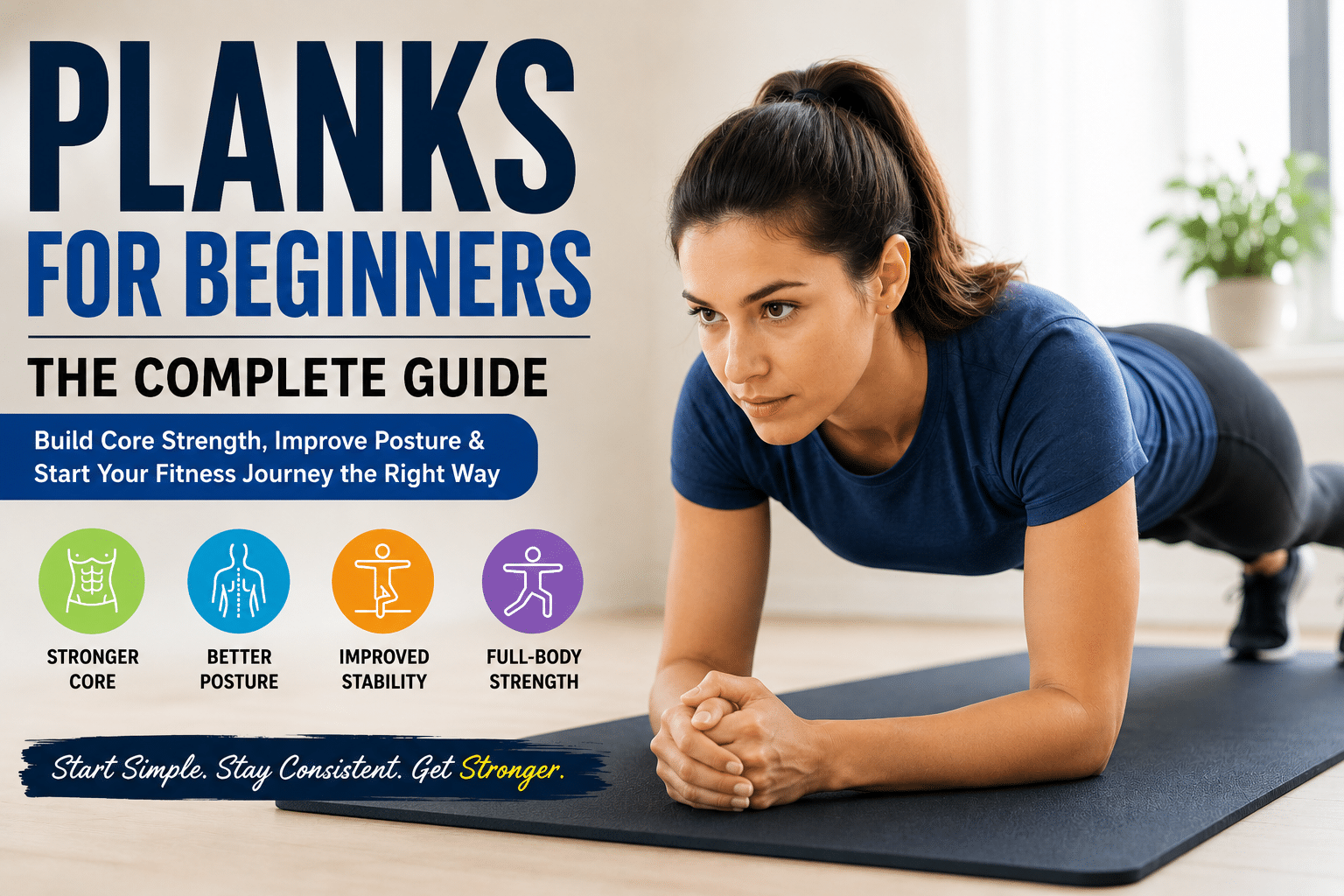


💡 Quick Takeaways
- Planks strengthen your entire core.
- Beginners should start with 10–20 second holds.
- Proper form matters more than duration.
- Knee planks help build confidence safely.
- Practice 2–4 times each week.
Most beginners think a plank is simply about holding a position for as long as possible. In reality, proper plank form matters far more than the length of time you can hold it. A correctly performed plank strengthens your core, improves posture, enhances balance, and supports everyday movements, while poor technique can place unnecessary stress on your lower back, shoulders, and neck.
The good news is that you don’t need expensive equipment or advanced fitness experience to master this exercise. Whether you’re exercising at home or in the gym, planks for beginners are one of the most effective bodyweight exercises for building core stability and laying the foundation for more challenging strength-training movements.
In this guide, you’ll learn how to do a plank correctly, the muscles it works, common mistakes to avoid, beginner-friendly modifications, and a simple progression plan to help you build strength safely and confidently.
Quick Facts
| Quick Fact | Details |
|---|---|
| Exercise Type | Isometric bodyweight exercise |
| Primary Muscles Worked | Core, rectus abdominis, transverse abdominis, obliques |
| Secondary Muscles Worked | Shoulders, chest, glutes, lower back, quadriceps |
| Difficulty Level | Beginner |
| Equipment Needed | None (exercise mat optional) |
| Recommended Hold Time | 10–30 seconds for beginners |
| Training Frequency | 2–4 sessions per week |
| Primary Benefits | Core strength, posture, spinal stability, balance |
What Is a Plank?
A plank is an isometric bodyweight exercise that strengthens your core by requiring you to hold your body in a straight, stable position without movement. Unlike exercises that involve repeated repetitions, such as crunches or sit-ups, a plank challenges your muscles to maintain tension throughout the entire hold.
Although planks are best known for strengthening the abdominal muscles, they are actually a full-body exercise. A properly performed plank activates your rectus abdominis, transverse abdominis, obliques, glutes, shoulders, chest, and quadriceps to help stabilize your spine and improve overall body control.
One of the reasons plank exercises for beginners are so popular is their simplicity. They require no equipment, very little space, and can be performed almost anywhere. More importantly, learning proper plank technique builds the core stability needed for many other exercises, including push-ups, squats, lunges, and overhead presses.
Rather than focusing on how long you can hold a plank, beginners should prioritize proper plank form. Maintaining a neutral spine, engaging the core, and keeping the body aligned from head to heels will produce better results than holding an incorrect position for a longer time.
Why Are Planks So Effective?
Planks train your body to resist movement rather than create it. This ability, known as core stability, plays an important role in maintaining good posture, protecting the lower back, and transferring force efficiently during everyday activities and sports.
Whether you’re lifting groceries, climbing stairs, carrying a child, or performing strength-training exercises in the gym, a strong and stable core helps your body move more efficiently while reducing unnecessary strain on your spine.
Expert Tip
Think of a plank as a foundation exercise, not an endurance competition. For beginners, holding a perfect plank for 20–30 seconds is far more beneficial than forcing yourself to hold poor form for a full minute.
Benefits of Planks for Beginners
A plank may look simple, but it is one of the most effective bodyweight exercises for developing a stronger, more stable body. Unlike exercises that isolate a single muscle group, a properly performed plank activates your core, shoulders, chest, back, glutes, and legs simultaneously. This full-body engagement makes planks for beginners an excellent foundation for improving strength, posture, and overall fitness.
Whether your goal is to exercise more confidently, reduce your risk of injury, or prepare for more advanced workouts, regular plank practice offers benefits that extend well beyond your abdominal muscles.
Builds Core Strength and Stability
One of the biggest plank exercise benefits is strengthening the muscles that stabilize your spine. During a plank, your rectus abdominis, transverse abdominis, and obliques work together to keep your torso steady and properly aligned.
A stronger core improves balance, supports better movement patterns, and provides a solid foundation for everyday activities such as lifting, bending, carrying groceries, and climbing stairs.
Improves Posture and Spinal Alignment
Poor posture often develops when the core muscles are weak and unable to support the spine effectively. Performing planks with proper plank form helps strengthen the muscles responsible for maintaining good posture, making it easier to sit, stand, and walk with proper alignment.
Over time, improved posture may also reduce unnecessary stress on your neck, shoulders, and lower back during daily activities.
Enhances Balance and Functional Fitness
Planks train your body to resist movement while maintaining stability. This type of strength, known as core stability, is essential for everyday tasks and athletic performance.
Better balance and coordination can improve activities such as:
- Walking on uneven surfaces
- Carrying heavy objects
- Climbing stairs
- Lifting safely
- Playing recreational sports
Unlike isolation exercises, planks teach multiple muscle groups to work together as a coordinated unit.
Supports Other Strength-Training Exercises
Learning how to do a plank correctly builds the stability needed for many popular exercises, including:
Developing a stable core first often improves exercise technique and helps you generate force more efficiently during strength training.
Requires No Equipment and Fits Any Fitness Level
One of the biggest advantages of plank exercises for beginners is their accessibility. You can perform them almost anywhere using only your body weight and, if desired, an exercise mat for comfort.
As your strength improves, you can gradually increase the hold time or progress to more challenging variations without needing expensive gym equipment.
May Help Reduce the Risk of Back Pain
A strong core helps support the spine during everyday movement. When performed with correct technique, planks strengthen the muscles that stabilize the trunk, which may reduce excessive strain on the lower back.
However, if you experience sharp pain while planking, stop the exercise and reassess your form. Persistent pain should be evaluated by a qualified healthcare professional or physiotherapist.
Key Takeaways
The greatest benefit of planks isn’t simply building stronger abdominal muscles, it’s developing a stable, well-balanced body that moves more efficiently during both exercise and everyday life.
Before You Start Your First Plank
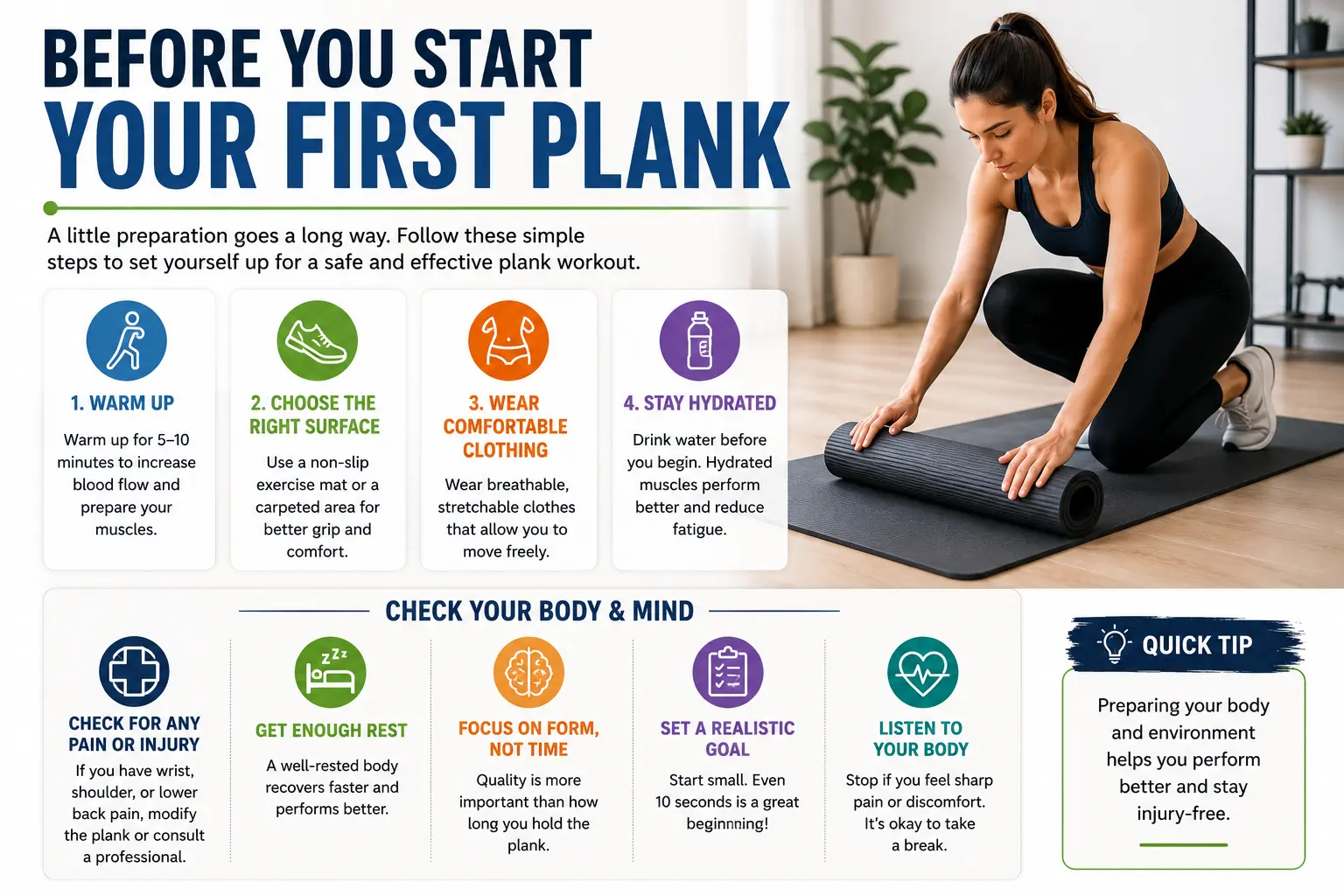
You don’t need exceptional strength or athletic experience to perform a plank, but taking a few moments to prepare can make the exercise safer, more comfortable, and more effective. Before getting into position, make sure you’re working on a flat, stable surface and wearing clothing that allows you to move freely.
If you’re completely new to exercise, don’t worry about holding a plank for a long time. Your first goal should be learning proper plank form, not setting an endurance record. Even a correctly performed 10–20 second plank is more beneficial than holding poor form for a full minute.
Warm Up for 3–5 Minutes
A short warm-up increases blood flow to your muscles and prepares your shoulders, hips, and core for exercise. Before attempting your first plank, spend a few minutes performing light movements such as:
- Arm circles
- Shoulder rolls
- Cat-Cow stretches
- Hip circles
- Marching in place
These simple movements improve mobility and help reduce stiffness before loading your body in a plank position.
Choose the Right Starting Variation
Many beginners believe they must immediately perform a standard forearm plank. In reality, selecting a variation that matches your current fitness level allows you to build strength gradually while maintaining proper technique.
A simple progression is:
- Incline Plank – Best for complete beginners or anyone with limited upper-body strength.
- Knee Plank – Reduces the load while helping you learn correct body alignment.
- Forearm Plank – The standard beginner plank once you can comfortably maintain proper form.
Starting with an easier variation is not a setback—it’s often the fastest way to develop the strength and confidence needed for the full exercise.
Focus on Quality Over Time
One of the most common mistakes beginners make is trying to hold a plank for as long as possible. As fatigue sets in, the hips often sag, the shoulders round, and the lower back begins to compensate.
Instead of chasing longer hold times, concentrate on maintaining a straight body line and controlled breathing. End the exercise when you can no longer maintain proper form.
Remember:
A perfect 20-second plank is far more effective than a poor-quality 60-second plank.
Pro Tip
If you’re unsure whether your body is aligned correctly, perform your first few planks in front of a mirror or record yourself from the side. Reviewing your posture can help you spot common mistakes, such as sagging hips or raised shoulders, that are difficult to notice while exercising.
How to Do a Plank Correctly
Learning how to do a plank correctly is more important than holding the position for a long time. A properly performed plank strengthens your core, improves posture, and protects your lower back, while poor technique can reduce the exercise’s effectiveness and increase unnecessary strain on your joints.
Follow these simple steps to perform a beginner-friendly forearm plank with proper form.
Step 1 – Get Into the Starting Position
Begin by kneeling on an exercise mat or another comfortable surface. Place your forearms on the floor with your elbows positioned directly beneath your shoulders. Your forearms should remain parallel, or your hands may be lightly clasped together—choose whichever position feels most comfortable without creating tension in your shoulders.
Extend one leg behind you, then the other, so your body forms a straight line from your head to your heels.
Beginner Tip: If maintaining this position feels too difficult, start with a knee plank until you build enough core strength for the full version.
Step 2 – Align Your Body From Head to Heels
Before you begin holding the plank, check your body position.
Your body should form one straight line from your head to your heels.
- Head in a neutral position
- Neck relaxed
- Shoulders directly above the elbows
- Hips level with the shoulders
- Legs straight
- Heels pushing gently backward
Avoid lifting your hips too high or allowing them to sag toward the floor.
Step 3 – Brace Your Core and Keep Breathing
One of the biggest mistakes beginners make is simply pulling in the stomach.
Instead, gently tighten your abdominal muscles as though preparing for someone to tap your stomach. At the same time:
- Squeeze your glutes.
- Tighten your thighs.
- Press your forearms firmly into the floor.
- Continue breathing slowly and naturally.
Never hold your breath. Controlled breathing helps maintain stability and reduces unnecessary tension throughout your body.
Step 4 – Hold the Position With Good Form
Maintain your body alignment for 10–30 seconds, depending on your current fitness level.
Stop the exercise if:
- Your hips begin to sag.
- Your lower back starts to arch.
- Your shoulders collapse.
- You cannot maintain steady breathing.
- You feel sharp pain rather than normal muscle fatigue.
As your strength improves, gradually increase your hold time while continuing to prioritize proper technique.
Step 5 – Return to the Starting Position
To finish the exercise, gently lower your knees to the floor before relaxing your body. Avoid dropping your hips suddenly or collapsing onto the mat, as maintaining control throughout the movement reinforces good exercise habits.
Quick Form Checklist
| Body Part | Correct Position |
|---|---|
| Head | Neutral, eyes looking slightly ahead on the floor |
| Neck | In line with the spine |
| Shoulders | Directly above the elbows or wrists |
| Core | Braced while breathing normally |
| Hips | Level with the shoulders; no sagging or piking |
| Legs | Straight with quads and glutes engaged |
| Feet | Hip-width apart for beginners |
What Muscles Do Planks Work?
Planks are often associated with abdominal training, but they actually activate multiple muscle groups simultaneously. This full-body engagement is one of the reasons planks are considered one of the most effective bodyweight exercises for improving stability, posture, and functional strength.
| Muscle Group | Role During a Plank |
|---|---|
| Rectus Abdominis | Maintains trunk stability and resists spinal extension |
| Transverse Abdominis | Supports the spine and braces the core |
| Obliques | Prevent the torso from rotating |
| Shoulders (Deltoids) | Stabilize the upper body |
| Chest (Pectorals) | Assist shoulder stability |
| Glutes | Keep the pelvis aligned |
| Quadriceps | Maintain straight-leg position |
| Lower Back | Supports spinal alignment |
No single muscle works in isolation during a plank. Instead, your body functions as one coordinated unit, improving movement efficiency and preparing you for everyday activities and strength-training exercises.
Common Plank Mistakes (and How to Fix Them)
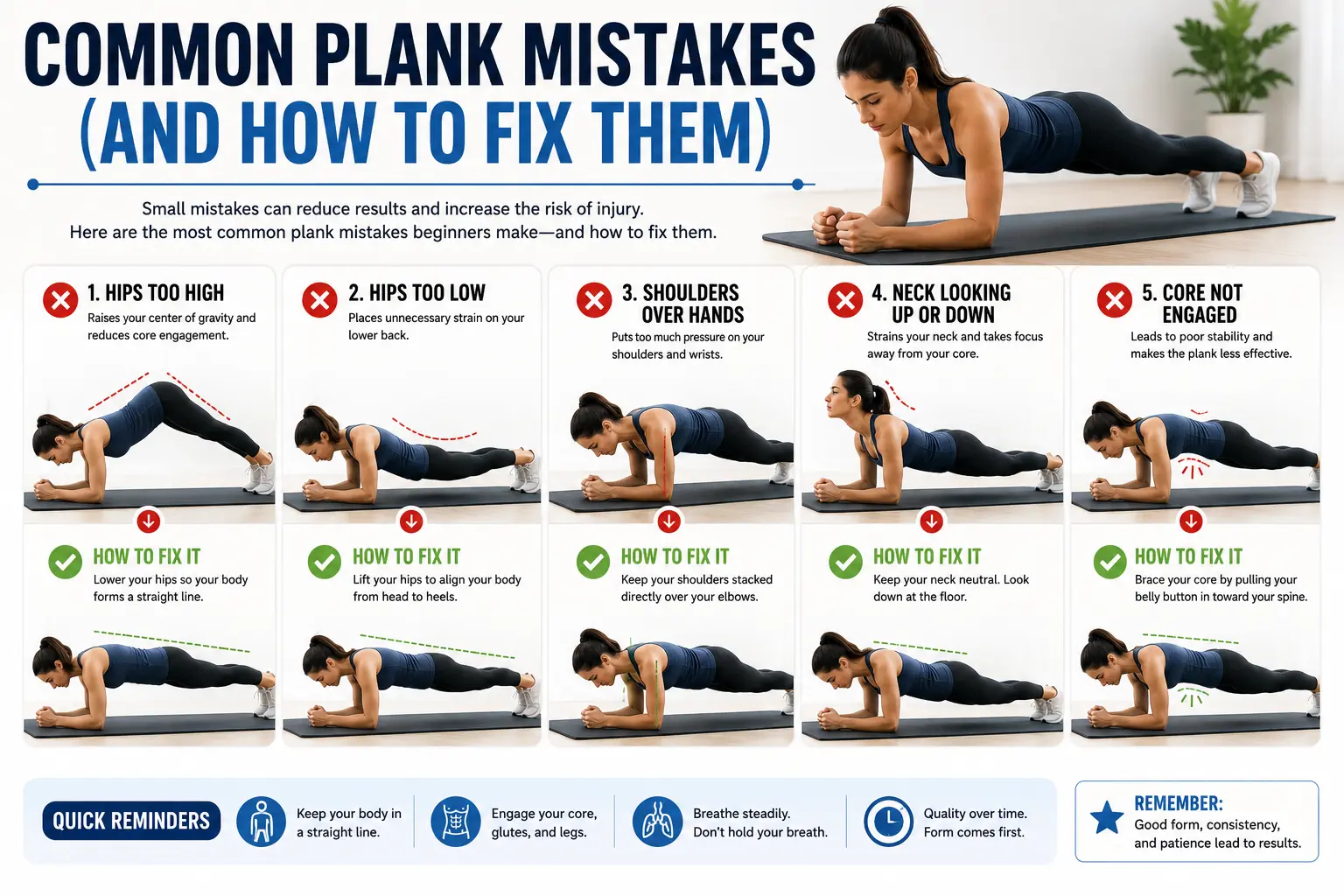
Even a small mistake can reduce the effectiveness of a plank and place unnecessary stress on your lower back, shoulders, or neck. The good news is that most form errors are easy to correct once you know what to look for.
Before increasing your hold time, make sure you’re not making any of these common beginner mistakes.
Letting Your Hips Sag
This is one of the most common mistakes beginners make. As your core muscles fatigue, your hips begin to drop toward the floor, placing excessive pressure on the lower back instead of your abdominal muscles.
How to fix it:
- Brace your core before lifting into the plank.
- Squeeze your glutes throughout the hold.
- If you can’t maintain a straight body line, shorten the hold time or switch to a knee plank.
Why it matters: A shorter plank with proper form is far more effective than a longer hold with sagging hips.
Raising Your Hips Too High
Some beginners lift their hips to make the exercise feel easier. Although this reduces the load on the core, it also decreases the effectiveness of the plank.
How to fix it:
- Keep your shoulders, hips, knees, and heels aligned.
- Imagine balancing a straight wooden board along your back.
- Check your posture in a mirror or record yourself from the side.
Looking Forward Instead of Down
Constantly looking ahead causes your neck to extend, creating unnecessary tension in the cervical spine.
How to fix it:
- Keep your neck neutral.
- Look at the floor about 12–18 inches (30–45 cm) in front of your elbows or hands.
- Think of your head as a natural extension of your spine.
Holding Your Breath
Many beginners instinctively hold their breath while concentrating on the exercise. This increases tension and often causes fatigue to set in more quickly.
How to fix it:
- Breathe slowly and steadily throughout the hold.
- Exhale gently as you brace your core.
- Maintain a comfortable breathing rhythm instead of taking shallow breaths.
Allowing the Shoulders to Collapse
When the shoulders sink toward the floor, unnecessary stress is placed on the shoulder joints and upper back.
How to fix it:
- Press your forearms firmly into the floor.
- Keep your shoulders stacked directly above your elbows.
- Maintain gentle engagement through your upper back without shrugging.
Focusing Only on the Abdominal Muscles
Many people believe a plank only trains the abs, so they forget to activate the rest of their body.
A good plank is a full-body exercise.
How to fix it:
Remember this simple checklist:
- Brace your core
- Squeeze your glutes
- Tighten your thighs
- Push your forearms into the floor
- Reach your heels backward
Creating full-body tension improves stability and makes the exercise far more effective.
Quick Reference Table
| Common Mistake | Why It Happens | How to Fix It |
|---|---|---|
| Hips sagging | Weak or fatigued core | Brace your core and reduce hold time |
| Hips too high | Trying to make the exercise easier | Keep your body in one straight line |
| Looking forward | Neck compensation | Look slightly ahead at the floor |
| Holding your breath | Over-tensing the body | Maintain slow, controlled breathing |
| Shoulders collapsing | Poor shoulder stability | Press through your forearms and keep shoulders stacked |
| Relaxing the legs | Focusing only on the abs | Engage your glutes and quadriceps throughout the hold |
Expert Tip
Don’t judge your progress by how long you can hold a plank. Judge it by how well you maintain proper form. Improving technique first will naturally lead to longer, stronger, and safer plank holds over time.
Beginner Plank Modifications
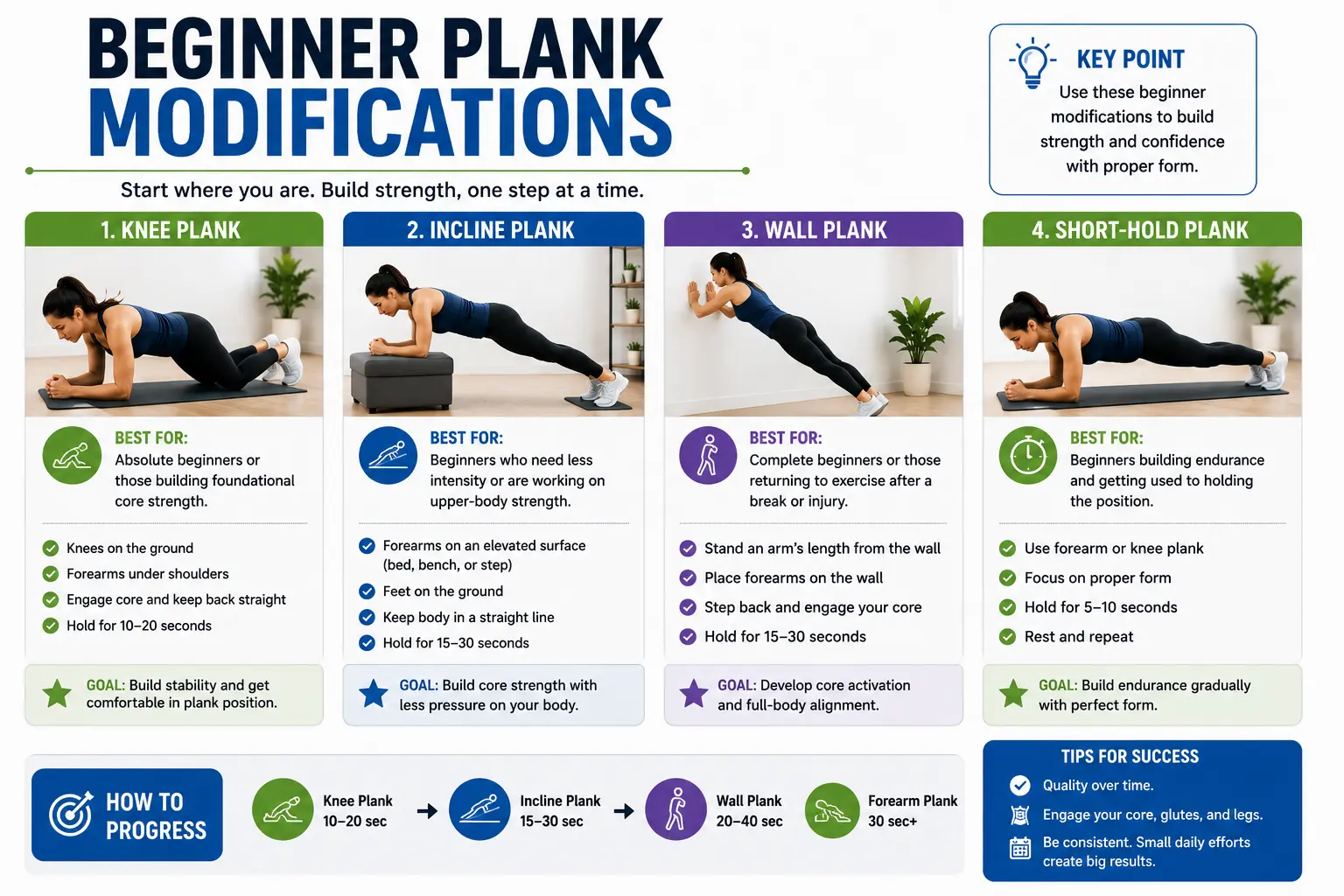
Not everyone can perform a standard forearm plank on their first attempt and that’s perfectly normal. Choosing an easier variation allows you to develop proper technique, build core strength gradually, and reduce unnecessary strain on your shoulders, wrists, and lower back.
Remember, progressing safely is far more important than forcing yourself into an exercise you’re not yet ready to perform.
Knee Plank (Best Starting Point)
If you’re completely new to planks, the knee plank is the ideal place to begin. By keeping your knees on the floor, you reduce the amount of body weight your core and upper body need to support while still learning proper alignment.
How to perform a knee plank
- Kneel on an exercise mat.
- Position your elbows directly beneath your shoulders.
- Extend your body from your head to your knees in a straight line.
- Brace your core and keep your hips level.
- Hold the position for 10–20 seconds while breathing normally.
Best for
- Complete beginners
- People returning after a long break
- Anyone still developing core strength
Incline Plank (Easiest Variation)
An incline plank is performed with your forearms or hands resting on a sturdy elevated surface such as a bench, countertop, or sturdy table. Because your body is positioned at an angle, less body weight is supported by your core, making the exercise easier while reinforcing proper technique.
Best for
- Older adults
- Beginners with limited upper-body strength
- People recovering their confidence after inactivity
Standard Forearm Plank
Once you can comfortably maintain a knee plank or incline plank with proper form, you’re ready to progress to the traditional forearm plank.
Focus on quality rather than duration.
A correctly performed 20-second plank is far more valuable than a poorly executed one-minute hold.
Which Plank Variation Should You Choose?
| Variation | Difficulty | Best For |
|---|---|---|
| Incline Plank | ⭐ Easy | Absolute beginners and older adults |
| Knee Plank | ⭐⭐ Easy–Moderate | Building core strength and learning proper form |
| Forearm Plank | ⭐⭐⭐ Moderate | Beginners ready for the standard plank |
Recommended Plank Hold Times for Beginners
If you’re just learning how to do a plank correctly, use the following recommendations as a starting point:
These times are only planking guidelines. If your hips begin to sag or your lower back starts to arch, end the set and rest before trying again.
| Week | Goal | Hold Time | Focus |
|---|---|---|---|
| Week 1 | Learn technique | 10–15 sec | Body alignment & breathing |
| Week 2 | Improve stability | 20–30 sec | Core engagement |
| Week 3 | Build endurance | 30–45 sec | Consistency & control |
| Week 4 | Gain confidence | 45–60 sec | Perfect form & longer holds |
When Should You Increase Your Hold Time?
Instead of increasing your plank duration every workout, wait until you can comfortably complete all of your planned sets with excellent form.
As a simple rule:
- Hold your plank with proper technique.
- Finish all planned sets without excessive shaking or loss of alignment.
- Increase your hold time by 5–10 seconds during your next workout.
Small, consistent improvements are more effective than making large jumps that compromise technique.
Frequently Asked Questions (FAQs)
Are planks good for beginners?
Yes. Planks are one of the best bodyweight exercises for beginners because they strengthen the core, improve posture, and require no equipment. Start with short holds of 10–20 seconds and focus on proper technique rather than duration. As your strength improves, gradually increase your hold time.
How long should a beginner hold a plank?
Most beginners should aim for 10–30 seconds per set while maintaining proper form. Once you can comfortably complete all your sets without your hips sagging or your shoulders collapsing, increase the hold time by 5–10 seconds.
How many planks should beginners do each day?
Quality matters more than quantity. Beginners can start with 2–4 sets, holding each plank for the recommended time and resting 30–60 seconds between sets. Practicing 2–4 times per week is usually enough to build strength safely.
Do planks help build abs?
Yes, but planks strengthen the entire core, not just the visible abdominal muscles. They activate the rectus abdominis, transverse abdominis, obliques, glutes, and lower back muscles, helping improve stability and posture. Visible abs also depend on overall body fat percentage and nutrition.
Do planks burn belly fat?
No exercise can specifically burn fat from one area of the body. Planks strengthen your core and contribute to overall fitness, but reducing belly fat requires a combination of regular exercise, a balanced diet, and a consistent calorie deficit.
Is it normal to shake during a plank?
Yes. Mild shaking is common, especially for beginners, because your muscles are working to maintain stability. However, if shaking causes your form to break down, end the set, rest, and try again.
Should I do forearm planks or high planks?
Both are effective. Forearm planks place less stress on the wrists and are ideal for most beginners, while high planks involve greater shoulder and wrist stability. Start with the variation that allows you to maintain proper form comfortably.
Can I do planks every day?
You can, but most beginners benefit from performing planks 2–4 times per week. Giving your muscles time to recover helps improve strength and reduces the risk of overuse or poor technique caused by fatigue.
Key Takeaways
- Planks are one of the best beginner-friendly exercises for building core strength and stability.
- Proper form is more important than holding the position for a long time.
- Start with 10–30 second holds and increase gradually as your technique improves.
- Engage your core, glutes, and legs while maintaining a straight body line.
- Practice consistently 2–4 times per week for steady progress.
- Stop the exercise if you experience sharp pain or cannot maintain proper alignment.
- Once you’ve mastered the basics, you can safely progress to more challenging plank variations.
Conclusion
Planks are a simple yet highly effective exercise that can help beginners build core strength, improve posture, and develop the stability needed for everyday activities and more advanced workouts. The key to success isn’t holding the longest plank—it’s performing every repetition with proper technique and progressing gradually over time.
Whether you’re starting with a knee plank, incline plank, or standard forearm plank, focus on quality, stay consistent, and build your strength step by step. With regular practice, planks can become one of the most valuable exercises in your fitness routine, helping you move better, feel stronger, and reduce your risk of injury.