

💡 Quick Takeaways
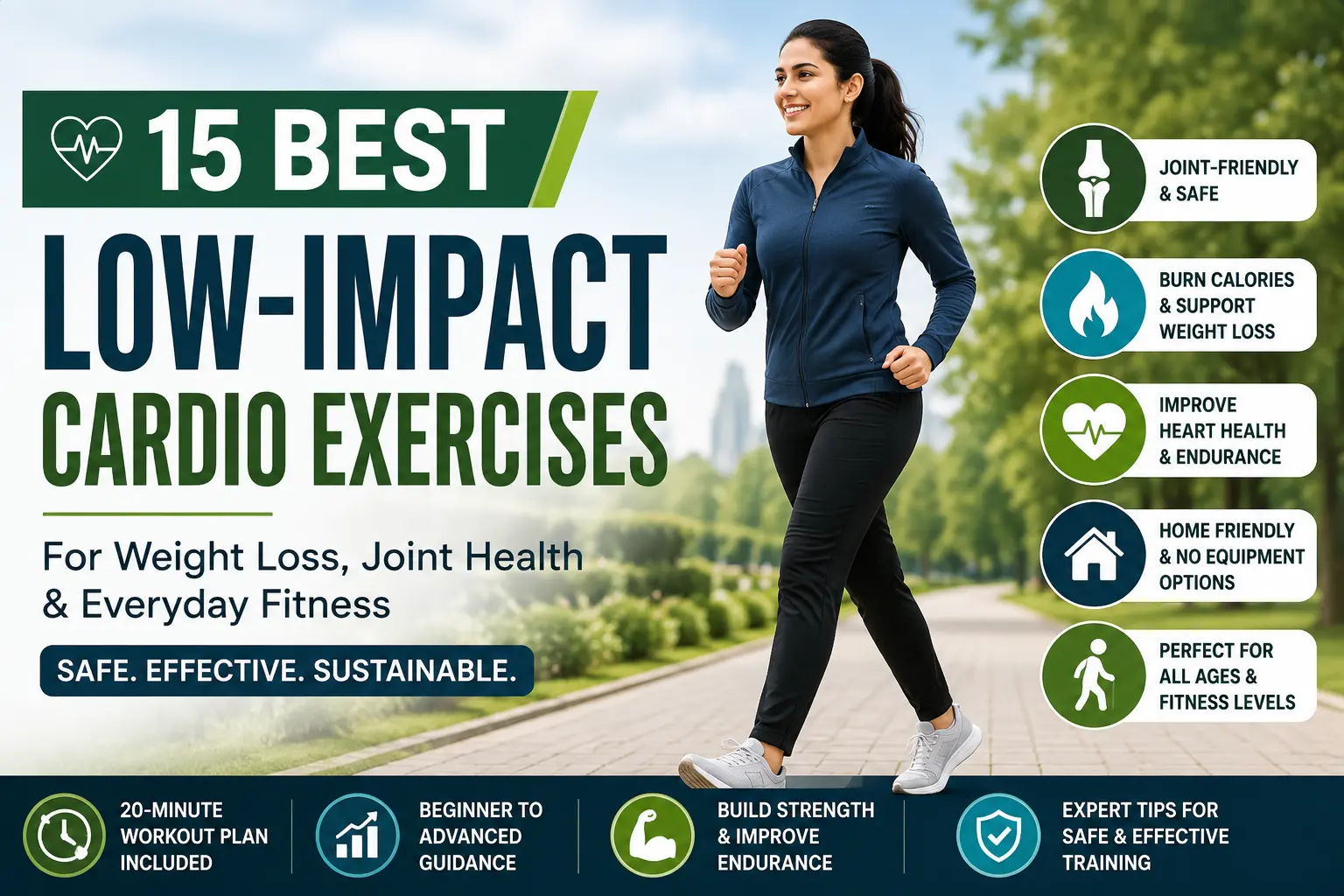
- Low-impact cardio exercises raise your heart rate while placing less stress on your knees, hips, ankles, and lower back, making them ideal for beginners, older adults, and people recovering from injuries.
- Walking, cycling, swimming, rowing, elliptical training, and bodyweight circuits are among the most effective low-impact cardio options for improving cardiovascular fitness and supporting healthy weight loss.
- Adults should aim for at least 150 minutes of moderate-intensity aerobic activity each week, or 75 minutes of vigorous activity, combined with muscle-strengthening exercises on two or more days per week, according to international physical activity guidelines.
- The best results come from consistency, progressive overload, and choosing exercises that match your fitness level, joint health, and personal goals, not from finding a single “perfect” workout.
- This guide includes joint-friendly exercises, beginner modifications, weekly workout plans, calorie comparisons, expert coaching tips, and research-backed recommendations to help you train safely and effectively.
Quick Snapshot
| Category | Quick Recommendation |
|---|---|
| Best for Beginners | Brisk Walking or Marching in Place |
| Best for Weight Loss | Incline Walking or Stationary Cycling |
| Best for Bad Knees | Cycling, Swimming, or Elliptical Training |
| Best for Seniors | Walking, Water Aerobics, or Chair Cardio |
| Best No-Equipment Workout | Low-Impact Bodyweight Circuit |
| Best Full-Body Exercise | Rowing Machine or Swimming |
| Recommended Weekly Cardio | At least 150 minutes of moderate aerobic exercise |
| Equipment Needed | Optional (many exercises require none) |
| Difficulty Level | Beginner to Advanced |
What Are Low-Impact Cardio Exercises?
Low-impact cardio exercises are aerobic activities that increase your heart rate while keeping at least one foot in contact with the ground or minimizing the force placed on your joints. Unlike high-impact workouts such as running or plyometric jumping, these exercises reduce repetitive stress on your knees, hips, ankles, and lower back while still improving cardiovascular fitness, burning calories, and building endurance. They are ideal for beginners, older adults, people carrying extra body weight, and anyone returning to exercise after an injury.
The term “low impact” refers to the amount of force your body absorbs, not the intensity of your workout. A brisk uphill walk, vigorous rowing session, or fast-paced cycling workout can raise your heart rate into a challenging training zone without the repeated pounding associated with high-impact activities. In other words, low impact does not mean low results.
Regular low-impact cardio strengthens your heart, lungs, and circulatory system while improving the efficiency with which your body delivers oxygen to working muscles. Over time, this can enhance endurance, support healthy weight management, improve blood sugar control, and reduce the risk of chronic diseases when combined with a balanced diet and resistance training.
Many people mistakenly believe they must run or perform explosive jumps to improve fitness. In reality, the most effective cardio program is the one you can perform consistently without aggravating existing joint pain or forcing long recovery periods. That’s why low-impact cardio has become a cornerstone of sustainable fitness for recreational exercisers, busy professionals, and adults managing mild knee, hip, or lower-back discomfort.
Low-Impact Cardio vs. High-Impact Cardio: What’s the Difference?
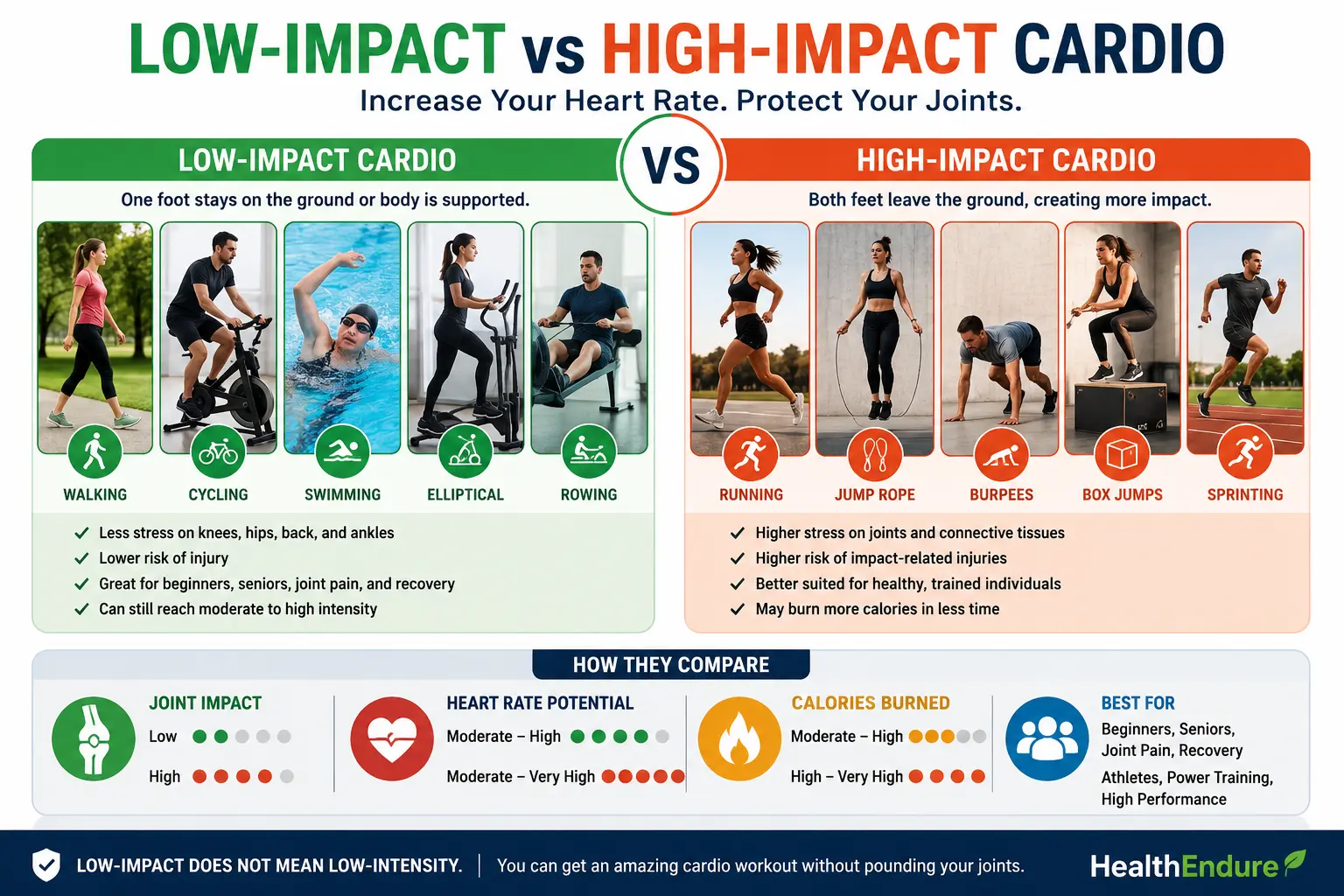
The biggest difference between low-impact and high-impact cardio is how much force your joints absorb during each movement, not how hard your heart works. High-impact exercises involve moments when both feet leave the ground simultaneously, creating greater ground reaction forces upon landing. Low-impact exercises keep one foot in contact with the floor or use equipment that supports your body weight, helping reduce repetitive stress while still challenging your cardiovascular system.
Low-impact cardio is also frequently referred to as a low-intensity workout or light cardio. While low-impact describes joint protection and light cardio describes effort level, both provide an effective way to burn calories without joint strain.
Low-Impact Cardio vs. Low-Intensity Workout vs. Low-Impact Aerobics
Many people confuse a low-impact cardio exercise with a low-intensity workout or light aerobic exercise:
- Low-Impact Aerobics: Exercises where at least one foot remains on the ground at all times (e.g., step-jacks, marching, rowing), protecting your knees while elevating your heart rate into the fat-burning zone.
- Low-Intensity Cardio (LISS): Refers to effort level (keeping your heart rate around 50–60% of your max), such as slow walking.
- High-Intensity Low-Impact Cardio: Combines joint-friendly movements with high effort (e.g., heavy kettlebell swings or rapid assault bike intervals) to maximize calorie burn without joint stress.
| Feature | Low-Impact Cardio | High-Impact Cardio |
|---|---|---|
| Joint Stress | Low | High |
| Feet Contact | Usually one foot remains grounded | Both feet frequently leave the ground |
| Examples | Walking, cycling, swimming, rowing, elliptical | Running, jump rope, burpees, box jumps |
| Best For | Beginners, seniors, joint pain, recovery | Healthy athletes, power training |
| Injury Risk | Lower | Higher if technique or recovery is poor |
| Heart Rate Potential | Moderate to High | Moderate to Very High |
Research Insight
Current physical activity guidelines emphasize that moderate-to-vigorous aerobic exercise can be achieved through both low-impact and high-impact activities. The determining factor is the intensity of the effort, not whether your feet leave the ground. For many adults with joint concerns, low-impact cardio offers a safer way to meet recommended weekly activity levels while maintaining long-term consistency.
Why Are Low-Impact Cardio Exercises Better for Your Joints?
Low-impact cardio exercises reduce the repetitive force placed on your knees, hips, ankles, and lower back while still providing an effective cardiovascular workout. Instead of repeatedly pounding your joints through jumping or hard landings, these exercises allow you to elevate your heart rate using smooth, controlled movements. For adults in their 30s and 40s dealing with mild joint pain, previous injuries, or extra body weight, this often means you can train more consistently with less discomfort and a lower risk of overuse injuries.
Every time your foot strikes the ground during high-impact activities like running or plyometric jumps, your joints absorb ground reaction forces that can be several times your body weight. Low-impact exercises either keep one foot in contact with the ground or support your body with equipment such as a bicycle, rowing machine, swimming pool, or elliptical trainer. The result is less cumulative stress on your connective tissues without sacrificing meaningful cardiovascular benefits.
Just as importantly, low-impact cardio encourages training consistency. Missing workouts because your knees ache or your lower back flares up is one of the biggest obstacles to long-term fitness. Choosing exercises your body tolerates well allows you to accumulate more quality training sessions over weeks and months, which ultimately produces better results than short bursts of overly aggressive workouts.
Who Benefits Most from Low-Impact Cardio?
Low-impact cardio is suitable for almost anyone, but it offers the greatest advantages for people who want sustainable fitness without unnecessary joint stress. While healthy athletes also use these workouts for recovery days, they are particularly valuable for adults returning to exercise after a long break or managing chronic joint discomfort.
It is especially recommended for:
- Adults aged 35–45 returning to regular exercise after a sedentary period.
- People experiencing mild knee, hip, ankle, or lower-back discomfort.
- Individuals carrying excess body weight who want to reduce impact during exercise.
- Older adults aiming to improve cardiovascular health while maintaining balance and mobility.
- People recovering from minor musculoskeletal injuries after receiving medical clearance.
- Anyone seeking a long-term cardio routine that is easier to recover from than high-impact training.
Does Low Impact Mean Lower Results?
No. Low-impact cardio can improve heart health, endurance, calorie expenditure, and overall fitness just as effectively as many high-impact workouts when the intensity and duration are appropriate. The deciding factor is how hard your cardiovascular system works, not whether your feet leave the ground.
A brisk incline walk, an interval session on a stationary bike, or a vigorous rowing workout can elevate your heart rate into moderate or vigorous training zones while remaining significantly easier on your joints than repetitive jumping or sprinting.
This distinction is important because many people avoid low-impact workouts, assuming they are only for rehabilitation. In reality, many competitive athletes deliberately include low-impact cardio to increase training volume, improve recovery, and reduce cumulative joint stress throughout the week.
Research Insight
Research suggests that people with knee osteoarthritis can benefit from regular aerobic activity, with improvements reported in pain, physical function, gait performance, and quality of life. Importantly, evidence does not support a single “best” exercise for everyone. The better choice is often the activity a person can perform comfortably and consistently.
| Exercise | Joint Impact | Calories Burned (30 min*) | Best For |
|---|---|---|---|
| Brisk Walking | ⭐ | 120–200 | Beginners, heart health |
| Stationary Cycling | ⭐ | 210–320 | Knee-friendly weight loss |
| Swimming | ⭐ | 220–350 | Full-body conditioning |
| Elliptical Trainer | ⭐ | 200–330 | Joint-friendly endurance |
| Rowing Machine | ⭐⭐ | 220–370 | Full-body cardio |
| Running | ⭐⭐⭐⭐⭐ | 280–450 | Healthy runners |
Can Low-Impact Cardio Help You Lose Weight?
Yes. Low-impact cardio can be highly effective for weight loss when combined with a calorie-controlled diet and performed consistently. Fat loss doesn’t depend on whether an exercise is high or low impact; it depends on creating a sustainable calorie deficit over time. Low-impact workouts often make this easier because they place less stress on your joints, allowing you to exercise more frequently and recover faster.
Regular low-impact cardio also improves cardiovascular fitness, increases daily energy expenditure, and helps preserve an active lifestyle. When combined with resistance training and adequate protein intake, it supports fat loss while helping maintain lean muscle mass during a calorie deficit.
Why Consistency Beats Intensity for Fat Loss
The best cardio program is the one you can repeat week after week. High-impact workouts may burn more calories per minute, but they also demand longer recovery and may not be suitable for everyone. Low-impact cardio reduces fatigue on your joints, making it easier to accumulate more weekly training volume.
Think about it this way:
- One 20-minute workout each week won’t transform your health.
- Four 30-minute sessions performed consistently over several months can.
Weight loss is driven by habits, not heroic workouts.
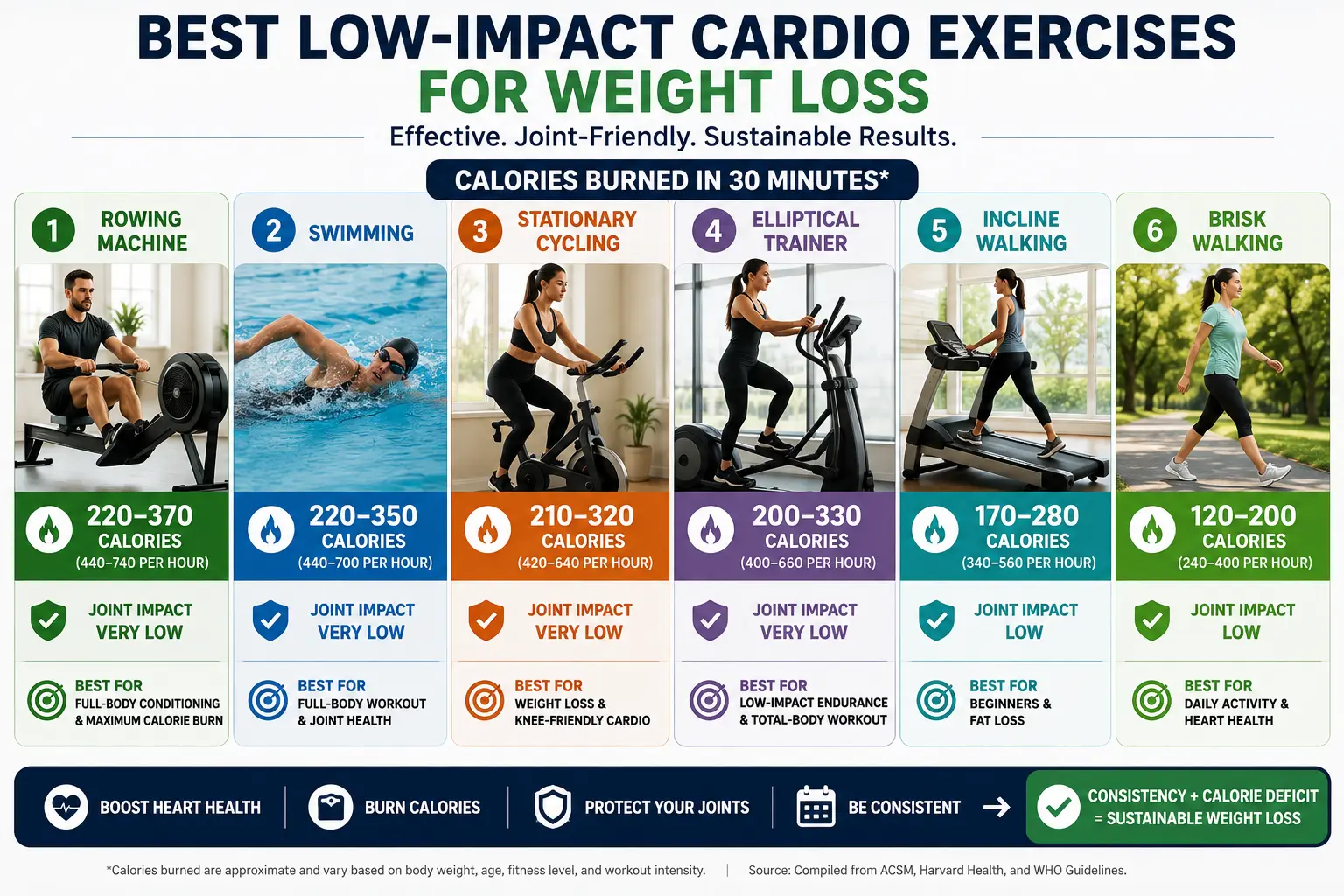
Which Low-Impact Cardio Burns the Most Calories?
Calorie burn varies with body weight, workout intensity, and duration, but some low-impact exercises naturally demand more energy than others. Full-body movements that recruit multiple muscle groups generally burn more calories than lower-body-only activities.
Calories Burned in 30 Minutes*
| Exercise | Approximate Calories | Best For |
|---|---|---|
| Rowing Machine | 220–370 | Full-body conditioning |
| Swimming | 220–350 | Joint-friendly endurance |
| Stationary Cycling | 210–320 | Weight loss & knee comfort |
| Elliptical Trainer | 200–330 | Low-impact cardio |
| Incline Walking | 170–280 | Fat loss beginners |
| Brisk Walking | 120–200 | Daily activity |
*Values vary depending on body weight and exercise intensity.
Although calorie burn is useful, don’t choose an exercise based solely on numbers. The most effective option is the one you enjoy enough to perform regularly.
| Goal | Weekly Recommendation |
|---|---|
| General Health | 150 minutes of moderate cardio |
| Weight Loss | 200–300 minutes of moderate cardio |
| Weight Maintenance | 150–250 minutes plus strength training |
| Beginners | Start with 20–30 minutes, 3 days per week |
Progress gradually by increasing either your workout duration or intensity—not both at the same time.
Research Insight
Research consistently shows that body weight changes are influenced more by total weekly physical activity, dietary intake, and long-term adherence than by choosing a specific cardio exercise. Whether you walk, cycle, swim, or use an elliptical trainer, sustainable fat loss depends on creating an energy deficit that you can maintain over time.
Which Low-Impact Cardio Exercise Is Best for Your Goal?
The best low-impact cardio exercise depends on your fitness goal, current joint health, available equipment, and personal preference. There isn’t a single exercise that outperforms all others. Someone recovering from knee discomfort has different needs than someone training for weight loss or improving endurance. Choosing the right exercise for your specific situation makes it easier to stay consistent, reduce injury risk, and achieve better long-term results.
Before exploring individual exercises, use the guide below to identify the option that best matches your goals quickly.
Goal-Based Decision Guide
| If Your Goal Is… | Best Exercise | Why It Works |
|---|---|---|
| Lose Body Fat | Incline Walking | Burns more calories than level walking while remaining joint-friendly. |
| Protect Bad Knees | Stationary Cycling | Smooth pedaling minimizes impact while strengthening the lower body. |
| Recover After Injury | Swimming | Water supports body weight, reducing stress on joints. |
| Improve Heart Health | Brisk Walking | Easy to maintain consistently and ideal for meeting weekly cardio recommendations. |
| Full-Body Conditioning | Rowing Machine | Engages both upper and lower body for higher calorie expenditure. |
| Exercise at Home | Low-Impact Bodyweight Circuit | Requires little or no equipment and improves overall fitness. |
| Beginner Fitness | Marching in Place | Safe, simple, and easy to progress gradually. |
| Adults Over 60 | Walking + Water Aerobics | Supports balance, mobility, and cardiovascular health with minimal joint stress. |
Best Low-Impact Cardio for Weight Loss
If your goal is sustainable fat loss, choose exercises that you enjoy enough to perform consistently rather than chasing the highest calorie burn. Incline walking, rowing, cycling, swimming, and elliptical training all create meaningful energy expenditure while remaining easier on your joints than running.
Pairing cardio with resistance training and a calorie-controlled eating pattern generally produces better body composition results than cardio alone.
Best Low-Impact Cardio for Bad Knees
Cycling, swimming, water aerobics, and elliptical training are among the safest low-impact exercises for overweight individuals and those with bad knees, as they support body weight while protecting joint cartilage
Pain should never steadily worsen throughout a workout. Mild muscular fatigue is expected; sharp or increasing joint pain is not.
Best Low-Impact Cardio for Beginners
Walking remains one of the best starting points because it requires no special skills or equipment and is easy to adjust for pace and duration. As your fitness improves, you can gradually introduce marching drills, cycling, rowing, or low-impact interval circuits.
A simple rule is to finish each workout feeling like you could comfortably complete another five minutes if needed. That usually indicates an appropriate training intensity for beginners.
15 Best Low-Impact Cardio Exercises
The best low-impact cardio exercises improve cardiovascular fitness, burn calories, and strengthen your muscles without placing excessive stress on your joints. Whether you’re exercising at home, returning after an injury, or looking for a sustainable way to lose weight, the following exercises can help you stay active while protecting your knees, hips, and lower back. Choose one or two exercises you enjoy, focus on proper form, and gradually increase your workout duration or intensity as your fitness improves.
Best No-Equipment Low-Impact Cardio Exercises
You don’t need expensive equipment or a gym membership to get an effective cardio workout. These bodyweight exercises raise your heart rate, improve endurance, and can easily be performed in your living room, office, or backyard. They’re ideal for beginners, busy professionals, and anyone looking for convenient, joint-friendly workouts.
1. Brisk Walking
Brisk walking remains one of the most effective low-impact cardio exercises because it improves heart health, supports weight loss, and is easy to maintain long term. Increasing your walking pace or choosing an uphill route can significantly raise your heart rate without increasing joint impact.
| Best For | Beginners, Weight Loss, Seniors |
|---|---|
| Calories (30 min) | 120–200 |
| Equipment | Comfortable Walking Shoes |
| Impact Level | ⭐ Low |
How to do it
- Walk at a pace that slightly increases your breathing.
- Keep your head up and shoulders relaxed.
- Swing your arms naturally.
- Continue for 20–45 minutes.
Coach Tip: Walk faster before walking farther. Increasing pace improves cardiovascular fitness without adding unnecessary strain to your joints.
2. Marching in Place
Marching in place is a simple yet surprisingly effective cardio exercise that improves circulation, balance, and endurance while requiring very little space. It works particularly well as a warm-up or as part of a home workout circuit.
| Best For | Home Workouts, Beginners |
|---|---|
| Calories (30 min) | 100–170 |
| Equipment | None |
| Impact Level | ⭐ Low |
How to do it
- Stand tall with your feet hip-width apart.
- Lift one knee comfortably toward hip level.
- Swing the opposite arm naturally.
- Alternate legs continuously for one to three minutes.
Coach Tip: Keep your core engaged throughout the movement instead of leaning backward as your knees rise.
3. Low-Impact Jumping Jacks
Low-impact jumping jacks deliver many of the cardiovascular benefits of traditional jumping jacks without repeated jumping or hard landings. By stepping one foot out at a time instead of jumping, you reduce joint stress while maintaining a steady cardio rhythm.
| Best For | Home Cardio, Weight Loss |
|---|---|
| Calories (30 min) | 140–220 |
| Equipment | None |
| Impact Level | ⭐ Low |
How to do it
- Stand with your feet together.
- Step one foot sideways while raising both arms overhead.
- Return to the starting position.
- Repeat on the opposite side with a smooth rhythm.
Coach Tip: Focus on continuous movement rather than speed. A steady pace keeps your heart rate elevated while reducing unnecessary fatigue.
4. Shadow Boxing
Shadow boxing is a full-body cardio workout that combines fast arm movements, light footwork, and core engagement to improve endurance without heavy impact on your joints. It also enhances coordination and helps relieve stress.
| Best For | Fat Loss, Coordination, Home Workouts |
|---|---|
| Calories (30 min) | 180–300 |
| Equipment | None |
| Impact Level | ⭐ Low |
How to do it
- Stand in a comfortable athletic stance.
- Throw controlled jabs, crosses, hooks, and uppercuts.
- Keep your feet moving with small, light steps.
- Maintain a steady rhythm for 30–60 seconds before resting.
Coach Tip: Rotate your hips with every punch instead of relying only on your arms. This increases power while engaging your core and burning more calories.
Best Equipment-Based Low-Impact Cardio Exercises
Cardio machines provide a controlled, joint-friendly way to improve endurance and burn calories. They are particularly useful for people recovering from injuries, managing knee discomfort, or looking to increase workout intensity without repetitive impact.
5. Stationary Cycling
Stationary cycling is one of the best low-impact cardio exercises for weight loss because it burns calories while placing minimal stress on your knees and ankles. You can easily adjust the resistance to match your fitness level, making it suitable for beginners and experienced exercisers alike.
| Best For | Weight Loss, Bad Knees, Beginners |
|---|---|
| Calories (30 min) | 210–320 |
| Equipment | Stationary Bike |
| Impact Level | ⭐ Very Low |
How to do it
- Adjust the seat so your knee has a slight bend at the bottom of each pedal stroke.
- Maintain an upright posture with relaxed shoulders.
- Pedal at a comfortable cadence before increasing resistance.
- Continue for 20–40 minutes.
Coach Tip: Increase resistance gradually instead of pedaling faster. You’ll build stronger legs while keeping your workout joint-friendly.
6. Elliptical Trainer
The elliptical trainer mimics walking and running without the repetitive impact of your feet striking the ground. It delivers an excellent cardiovascular workout while engaging both the upper and lower body.
| Best For | Joint Protection, Fat Loss |
|---|---|
| Calories (30 min) | 200–330 |
| Equipment | Elliptical Machine |
| Impact Level | ⭐ Very Low |
How to do it
- Place your feet flat on the pedals.
- Hold the moving handles lightly.
- Maintain an upright posture.
- Push and pull smoothly using both your arms and legs.
Coach Tip: Don’t lean heavily on the handles. Let your legs generate most of the movement while your arms assist naturally.
7. Rowing Machine
The rowing machine is one of the most efficient full-body cardio exercises, engaging your legs, core, back, and arms in every stroke. Despite its intensity, the movement remains low impact because your body is supported throughout the exercise.
| Best For | Full-Body Conditioning |
|---|---|
| Calories (30 min) | 220–370 |
| Equipment | Rowing Machine |
| Impact Level | ⭐ Low |
How to do it
- Push through your legs first.
- Lean back slightly.
- Pull the handle toward your lower ribs.
- Reverse the movement smoothly.
Coach Tip: Think “legs → hips → arms” on the pull and “arms → hips → legs” on the return. This rhythm improves power and reduces lower-back strain.
8. Stair Climber
The stair climber strengthens your glutes, quadriceps, calves, and cardiovascular system without the high-impact landing forces of running. It also improves lower-body endurance and burns a significant number of calories.
| Best For | Lower-Body Strength, Fat Loss |
|---|---|
| Calories (30 min) | 220–360 |
| Equipment | Stair Climber |
| Impact Level | ⭐⭐ Low |
How to do it
- Stand upright without leaning on the handrails.
- Step naturally through each stride.
- Keep your core engaged.
- Maintain a steady pace for 15–30 minutes.
Coach Tip: Use the handrails only for balance. Supporting your body weight with your arms reduces both calorie burn and training effectiveness.
Best Water-Based Low-Impact Cardio Exercises
Water-based workouts reduce the load on your joints while providing natural resistance that challenges your muscles and cardiovascular system. They’re particularly beneficial for people with arthritis, obesity, or recovering from lower-body injuries.
9. Swimming
Swimming is one of the best total-body low-impact cardio exercises because the water supports your body while allowing nearly every major muscle group to work. It improves cardiovascular endurance, flexibility, and muscular strength with minimal joint stress.
| Best For | Joint Pain, Full-Body Fitness |
|---|---|
| Calories (30 min) | 220–350 |
| Equipment | Swimming Pool |
| Impact Level | ⭐ Very Low |
How to do it
- Choose a comfortable swimming stroke.
- Maintain steady breathing.
- Focus on smooth, controlled movements.
- Swim continuously or in short intervals.
Coach Tip: Beginners should prioritize technique over speed. Efficient strokes conserve energy and make longer workouts easier.
10. Water Aerobics
Water aerobics combines aerobic exercise with the natural resistance of water, making it ideal for improving cardiovascular fitness without overloading your joints. It’s especially popular among older adults and those recovering from injuries.
| Best For | Seniors, Rehabilitation |
|---|---|
| Calories (30 min) | 150–250 |
| Equipment | Swimming Pool |
| Impact Level | ⭐ Very Low |
How to do it
- Stand in chest-deep water.
- Perform marching, knee lifts, and arm movements.
- Move continuously for 20–30 minutes.
- Increase intensity gradually.
Coach Tip: Push firmly against the water during every movement. Water resistance increases the workout without increasing joint impact.
Best Functional Low-Impact Cardio Exercises
Functional cardio exercises combine multiple muscle groups to improve cardiovascular fitness, balance, coordination, and everyday movement. They require little or no equipment and are excellent for home workouts, calorie burning, and overall conditioning.
11. Dance Cardio
Dance cardio transforms simple movements into a fun, calorie-burning workout that improves coordination, balance, and cardiovascular endurance. It’s ideal for people who find traditional cardio repetitive or difficult to maintain.
| Best For | Weight Loss, Home Fitness |
|---|---|
| Calories (30 min) | 180–300 |
| Equipment | None |
| Impact Level | ⭐ Low |
How to do it
- Choose upbeat music with a comfortable tempo.
- Combine side steps, knee lifts, and arm swings.
- Keep moving continuously for 20–30 minutes.
- Focus on rhythm rather than perfect choreography.
Coach Tip: Keep your feet light and movements controlled. Good rhythm is more important than complicated dance steps.
12. Bodyweight Cardio Circuit
A bodyweight circuit combines several low-impact exercises into one continuous workout, making it one of the most effective ways to improve fitness at home. Alternating movements keeps your heart rate elevated while reducing repetitive stress on individual joints.
| Best For | Home Workouts, Fat Loss |
|---|---|
| Calories (30 min) | 180–320 |
| Equipment | None |
| Impact Level | ⭐ Low |
Sample Circuit
- 45 sec March in Place
- 45 sec Bodyweight Squats
- 45 sec Shadow Boxing
- 45 sec Step Touch
- Rest 60 sec and repeat 3 rounds
Coach Tip: Move smoothly between exercises instead of rushing. Continuous movement is what keeps your heart rate elevated.
13. Chair Cardio
Chair cardio provides a safe, accessible way to improve cardiovascular fitness for seniors, beginners, or anyone with limited mobility. Seated exercises reduce balance demands while still encouraging movement and increasing circulation.
| Best For | Seniors, Rehabilitation |
|---|---|
| Calories (30 min) | 90–160 |
| Equipment | Sturdy Chair |
| Impact Level | ⭐ Very Low |
How to do it
- Sit upright with your feet flat on the floor.
- Alternate knee lifts and arm punches.
- Keep your core engaged.
- Continue for 15–30 minutes.
Coach Tip: Sit near the front edge of the chair to encourage better posture and greater core engagement.
14. Resistance Band Cardio
Resistance band exercises add muscular resistance to traditional cardio movements, increasing workout intensity without adding joint impact. They are excellent for improving muscular endurance while maintaining a steady heart rate.
| Best For | Muscle Endurance, Home Fitness |
|---|---|
| Calories (30 min) | 150–250 |
| Equipment | Resistance Band |
| Impact Level | ⭐ Low |
How to do it
- Secure the band safely.
- Perform rows, presses, or side steps with continuous movement.
- Maintain a moderate pace.
- Complete 10–15 repetitions before changing exercises.
15. Step-Ups
Step-ups strengthen your legs, improve balance, and elevate your heart rate using a simple platform or staircase. Because one foot always remains supported, they provide an effective low-impact alternative to jumping exercises.
Coach Tip: Choose a lighter band that allows continuous movement instead of stopping after only a few repetitions.
| Best For | Lower-Body Strength, Heart Health |
|---|---|
| Calories (30 min) | 180–300 |
| Equipment | Low Step or Bench |
| Impact Level | ⭐⭐ Low |
How to do it
- Step onto a sturdy platform with one foot.
- Push through your heel to stand.
- Step down with control.
- Alternate leading legs every 10–15 repetitions.
Coach Tip: Use a step that’s roughly knee height or lower. Higher platforms can place unnecessary stress on your knees if your mobility is limited.
20-Minute Low-Impact Cardio Workout Plan
You don’t need an hour-long workout to improve your cardiovascular fitness. A well-structured 20-minute low-impact routine can elevate your heart rate, burn calories, and improve endurance while remaining gentle on your joints. This beginner-friendly workout requires little or no equipment and can be adjusted to match your fitness level.
20-Minute Beginner Workout
| Time | Exercise |
|---|---|
| 3 min | Brisk Walking or Marching in Place (Warm-up) |
| 2 min | Low-Impact Jumping Jacks |
| 2 min | Shadow Boxing |
| 2 min | Bodyweight Squats |
| 2 min | Step-Ups or Marching |
| 2 min | Brisk Walking Recovery |
| 2 min | Resistance Band Cardio (Optional) |
| 3 min | Brisk Walking & Stretching (Cool-down) |
Beginner Progression
| Week | Workout Time | Sessions/Week |
|---|---|---|
| Week 1 | 15–20 min | 3 |
| Week 2 | 20 min | 4 |
| Week 3 | 25 min | 4–5 |
| Week 4 | 30 min | 5 |
Coach Tip: Finish each workout feeling challenged—but not exhausted. If you can recover well and repeat the session tomorrow, you’re training at the right intensity.
Common Low-Impact Cardio Mistakes (and How to Fix Them)
Low-impact doesn’t mean mistake-proof. Poor technique, progressing too quickly, or choosing the wrong exercise can reduce results and increase discomfort. Avoid these common errors to get the most from every workout.
| Mistake | Why It Happens | How to Fix It |
|---|---|---|
| Exercising too slowly | Heart rate never reaches a training zone | Walk faster, add arm movement, or increase resistance. |
| Poor posture | Slouching places extra stress on the neck and lower back | Keep your chest lifted, shoulders relaxed, and core engaged. |
| Doing the same workout every day | Your body adapts and progress slows | Alternate walking, cycling, rowing, swimming, and bodyweight circuits. |
| Skipping warm-ups | Muscles and joints aren’t prepared for exercise | Spend 3–5 minutes marching or walking before each session. |
| Progressing too quickly | Duration and intensity increase at the same time | Increase either time or intensity—not both in the same week. |
| Ignoring joint pain | Continuing through sharp pain may worsen irritation | Stop the exercise, modify the movement, or switch to a lower-impact option. |
Coach Tip: Mild muscle fatigue is normal. Sharp, persistent, or worsening joint pain is not. Adjust your workout before pushing harder.
Frequently Asked Questions
Is low-impact cardio good for weight loss?
Yes. Low-impact cardio supports weight loss by increasing calorie expenditure and helping create a sustainable calorie deficit. Combined with a balanced diet and strength training, it can be just as effective as many higher-impact workouts.
Can I do low-impact cardio every day?
Yes, provided you vary your workouts and allow your body to recover. Alternating walking, cycling, swimming, and bodyweight circuits reduces repetitive stress while helping maintain consistent activity.
Which low-impact cardio exercise burns the most calories?
Rowing, swimming, stair climbing, and high-resistance cycling generally burn the most calories because they engage multiple muscle groups. However, consistency matters more than choosing the highest-calorie exercise.
Is walking enough for cardio?
For many adults, yes. Brisk walking performed regularly can improve heart health, endurance, and weight management. Increasing your pace, walking uphill, or extending your duration provides additional challenge.
What is the best low-impact cardio exercise for bad knees?
Stationary cycling, swimming, water aerobics, and elliptical training are often the most comfortable options because they reduce repetitive impact while allowing continuous movement.
Should I do cardio before or after strength training?
It depends on your goal. If building strength is your priority, perform strength training first while you’re fresh. If improving cardiovascular fitness is your main objective, start with cardio. For general health, either order can be effective.
Conclusion
Low-impact cardio exercises prove that you don’t need to punish your joints to improve your fitness. Whether you choose brisk walking, cycling, swimming, rowing, or a simple bodyweight circuit, the key is finding activities you enjoy and can perform consistently. Over time, those regular, joint-friendly workouts will strengthen your heart, improve endurance, support healthy weight management, and help you stay active for years to come.
Start with your current fitness level, focus on proper technique, and increase your workout duration or intensity gradually. Sustainable progress always beats short bursts of extreme effort, and your joints will thank you for it.