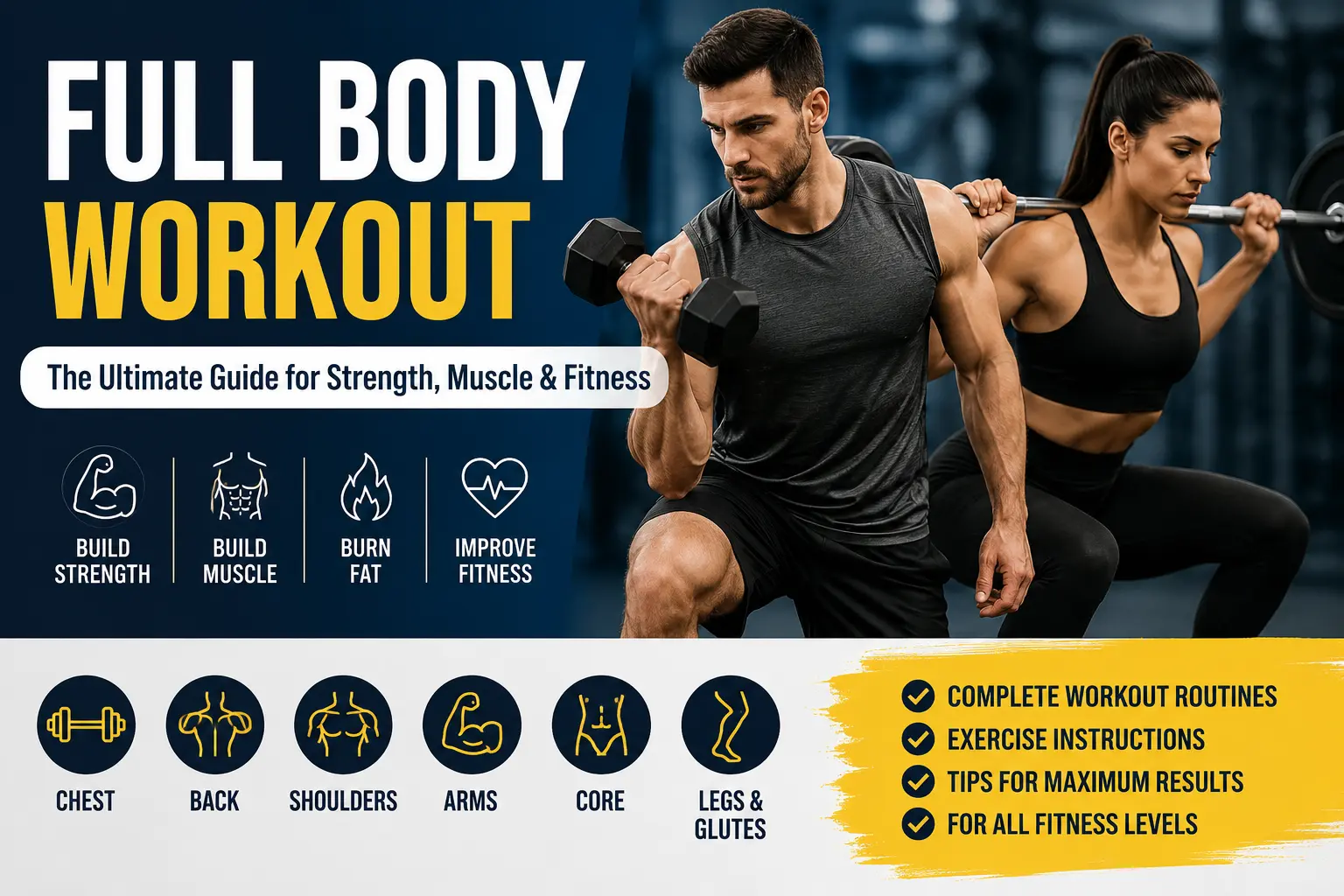


A full body workout trains all the major muscle groups, including your chest, back, shoulders, arms, core, and legs, in a single session. Combining compound and isolation exercises helps improve strength, build lean muscle, burn calories, and enhance overall fitness while making efficient use of your training time.
Whether you’re a beginner starting your fitness journey or an experienced lifter looking for an efficient training routine, full body workouts can be adapted to almost any fitness level and goal.
The World Health Organization physical activity guidelines recommend that adults perform muscle-strengthening activities involving all major muscle groups on at least two days per week to support overall health
In this comprehensive guide, you’ll learn:
- What a full body workout is and how it works
- The science-backed benefits of full body training
- The best compound and isolation exercises
- How to build an effective workout routine
- Sample workout plans for different fitness levels
- Common mistakes to avoid for better results
By the end of this guide, you’ll have everything you need to build a balanced full body workout routine that supports strength, muscle growth, fat loss, and long-term health.
| Quick Facts | |
|---|---|
| Best For | Strength, muscle gain, fat loss, general fitness |
| Workout Duration | 45–75 minutes |
| Training Frequency | 2–4 days per week |
| Equipment Needed | Bodyweight, dumbbells, barbells, or gym machines |
| Difficulty Level | Beginner to Advanced |
What Is a Full Body Workout?
A full body workout is a training routine that targets all the major muscle groups in a single exercise session. Instead of focusing on just one or two body parts, it combines exercises for the chest, back, shoulders, arms, core, glutes, and legs to create a balanced workout.
Most full body workout routines are built around compound exercises such as squats, deadlifts, bench presses, overhead presses, and rows because they train multiple muscle groups at the same time. Isolation exercises like bicep curls, lateral raises, or leg curls can then be added to improve muscle balance and target specific areas.
One of the biggest advantages of full body training is its flexibility. Whether you train 2, 3, or 4 days per week, you can adjust the workout based on your fitness level, available equipment, and goals, such as building muscle, increasing strength, improving fitness, or supporting fat loss.
Which Muscles Does a Full Body Workout Train?
A well-designed full body workout should include exercises for every major muscle group:
- Chest – Bench Press, Push-Ups
- Back – Bent-Over Rows, Seated Cable Rows
- Shoulders – Overhead Press, Lateral Raises
- Arms – Biceps Curls, Triceps Extensions
- Core – Planks, Side Planks
- Legs & Glutes – Squats, Romanian Deadlifts, Leg Press, Leg Curls
Training all these muscle groups in a balanced way improves overall strength, posture, coordination, and functional fitness while reducing the risk of muscular imbalances.
Who Should Do Full Body Workouts?
Full body workouts are suitable for almost everyone, including:
- Beginners learning proper exercise technique
- Busy professionals with limited training time
- People aiming for fat loss by increasing calorie expenditure
- Individuals building muscle and strength through progressive overload
- Anyone looking to improve overall fitness with a balanced training program
With the right exercise selection and recovery, a full body workout can be adapted for nearly every fitness level.
Benefits of Full body Workout
A well-designed full body workout offers far more than convenience. By training all the major muscle groups in a single session, it helps improve strength, muscle development, cardiovascular fitness, and overall health while making efficient use of your training time.
Improves Training Efficiency
One of the biggest advantages of a full body workout is that you train your entire body in a single session instead of dividing workouts into separate muscle groups. This approach is ideal for people with busy schedules because you can achieve excellent results with just 2 to 4 workouts per week.
Promotes Muscle Growth
Full body workouts stimulate every major muscle group several times each week, creating frequent opportunities for muscle repair and growth. When combined with progressive overload, proper nutrition, and adequate recovery, this training style can effectively support lean muscle development.
Burns More Calories
Because full body workouts recruit multiple muscle groups simultaneously, they generally require more energy than isolated muscle training. Compound exercises such as squats, deadlifts, bench presses, and rows elevate heart rate and increase calorie expenditure during and after the workout.
Builds Functional Strength
Unlike routines that isolate individual muscles, full body workouts emphasize natural movement patterns such as pushing, pulling, squatting, hinging, and carrying. These movements improve balance, coordination, posture, and everyday physical performance.
Supports Weight Management
Combining resistance training with compound movements helps preserve lean muscle while increasing daily energy expenditure. When paired with a balanced diet, full body workouts can support healthy weight loss and long-term body composition improvements.
Fits Almost Every Fitness Level
Whether you’re a beginner learning proper exercise technique or an experienced lifter looking for an efficient routine, full body workouts can be adapted to match your experience, available equipment, and training goals.
Improves Workout Consistency
Many people struggle to follow complicated workout splits. A full body routine is easier to maintain because missing one workout is less likely to leave an entire muscle group untrained, making it a practical long-term training strategy.
Boosts Mood and Energy Levels
Like other forms of regular physical activity, full body workouts stimulate the release of endorphins that help improve mood, reduce stress, and increase energy levels throughout the day.
Expert Tip:
If you can only exercise two or three days per week, a full body workout is often one of the most effective training methods because every workout contributes to your overall strength and muscle development.
Before You Start a Full Body Workout
Whether you’re training at home or in the gym, taking a few minutes to prepare before each workout can improve your performance, reduce the risk of injury, and help you achieve better long-term results. Before beginning any full body workout routine, keep the following recommendations in mind:
Start With Your Current Fitness Level
If you’re new to strength training, begin with lighter weights or bodyweight exercises and focus on learning proper movement patterns. As your strength, confidence, and technique improve, gradually increase the training intensity through progressive overload.
Prioritize Proper Exercise Form
Correct technique is more important than lifting heavier weights. Performing each exercise with good posture, controlled movements, and a full range of motion helps activate the target muscles while reducing unnecessary stress on your joints.
Warm Up Before Every Workout
Spend 5–10 minutes warming up before each session. A proper warm-up increases blood flow, improves joint mobility, activates your muscles, and prepares your body for resistance training.
Dynamic movements such as:
- Arm circles
- Leg swings
- Bodyweight squats
- Walking lunges
- Jumping jacks
- Light rowing or brisk walking
are excellent choices before beginning your workout.
Choose the Right Training Frequency
For most people, performing a full body workout 2 to 4 times per week provides enough stimulus for muscle growth while allowing adequate recovery between sessions.
As a general guideline:
- Beginners: 2–3 sessions per week
- Intermediate: 3–4 sessions per week
- Advanced: 3–4 sessions per week with progressive overload
Allow Time for Recovery
Muscles grow during recovery, not while you’re exercising. Aim for 7–9 hours of sleep, stay hydrated, consume enough protein, and schedule at least one rest day between intense full body sessions when needed.
Expert Tip
Focus on mastering a few fundamental compound exercises before adding more advanced movements. Building a strong foundation will improve your results and reduce the likelihood of injuries.
Full Body Workout Basics
Before choosing exercises or following a workout plan, it’s important to understand the basic principles that make a full body workout effective. A well-balanced routine should target every major muscle group while allowing sufficient recovery to support strength gains, muscle growth, and long-term progress.
The Five Essential Movement Patterns
A complete full body workout should include these movement patterns:
- Squat – Builds strength in the quadriceps, glutes, and core.
- Push – Targets the chest, shoulders, and triceps.
- Pull – Develops the back, biceps, and rear shoulders.
- Hip Hinge – Strengthens the glutes, hamstrings, and lower back.
- Core – Improves stability, posture, and balance.
Including at least one exercise from each movement pattern helps create a balanced workout while reducing muscular imbalances.
Balance Compound and Isolation Exercises
The foundation of every full body workout should be compound exercises because they train multiple muscle groups simultaneously and allow you to lift heavier loads.
Once the primary compound movements are complete, add isolation exercises to strengthen smaller muscles, improve symmetry, and address weak areas.
A balanced workout generally includes:
- 4–6 compound exercises
- 2–4 isolation exercises
- 1–2 core exercises
Plan Your Exercise Order
To maximize performance and reduce fatigue, perform exercises in this sequence:
- Compound lower-body exercises
- Compound upper-body exercises
- Accessory (isolation) exercises
- Core training
- Cool-down and stretching
Starting with larger muscle groups allows you to lift with better technique and generate more force before fatigue sets in.
Choose the Right Weight
Select a weight that allows you to complete the recommended repetitions while maintaining proper form.
As a general guideline:
- Strength: 4–6 repetitions
- Muscle growth: 8–12 repetitions
- Muscular endurance: 12–15 repetitions
When you can comfortably exceed your target repetitions with good form, gradually increase the weight or resistance to continue progressing.
Full Body Workout Routine
Workout A – Upper Body Strength and Muscle Building
Workout A focuses on developing upper-body strength by targeting the chest, shoulders, back, biceps, triceps, and supporting core muscles. The routine combines compound and isolation exercises to improve pushing and pulling strength while promoting balanced muscle development.
Target Muscles: Chest, Shoulders, Back, Biceps, Triceps, Rear Deltoids, Lats
Equipment Needed: Barbell, Dumbbells, Cable Machine, Pull-up Bar (optional)
Warm-Up (5–10 Minutes)
Prepare your upper body with 5–10 minutes of light cardio followed by dynamic movements such as:
- Arm Circles
- Band Pull-Aparts
- Shoulder Rolls
- Torso Twists
- Light Push-ups
- Jump Rope (Optional)
A proper warm-up increases blood flow, improves shoulder mobility, and prepares your muscles for heavier compound lifts.
Bench Press Powerhouse
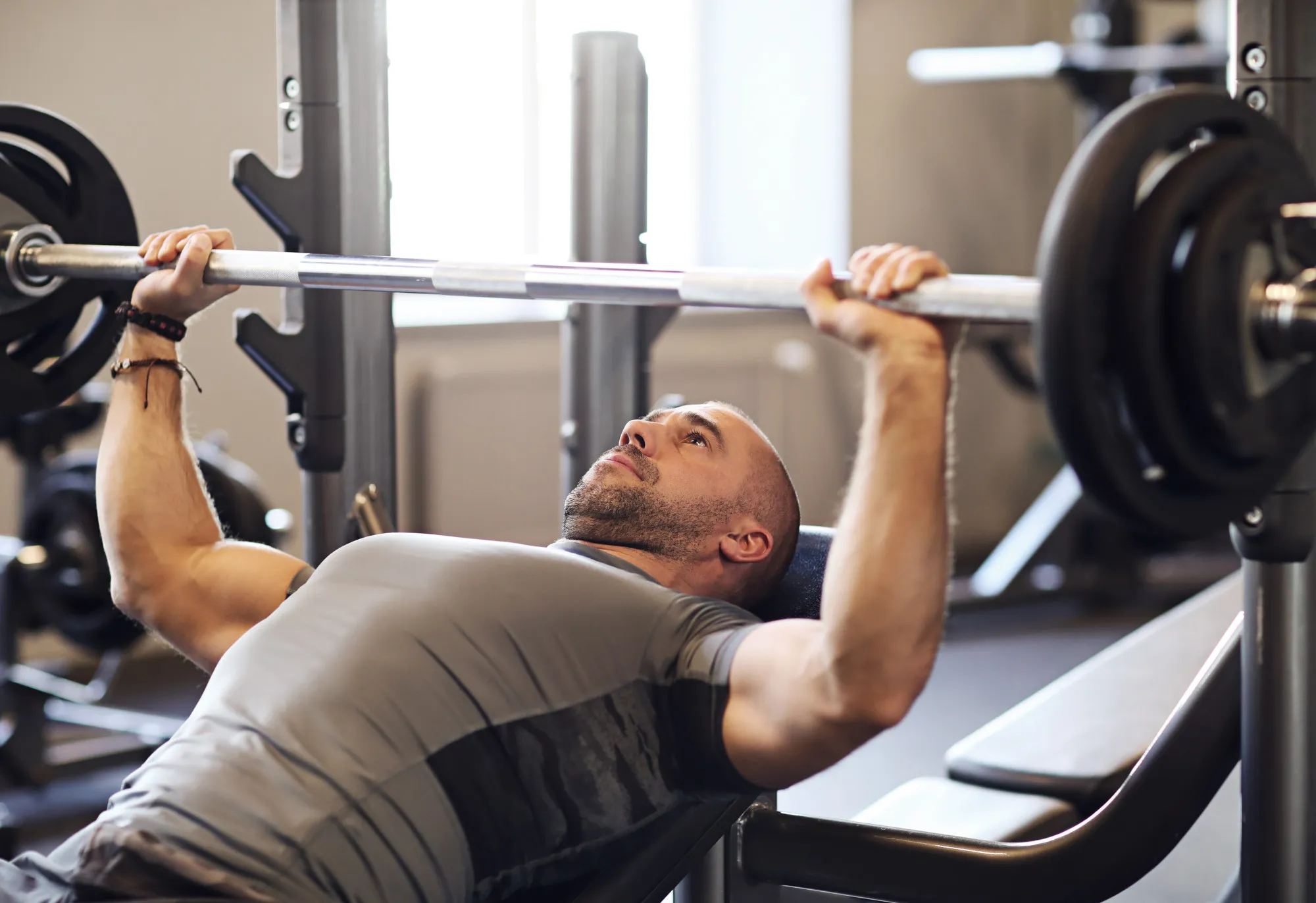
Sets: 3
Reps: 8–12
Primary Muscles: Chest, Triceps, Front Deltoids
The Bench Press is one of the most effective compound exercises for building upper-body strength and muscle mass. Keep your feet firmly planted, retract your shoulder blades, and lower the bar under control before pressing it back to the starting position.
Engaging in a full body workout with some weights promotes comprehensive muscle development and strength enhancement. Incorporating this complete body exercise ensures balanced muscle growth and overall fitness improvement.
Pro Tip: Avoid flaring your elbows excessively to reduce shoulder strain
Overhead Press – 10 reps
Sets: 3
Reps: 8–10
Primary Muscles: Shoulders, Triceps, Upper Chest
The overhead press is an excellent compound movement that works your deltoids, triceps, traps, and core.
Single-Arm Dumbbell Press
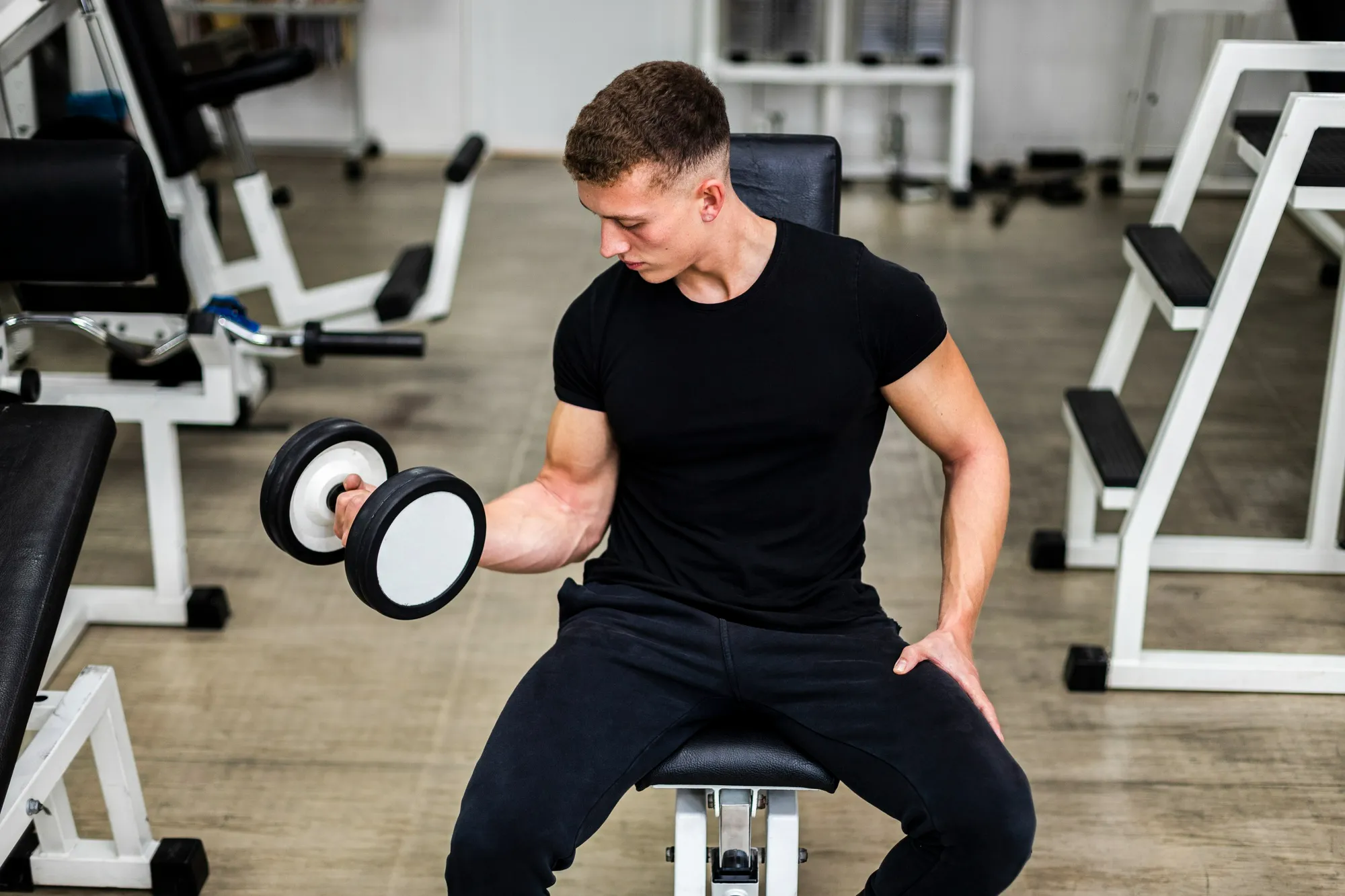
Sets: 3
Reps: 8–12 each side
Primary Muscles: Chest, Shoulders, Core
Elevate your bench press with the best dumbbell workout that adds core stability and corrects side imbalances. Grab a dumbbell in each hand, press one arm straight up while keeping the other lowered with your elbow tucked. Repeat on the opposite side, feeling the burn in both arms and your core, making this an excellent addition to your strength training routine.
Bent-Over Barbell Row

Sets: 3
Reps: 8–12
Primary Muscles: Lats, Rhomboids, Biceps
Sculpt a powerful back and impressive biceps with this classic move. Hinge at your hips, keeping your back straight and core engaged. Pull the barbell towards your chest, squeezing your shoulder blades together at the top. Feel the magic working in your lats and biceps with each controlled rep. This total body workout is an efficient and effective way to engage all major muscle groups for comprehensive fitness and strength development.
Incorporating bicep curls into your workout routine is also an excellent way to target and strengthen the muscles in your arms.
Seated Cable Row

Sets: 3
Reps: 10–15
Primary Muscles: Mid Back, Lats, Rear Deltoids
Harness the controlled environment of cable machines to target your upper back muscles with laser focus. Sit with your back straight and knees bent, pulling the cable handle towards your chest. Maximize the squeeze in your shoulder blades and relish the targeted back activation.
Push-ups
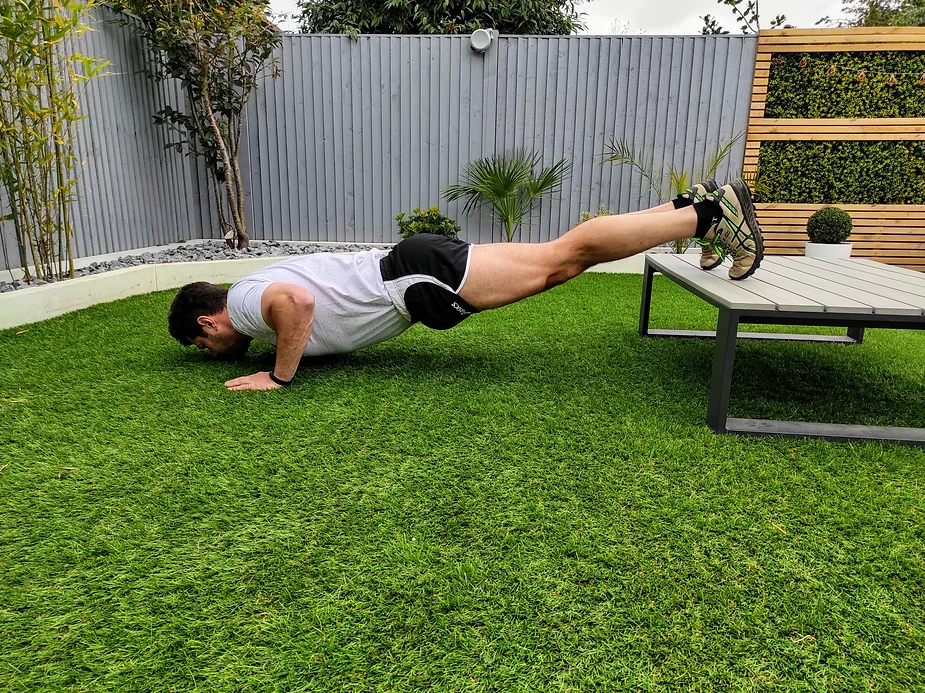
Sets: 3
Reps: To near failure
This bodyweight powerhouse never gets old. Challenge your chest, triceps, and shoulders with classic push-ups. Push-ups are an excellent bodyweight exercise that develops chest, shoulder, triceps, and core strength while improving muscular endurance.
Modify on your knees if needed, prioritizing perfect form with a straight back and engaged core. Incorporating push-ups and other bodyweight exercises will help you feel the burn, build strength, and develop a balanced physique with every rep.
Research Facts: A meta-analysis published in the Journal of Strength and Conditioning Research found that bodyweight training interventions, including push-ups, significantly increased muscle hypertrophy (growth) in untrained individuals.
Cool-down (5 minutes): Don’t neglect recovery! Unwind with static stretches for your chest, back, shoulders, and triceps. Hold each stretch for 30 seconds, savoring the release of tension and promoting optimal muscle recovery.
Workout B – Lower Body Strength and Power
Workout B focuses on strengthening the lower body by targeting the quadriceps, hamstrings, glutes, calves, and core stabilizers. These exercises improve lower-body strength, balance, athletic performance, and functional movement while supporting overall muscle development.
Target Muscles
- Quadriceps
- Hamstrings
- Glutes
- Calves
Equipment Needed
- Exercise Mat
- Barbell
- Dumbbells
- Leg Press Machine
- Leg Curl Machine
Warm-up (5 minutes): Prime your lower body for action with dynamic stretches like leg swings, high knees, and butt kicks. Elevate your heart rate with light cardio like jumping jacks or jumping rope.
Leg Press Powerhouse

Sets: 3
Reps: 10–15
Primary Muscles
- Quadriceps
- Glutes
- Hamstrings
This machine marvel carves your quads and hamstrings with controlled precision. Adjust the weight for a challenging yet controlled rep range. Focus on pushing through your heels and engaging your core for maximum muscle activation.
Barbell Squat

Sets: 3
Reps: 8–12
Primary Muscles
- Quadriceps
- Glutes
- Core
- Hamstrings
Don’t underestimate the power of squats in your full body work series. They not only strengthen your legs and core, but also engage your back and shoulders for a truly comprehensive workout.
Choose back or front squats based on your goals and comfort level. Back squats target inner and outer thighs, while front squats enhance core strength and balance. Prioritize proper form: keep your back straight, core engaged, knees tracking outwards, and heels firmly planted.
Barbell Pause Squats
Pause squats are a variation of barbell squats with a two-second pause at the bottom. They help strengthen lower body muscles, improve balance and stability, and enhance overall physical health and athletic performance.
A study published in the Journal of Strength and Conditioning Research showed that full body training involving squats led to significantly higher post-exercise oxygen consumption (EPOC), indicating greater calorie expenditure even after the workout session.
Hamstring Heaven: Leg Curls

Sculpt defined hamstrings with this targeted exercise. Lie on your stomach with your feet secured under the machine’s pad. Curl your heels towards your glutes, feeling the squeeze in your hamstrings throughout the movement. Control the weight on both the lifting and lowering phases for optimal results.
Glute Bridge

Sets: 3
Reps: 15–20
Elevate your glutes and sculpt a stronger lower back with this bodyweight gem, a perfect complete body exercise. Lie on your back with knees bent and feet flat on the floor. Lift your hips towards the ceiling, squeezing your glutes at the top. Lower with control, feeling the burn in your glutes and hamstrings. Incorporating this movement into different types of workouts ensures balanced muscle engagement and full-body strength development.
Workout C – Core Strength and Stability
Target: Core, Cardiovascular System, Flexibility
Gear Up: Exercise mat, yoga mat (optional), foam roller (optional), water bottle
Warm-up (5 minutes): Prepare your body and mind for peak performance with light cardio like jumping jacks or jogging in place, followed by dynamic stretches like arm circles, torso twists, and leg swings.
Planks
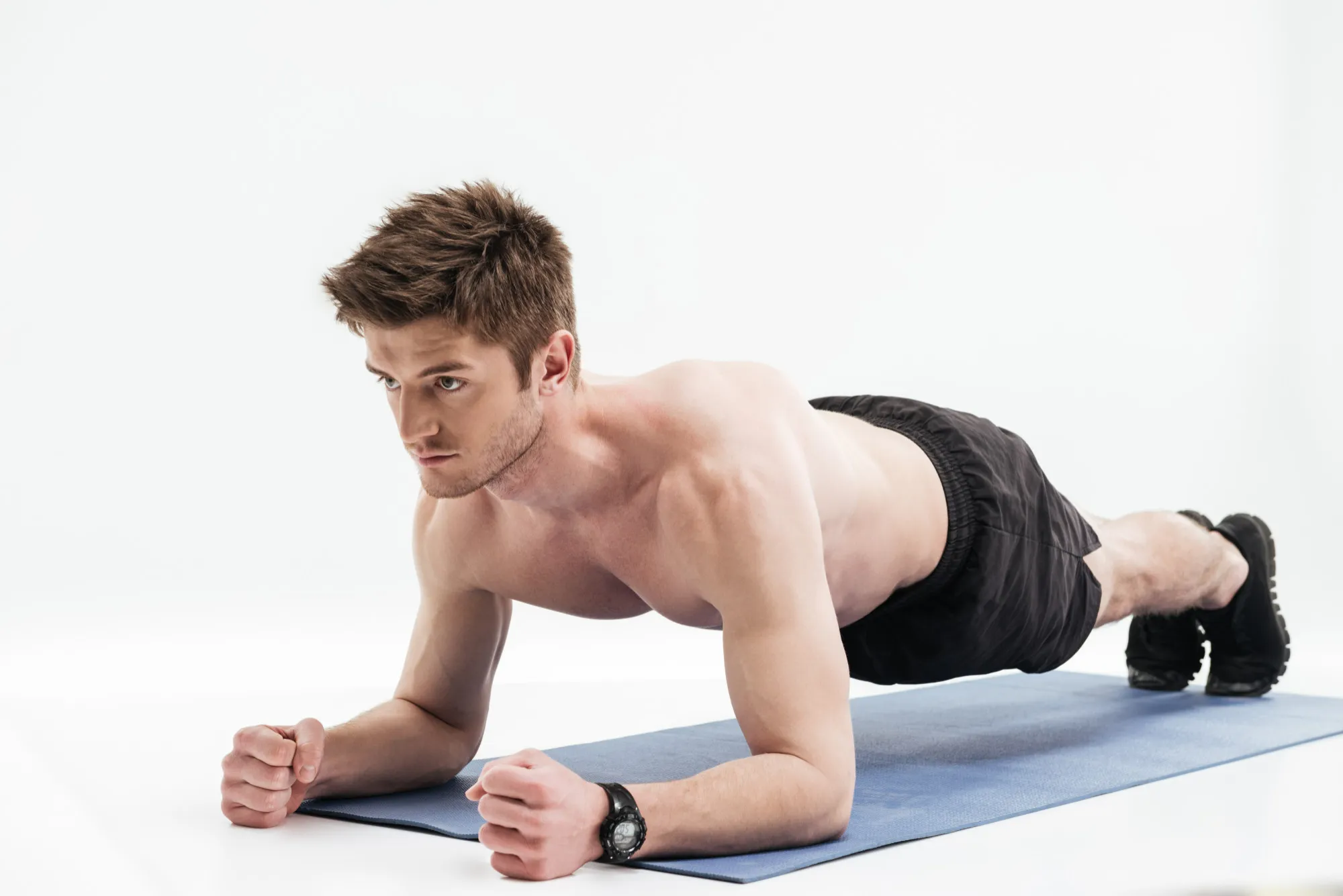
The plank is a foundational body weight exercise that strengthens your core, shoulders, and back, making it one of the most effective exercises for the entire body. Start on your forearms or hands, maintaining a straight line from head to heels. Engage your core and hold for the desired duration, feeling the burn in your abs and glutes. Incorporating planks into your routine enhances overall stability and contributes to full-body strength.
Side Plank
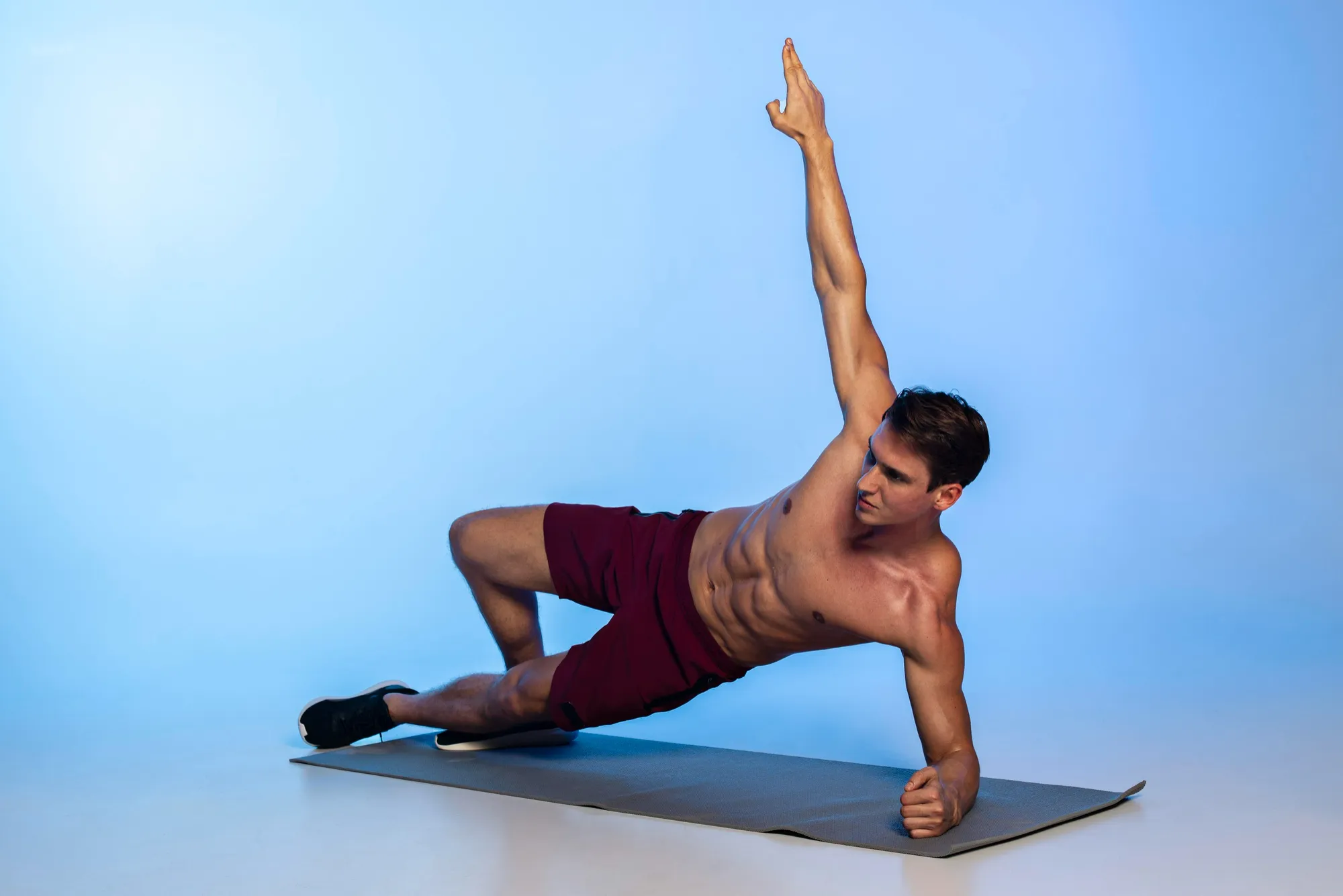
Side planks are a game-changer for core strength and stability. This isometric exercise engages your entire core while also working your obliques, making it a perfect addition to your full body workout routine for a strong and toned midsection.
Lie on your side with your elbow propped under your shoulder and your body in a straight line. Lift your hips off the ground, engaging your core, and hold for the desired duration. Repeat on the other side.
Twisting Plank
Elevate your plank with a rotational twist for enhanced core engagement. Start in a high plank, then rotate your hips to bring one knee towards your elbow. Return to plank and repeat on the other side. Feel the fire in your obliques and core with each controlled twist.
Unwind and improve your range of motion with a rejuvenating yoga flow. Focus on stretches that target your major muscle groups, paying particular attention to your hamstrings, quads, glutes, chest, and shoulders. Hold each stretch for 30 seconds, savoring the release of tension and promoting optimal recovery.
Cool-down (5 minutes): Don’t underestimate the power of recovery! Conclude your workout with static stretches, holding each for 30 seconds and focusing on your core, major muscle groups, and any tight areas.
Dead Bug
Sets: 3
Reps: 10–12 per side
Primary Muscles
- Core
- Lower Abs
- Hip Flexors
Bird Dog
Sets: 3
Reps: 10 each side
Targets
- Core
- Lower Back
- Stability
Full Body Workout vs Split Workout
One of the most common questions people ask is whether they should follow a full body workout or a traditional split workout. The answer depends on your fitness level, training schedule, recovery ability, and personal goals. Both training styles can build muscle and strength when programmed correctly, but each has its own advantages.
A full body workout trains all the major muscle groups during every workout session. This approach is ideal for people who train 2–4 days per week, allowing each muscle group to be stimulated multiple times while providing enough recovery between sessions.
A split workout, on the other hand, divides the body into separate muscle groups, such as chest, back, shoulders, arms, or legs, with each muscle trained on different days. This approach is commonly used by intermediate and advanced lifters who can commit to training 4–6 days per week.
Full Body Workout vs Split Workout Comparison
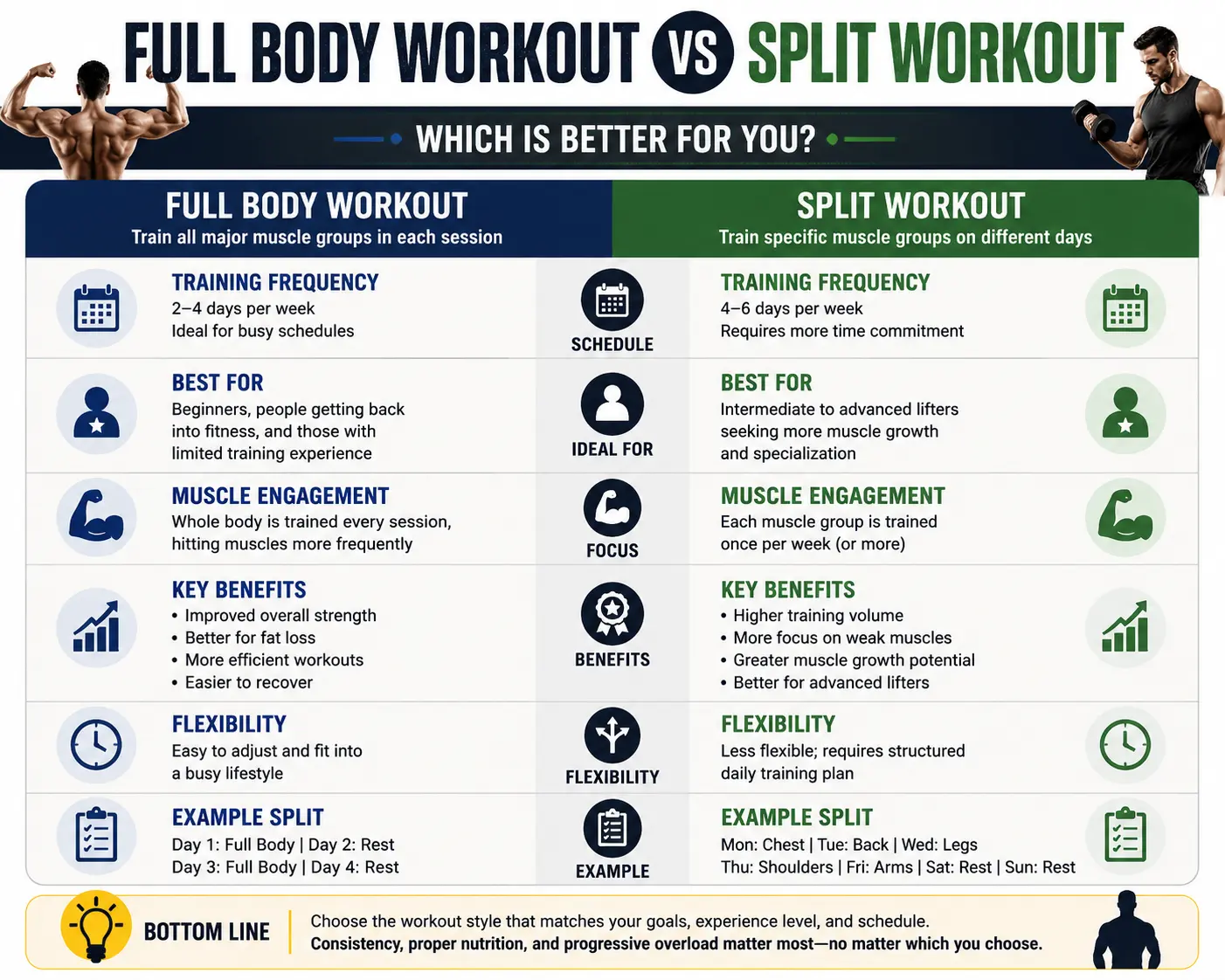
| Feature | Full Body Workout | Split Workout |
|---|---|---|
| Training Frequency | 2–4 days per week | 4–6 days per week |
| Muscles Trained | Entire body every session | One or two muscle groups per session |
| Workout Duration | 45–75 minutes | 60–90 minutes |
| Best For | Beginners, busy individuals, general fitness | Intermediate and advanced lifters |
| Recovery | Full recovery between sessions | Muscle groups recover while others are trained |
| Flexibility | Easier to maintain if a workout is missed | Missing workouts may disrupt the weekly split |
| Primary Goal | Strength, overall fitness, fat loss, muscle maintenance | Muscle hypertrophy and body-part specialization |
Which Workout Style Is Better?
Neither training style is universally better; the best choice depends on your body type, goals, and lifestyle.
Choose a full body workout if you:
- Train only 2–4 days per week
- Are new to resistance training
- Want to improve overall strength and fitness
- Prefer shorter, balanced workouts
- Want an efficient routine for muscle gain and fat loss
Choose a split workout if you:
- Can consistently train 4–6 days per week
- Want to dedicate more volume to individual muscle groups
- Have experience with resistance training
- Are focusing on advanced muscle hypertrophy
For most beginners and recreational lifters, a full body workout provides an excellent balance of efficiency, muscle development, and recovery. As training experience increases, some individuals may later transition to a split routine based on their goals and available training time.
Compound vs Isolation Exercises
A balanced full body workout should combine both compound and isolation exercises. While compound movements build overall strength and muscle by working multiple joints and muscle groups at the same time, isolation exercises focus on a single muscle to improve balance, correct weaknesses, and enhance muscle definition.
Understanding the difference helps you build a more effective workout and prioritize the exercises that deliver the greatest results.
What Are Compound Exercises?
Compound exercises involve movement at two or more joints, allowing multiple muscle groups to work together during a single exercise. Because they recruit more muscles, compound lifts are the foundation of most full body workout routines.
Examples include:
- Bench Press
- Squats
- Overhead Press
- Bent-Over Barbell Row
- Leg Press
These exercises should generally be performed at the beginning of your workout, when your energy levels are highest.
What Are Isolation Exercises?
Isolation exercises focus on one muscle group and involve movement at a single joint. They are useful for strengthening weaker muscles, improving muscle symmetry, and adding training volume after your main compound lifts.
Examples include:
- Biceps Curls
- Leg Curls
- Triceps Extensions
- Lateral Raises
- Calf Raises
Isolation exercises are best performed after compound movements, once the major muscle groups have been trained.
Which Should You Prioritize?
For most people, compound exercises should form the foundation of every full body workout, with isolation exercises used to complement the routine.
A practical guideline is:
- 4–6 compound exercises
- 2–4 isolation exercises
- 1–2 core exercises
This balance helps maximize strength, muscle growth, and workout efficiency without unnecessarily increasing workout duration.
Compound vs Isolation Exercises at a Glance
| Feature | Compound Exercises | Isolation Exercises |
|---|---|---|
| Muscles Worked | Multiple | Single |
| Joint Movement | Multiple joints | One joint |
| Strength Development | High | Moderate |
| Calorie Burn | Higher | Lower |
| Best Time in Workout | Beginning | End |
| Examples | Squats, Bench Press, Rows | Biceps Curl, Leg Curl, Calf Raise |
Progressive Overload: The Key to Long-Term Results
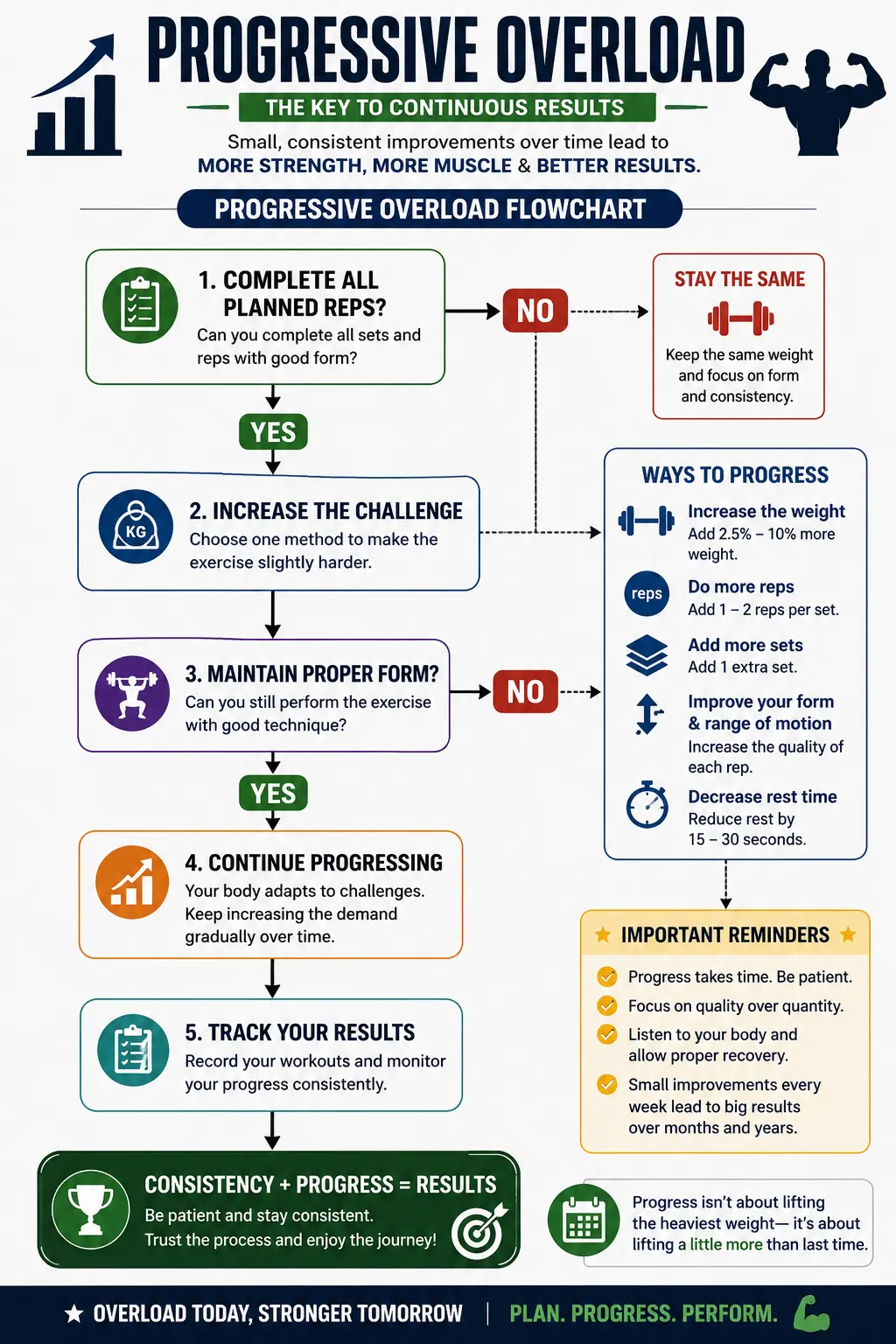
One of the biggest reasons people stop making progress is performing the same workout with the same weight, repetitions, and intensity for weeks or even months. To continue building strength, muscle, and overall fitness, your body must be challenged gradually over time. This training principle is known as progressive overload.
Progressive overload simply means increasing the demands placed on your muscles as they adapt to your workouts. By making small, consistent improvements, you encourage your muscles to become stronger while reducing the likelihood of hitting a training plateau.
How to Apply Progressive Overload
You don’t have to increase the weight every workout. Instead, focus on making gradual improvements using one of these methods:
- Increase the weight while maintaining proper form.
- Perform more repetitions with the same weight.
- Add an extra set to increase training volume.
- Improve your exercise technique and range of motion.
- Reduce rest time slightly between sets as your fitness improves.
Small improvements made consistently are more effective than making large increases too quickly.
How Often Should You Increase the Weight?
There is no fixed schedule for increasing resistance. As a general guideline, once you can complete all your planned sets and repetitions with proper technique and without excessive difficulty, it’s usually time to make the exercise slightly more challenging.
For most strength exercises, increasing the weight by 2.5% to 10%, depending on the exercise and your experience level, is a practical approach.
Track Your Progress
Keeping a workout journal or using a fitness app helps you monitor your progress and identify when it’s time to increase the challenge.
Record details such as:
- Exercises performed
- Weight used
- Number of sets
- Repetitions completed
- Rest periods
- Notes on workout difficulty
Tracking your workouts makes progressive overload more structured and helps maintain consistent long-term improvement.
Expert Tip: Progressive overload is about steady progression, not lifting the heaviest weight possible. Prioritize proper technique first, then gradually increase the training challenge while allowing enough time for recovery.
Frequently Asked Questions (FAQs)
Is a Full Body Workout Better Than a Split Workout?
Neither training style is universally better. A full body workout is generally the best choice for beginners, people with busy schedules, and anyone training 2–4 days per week because it works every major muscle group in each session. A split workout is often preferred by intermediate and advanced lifters who can train 4–6 days per week and want to dedicate more volume to individual muscle groups. Choose the routine that best matches your fitness level, goals, and weekly schedule.
How Many Days a Week Should You Do a Full Body Workout?
For most people, 2–4 full body workouts per week provide the ideal balance between training stimulus and recovery. Beginners usually achieve excellent results with 2–3 sessions weekly, while experienced lifters may train 3–4 times per week depending on their recovery, workout intensity, and fitness goals.
Can Beginners Do Full Body Workouts?
Yes. A full body workout routine is one of the best options for beginners because it allows you to practice fundamental movement patterns several times each week. This frequent practice helps improve exercise technique, build strength, and develop confidence while providing enough recovery between sessions.
Can You Build Muscle With a Full Body Workout?
Absolutely. A well-designed full body workout can effectively build muscle when combined with progressive overload, proper nutrition, sufficient protein intake, and adequate recovery. Focus on compound exercises, gradually increase the training challenge, and remain consistent to support long-term muscle growth.
Is a Full Body Workout Good for Weight Loss?
Yes. Full body workouts recruit multiple muscle groups during each session, increasing calorie expenditure while helping preserve lean muscle mass. Combined with a calorie-controlled diet and regular physical activity, they can support healthy and sustainable weight loss.
How Long Should a Full Body Workout Last?
Most full body workout sessions last between 45 and 75 minutes, depending on the number of exercises, rest periods, and your training experience. Beginners may complete effective workouts in around 45 minutes, while more advanced routines often require additional time.
How Many Exercises Should a Full Body Workout Include?
A balanced full body workout typically includes 6–10 exercises, with most of the routine built around compound movements. A practical structure is:
4–6 compound exercises
2–3 isolation exercises
1–2 core exercises
The exact number depends on your training experience, goals, and available time.
Should You Do Cardio Before or After a Full Body Workout?
If your primary goal is building strength or muscle, perform resistance training first and complete cardio afterward. This helps ensure you have enough energy to perform compound exercises with proper technique. If improving cardiovascular endurance is your main objective, you may choose to prioritize cardio instead.
What Should You Eat Before a Full Body Workout?
Eat a balanced meal containing complex carbohydrates and lean protein about 2–3 hours before training. If you’re working out sooner, a light snack such as a banana with yogurt or whole-grain toast with peanut butter 30–60 minutes before exercise can provide quick energy without causing discomfort.
How Long Should You Wait to Exercise After Eating?
The ideal waiting time depends on the size of your meal. After a large meal, wait approximately 2–3 hours before beginning a workout. After a light snack, 30–60 minutes is generally sufficient. Exercising too soon after eating may cause stomach discomfort, while waiting too long can leave you low on energy.
Conclusion
A full body workout is one of the most effective and time-efficient ways to build strength, increase lean muscle, improve overall fitness, and support long-term health. By training all the major muscle groups in a single session, it provides a balanced approach that works well for beginners, busy professionals, and experienced lifters alike.
Success with a full body workout doesn’t come from performing more exercises—it comes from following a well-structured routine, focusing on proper technique, applying progressive overload, and allowing your body enough time to recover between workouts. Consistency, rather than perfection, is what produces lasting results.
Whether your goal is to gain muscle, lose body fat, improve athletic performance, or simply become stronger and healthier, the workout routines and principles covered in this guide provide a solid foundation to help you progress safely and effectively.
Start with the routine that matches your current fitness level, track your progress, and make gradual improvements over time. Small, consistent steps can lead to significant long-term results.