

Quick Takeaways: What Are the Best Oblique Exercises?
- The best oblique routine trains more than twisting.
- Include movements for rotation, anti-rotation, lateral flexion, and lateral stability.
- Side planks challenge the obliques to stabilize the trunk against sideways movement.
- Russian twists, cable woodchops, and bicycle crunches train controlled trunk rotation.
- Pallof presses and suitcase carries teach your core to resist unwanted movement.
- You do not need all 10 exercises in a single workout.
- Choose exercises based on your fitness level, available equipment, and training goal.
At-a-Glance: 10 Best Oblique Exercises
| Exercise | Main Function | Equipment | Level |
|---|---|---|---|
| Side Plank | Anti-lateral flexion | None | Beginner |
| Russian Twist | Rotation | Optional weight | Beginner–Intermediate |
| Cable Woodchop | Rotation | Cable | Intermediate |
| Pallof Press | Anti-rotation | Cable or band | Beginner–Intermediate |
| Dumbbell Side Bend | Lateral flexion | Dumbbell | Beginner–Intermediate |
| Suitcase Carry | Anti-lateral flexion | Dumbbell or kettlebell | Beginner–Intermediate |
| Bicycle Crunch | Rotation | None | Beginner |
| Side Plank Hip Dip | Lateral stability | None | Intermediate |
| Windmill | Lateral flexion + stability | Dumbbell or kettlebell | Advanced |
| Hanging Oblique Knee Raise | Rotation + trunk control | Pull-up bar | Advanced |
What Are the Oblique Muscles and What Do They Do?
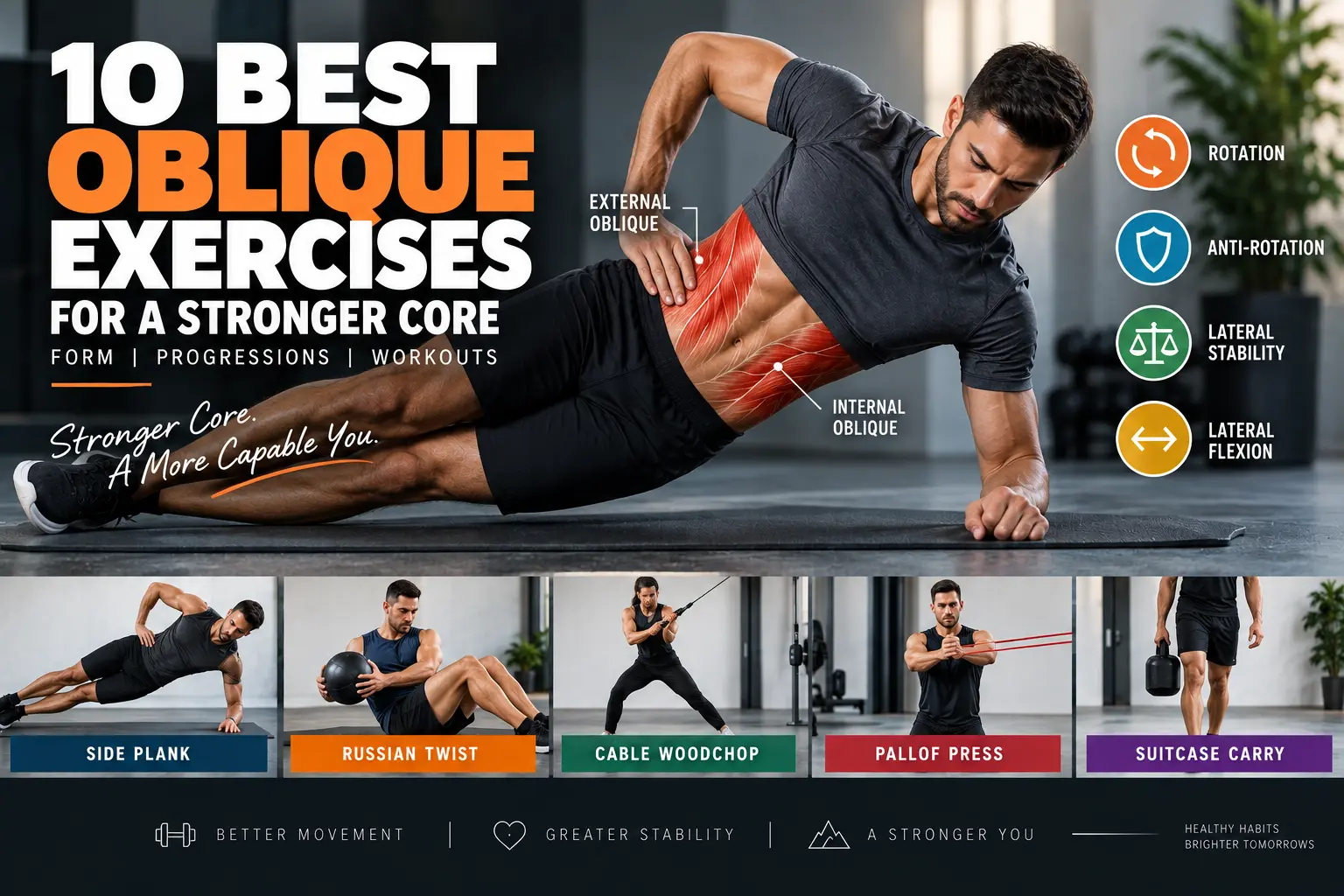
The obliques are the internal and external muscles along the sides of your abdomen. Together, they help rotate your trunk, bend it sideways, and resist unwanted movement. They also contribute to trunk stability when your arms and legs move.
Understanding these functions helps you choose better oblique exercises instead of relying only on repeated crunches or twists.
Where Are the Internal and External Obliques?
You have two layers of oblique muscles on each side of your trunk:
- External obliques: These are the more superficial muscles. Their fibers run diagonally downward and forward, forming much of the visible muscular area along your waist.
- Internal obliques: These lie beneath the external obliques. Their fibers generally run in the opposite diagonal direction.
The opposing fiber directions allow the two muscle layers to work together during trunk movement and stabilization. Depending on the movement, they can help produce rotation or create tension that keeps your torso controlled.
What Movements Do the Obliques Control?
Your obliques do more than twist your body. Their functions can be grouped into four important movement demands.
Rotation
The obliques contribute to turning your torso from side to side. Exercises such as Russian twists, cable woodchops, and bicycle crunches use this function.
Lateral flexion
This means bending your torso toward one side. Dumbbell side bends directly train this movement.
Anti-rotation
Instead of creating rotation, your obliques can resist a force trying to twist your torso. This is important when an external force pulls you sideways. The Pallof press is a classic example.
Anti-lateral flexion
Your obliques can also resist forces trying to bend your trunk sideways. A side plank or suitcase carry challenges this function by requiring you to keep your torso from collapsing toward the loaded or unsupported side.
Why Do Oblique Exercises Matter?
Strong obliques contribute to trunk stability and movement control. They help connect movements between your upper and lower body, particularly when you rotate, carry, lift, or change direction.
That makes oblique training relevant beyond developing visible abdominal definition. A well-rounded routine can challenge the trunk to produce movement when needed and resist movement when stability matters.
For everyday activities, these demands appear when carrying a bag on one side, lifting an object, reaching across your body, or turning while keeping your balance.
Research Insight
Effective core training is not limited to repeated trunk-flexion exercises. Research examining core-muscle activity shows that different exercise types can place different demands on the abdominal and trunk muscles, including the internal and external obliques. This supports using a variety of controlled movements rather than relying on one exercise pattern alone
What Makes an Oblique Exercise Effective?
An effective oblique exercise should challenge the muscles through a meaningful movement or stabilization demand while allowing you to maintain control and progress over time. The best choices are not necessarily the exercises that create the strongest burn. They are movements you can perform with good technique, appropriate resistance, and consistent progression.
Should You Train Rotation or Anti-Rotation?
Both have a place in effective oblique training, but they challenge the trunk differently.
Rotation means your obliques help produce controlled movement as your torso turns. Russian twists, cable woodchops, and bicycle crunches are examples of rotational exercises.
Anti-rotation means your obliques work to prevent your torso from turning when an outside force tries to rotate it. The Pallof press is a straightforward example.
Training both functions gives your obliques different demands instead of repeatedly practicing the same movement pattern.
Why Does Lateral Stability Matter?
Your obliques also help keep your torso from collapsing sideways. This is known as anti-lateral-flexion training.
A side plank challenges you to maintain your body position against gravity. A suitcase carry creates a similar demand while you walk with weight on one side.
These exercises train the ability to maintain a stable trunk while your body moves around it, a useful quality for both exercise and everyday carrying tasks.
Is There Really One Single Best Oblique Exercise?
No. There is no universal single best exercise for the obliques because these muscles perform several functions.
The better question is: Which exercise best matches your current goal?
A side plank may be a strong choice for lateral stability, while a cable woodchop suits controlled rotation. A Pallof press emphasizes anti-rotation, and a suitcase carry combines loading with lateral stability.
TRAINER TIP
Build Your Oblique Workout Around Functions
A simple framework is:
- One stability movement
- One rotational movement
- One anti-rotation movement
- One loaded movement, when appropriate
You do not need every exercise in every session. Select movements that complement each other and match your ability.
What Are the 10 Best Oblique Exercises?
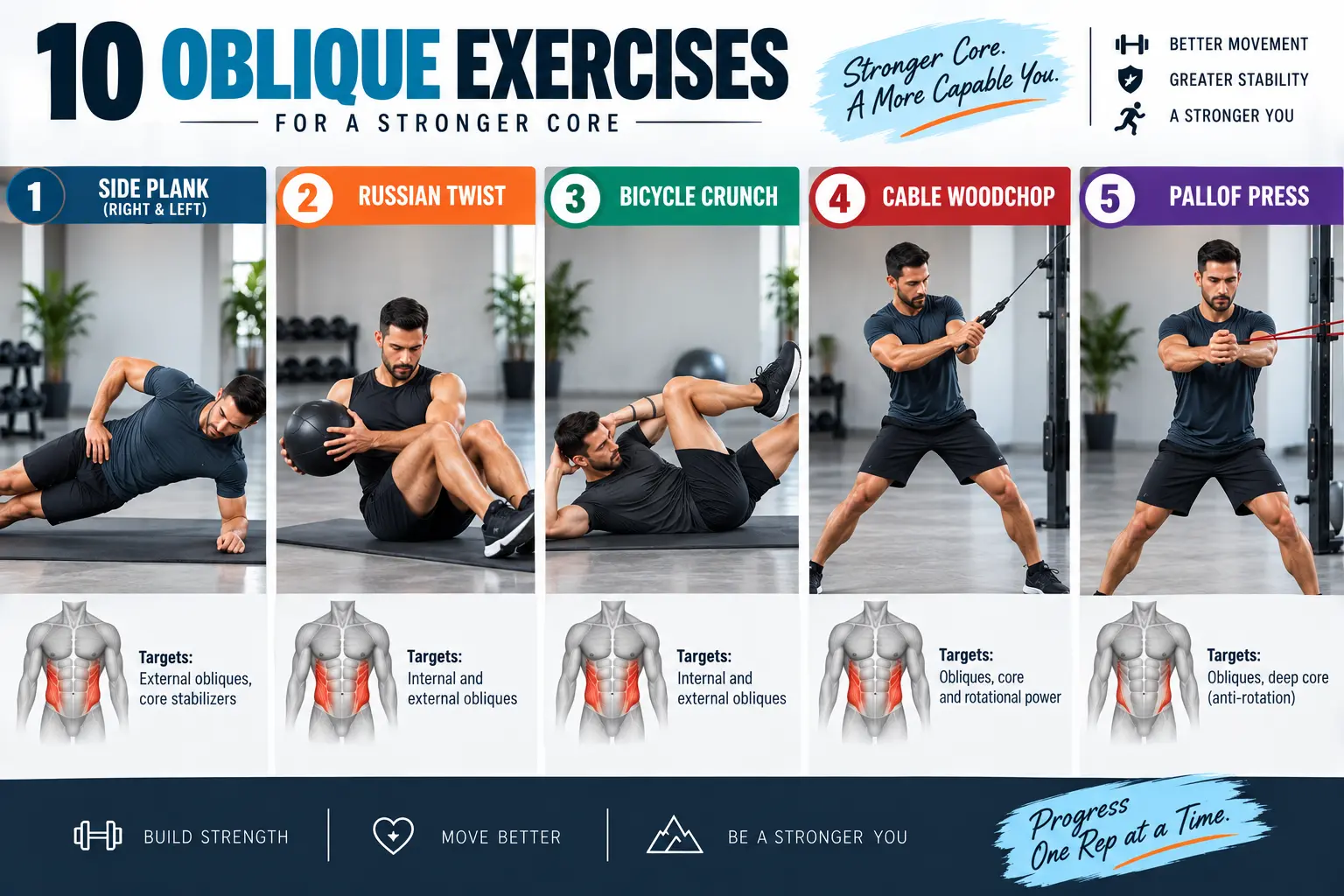
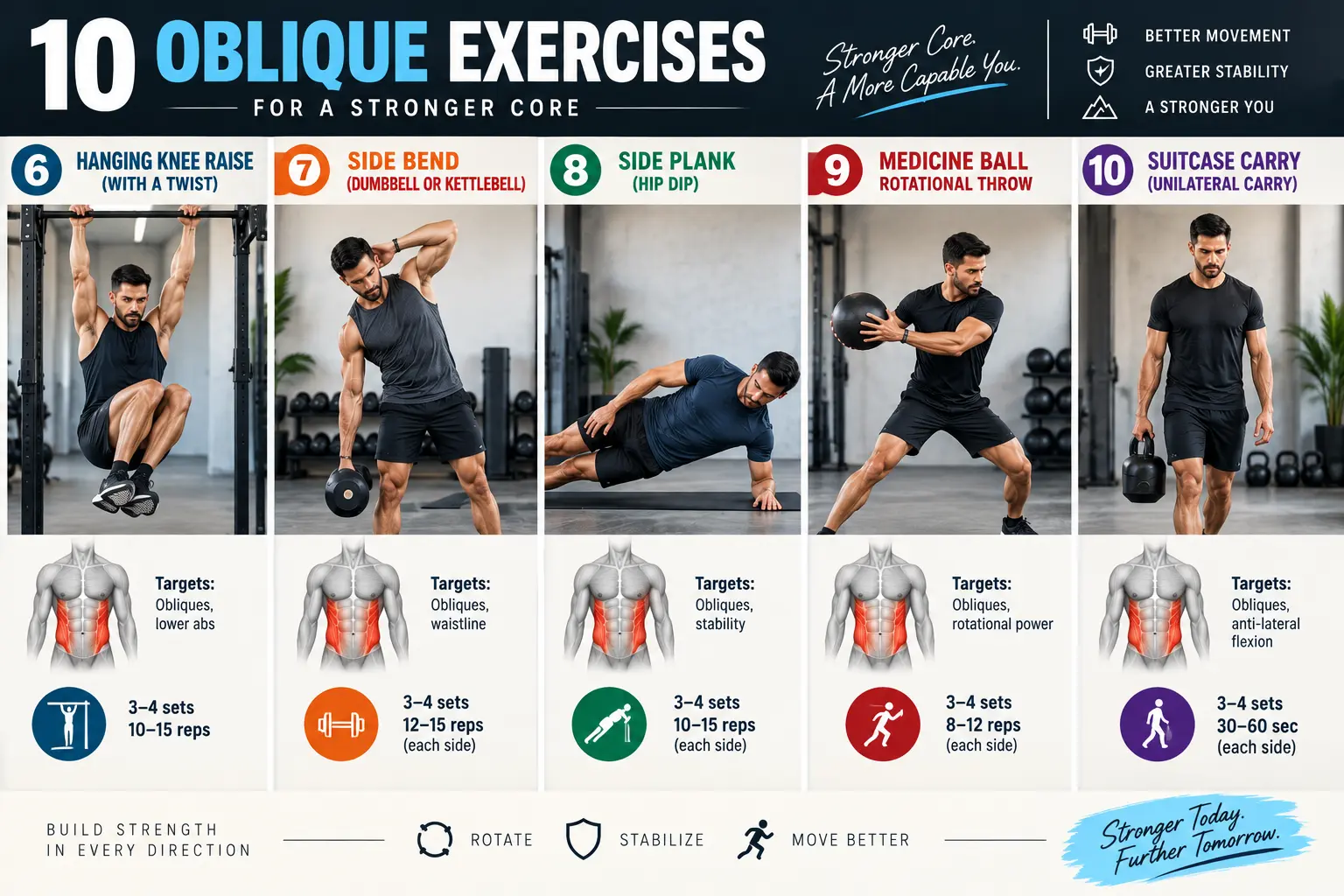
The best selection combines bodyweight, rotational, anti-rotational, lateral-flexion, and loaded movements. This approach trains the obliques through different functions instead of repeating the same pattern. You can choose from these 10 exercises based on your fitness level, equipment, and goal.
1. Side Plank
Primary function: Anti-lateral flexion and lateral stability
The side plank is one of the most useful bodyweight oblique exercises because it challenges you to keep your torso stable against gravity. It requires little space and can be modified easily for beginners.
Why Is the Side Plank One of the Best Oblique Exercises?
Your obliques work to keep your hips and trunk from dropping toward the floor. Unlike a traditional crunch, the side plank emphasizes stability rather than repeated trunk flexion.
It is also easy to progress without immediately adding external weight.
How Do You Do a Side Plank Correctly?
- Lie on your side with your elbow directly beneath your shoulder.
- Stack your legs and keep your body in a straight line.
- Brace your abdomen and lift your hips from the floor.
- Keep your head, shoulders, hips, and feet aligned.
- Hold the position while breathing steadily.
- Lower yourself with control.
Keep your supporting shoulder stable rather than allowing it to collapse toward your ear.
What Are the Most Common Side Plank Mistakes?
The most common problems are sagging hips, excessive rotation, and poor shoulder positioning. Holding for longer is not useful if your body position breaks down.
How Can Beginners Modify the Side Plank?
Start with a bent-knee side plank. Once you can maintain good alignment, progress to a full side plank. From there, increase the duration gradually before considering a weighted variation.
Expert Tip
Keep your hips lifted and aligned rather than allowing them to sag or rotate forward.
2. Russian Twist
Primary function: Controlled trunk rotation
The Russian twist trains the obliques through controlled rotational movement. It can be performed without equipment or with a light weight once you have established good control.
Why Do Russian Twists Work the Obliques?
The exercise requires your trunk to rotate from side to side while you maintain control of your torso. The obliques contribute to this rotation and help control the return to the starting position.
How Do You Perform a Russian Twist Correctly?
- Sit with your knees bent and feet positioned comfortably.
- Lean your torso back slightly while keeping your spine controlled.
- Brace your abdominal muscles.
- Rotate your torso toward one side.
- Return through the center and rotate toward the opposite side.
- Move smoothly rather than rushing between repetitions.
Think about turning your torso, rather than simply moving your hands from side to side.
Should Your Feet Stay on the Floor?
For most beginners, keeping your feet on the floor provides a more stable starting position. Lifting the feet increases the balance demand, but it is not automatically a better version.
Choose the variation that lets you maintain controlled rotation without losing your position.
What Mistakes Make Russian Twists Less Effective?
Common mistakes include swinging the arms, using momentum, rotating too quickly, and forcing an excessive range of motion. Adding weight before mastering the movement can make these problems worse.
SAFETY NOTE
Control the Rotation Before Adding Weight: Make the movement harder through better control first. Do not simply use heavier resistance to increase the challenge.
3. Cable Woodchop
Primary function: Loaded rotation
The cable woodchop adds adjustable resistance to trunk rotation. It is useful for intermediate trainees who can control their torso while coordinating movement through the hips and upper body.
Why Is the Cable Woodchop Useful for Oblique Strength?
Unlike bodyweight rotation, a cable provides resistance throughout the movement. Your obliques help produce and control rotation while your trunk works with the rest of your body.
How Do You Do a Cable Woodchop?
- Set the cable at an appropriate height.
- Stand with your feet stable and slightly apart.
- Hold the handle with both hands.
- Brace your trunk before beginning.
- Pull the handle diagonally across your body.
- Allow your hips and shoulders to coordinate naturally.
- Return to the starting position under control.
Use a resistance level that allows smooth repetitions.
Should Your Hips Rotate During a Woodchop?
Some coordinated movement from the hips and lower body is appropriate. The goal is not to lock your entire body and force all rotation through your lower back.
Instead, keep your trunk stable while allowing the hips, torso, and shoulders to coordinate. Avoid turning the movement into uncontrolled lumbar twisting.
How Can You Progress the Cable Woodchop?
Progress gradually by increasing resistance while maintaining technique. You can also adjust the cable position or stance to create a different movement challenge. Quality should remain the priority at every resistance level.
4. Pallof Press
Primary function: Anti-rotation
The Pallof press is different from a woodchop or Russian twist. Its main purpose is to resist rotation, making it a useful addition to a well-rounded oblique workout.
H4: What Does the Pallof Press Train?
The exercise challenges your trunk to remain facing forward while the cable or resistance band pulls you sideways. Your obliques help prevent the torso from rotating toward the resistance.
How Do You Perform a Pallof Press?
- Attach a resistance band or cable at approximately chest height.
- Stand sideways to the anchor point.
- Hold the handle close to your chest with both hands.
- Brace your trunk and establish a stable stance.
- Press your hands forward without allowing your torso to rotate.
- Pause briefly, then bring your hands back toward your chest.
- Complete your repetitions before switching sides.
Should You Rotate During a Pallof Press?
No—not during the standard Pallof press. The defining challenge is resisting the rotational force.
If you deliberately rotate your torso, you have changed the exercise and its primary training demand.
Research Insight
Resisting Rotation Is an Important Part of Core Training. The obliques do not only produce movement. They also help control unwanted movement. Anti-rotation exercises such as the Pallof press train the trunk to maintain position while an external force attempts to turn it.
5. Dumbbell Side Bend
Primary function: Lateral flexion
The dumbbell side bend directly trains lateral flexion, making it a useful option when your program needs a loaded side-bending movement.
How Do You Perform a Dumbbell Side Bend?
- Stand upright with your feet about hip-width apart.
- Hold one dumbbell beside your body.
- Brace your abdomen and keep your shoulders controlled.
- Bend your torso slightly toward the side holding the dumbbell.
- Return to an upright position using controlled movement.
- Complete your repetitions before switching sides.
Keep the movement deliberate rather than trying to achieve maximum range.
What Should You Avoid During Side Bends?
Avoid swinging the weight, rushing repetitions, twisting your torso, or using more resistance than you can control. Your torso should move laterally rather than turning through the movement.
Can Weighted Side Bends Build the Obliques?
Yes. Progressive resistance can provide a meaningful strength stimulus for the obliques. However, adding weight does not automatically make your waist wider. Changes in muscular size depend on factors such as training volume, resistance, nutrition, genetics, and your overall program.
6. Suitcase Carry
Primary function: Anti-lateral flexion and loaded stability
The suitcase carry turns a simple walking pattern into a demanding oblique stability exercise. Holding weight on one side creates a force that your trunk must resist.
Why Is the Suitcase Carry Good for the Obliques?
The uneven load encourages your torso to bend toward the weighted side. Your obliques and other trunk muscles work to maintain an upright position.
It also adds a practical carrying component that many traditional abdominal exercises do not provide.
How Do You Perform a Suitcase Carry?
- Hold a dumbbell or kettlebell in one hand.
- Stand tall with your shoulders level.
- Brace your abdomen without holding your breath.
- Walk slowly and maintain an upright torso.
- Keep the weight close to your side.
- Stop when your posture or control begins to deteriorate.
- Switch sides and repeat.
What Should You Feel During a Suitcase Carry?
You should feel your trunk working to maintain an upright, stable position. You should not need to lean dramatically away from the weight to complete the carry.
How Can You Make the Suitcase Carry Harder?
Progress through a heavier load, longer distance, or longer controlled carry. Avoid simply walking faster. Speed can make it harder to maintain the stable trunk position that makes the exercise useful.
7. Bicycle Crunch
Primary function: Bodyweight rotation
Bicycle crunches combine abdominal flexion with alternating trunk rotation. They require no equipment, making them a convenient choice for oblique exercises at home.
How Do You Perform Bicycle Crunches Correctly?
- Lie on your back with your hands lightly supporting your head.
- Lift your shoulders and bring your knees into a comfortable position.
- Extend one leg while bringing the opposite knee inward.
- Rotate your torso toward the bent knee.
- Return through the center and switch sides.
- Continue with controlled alternating repetitions.
Avoid pulling your head forward with your hands.
Why Do People Rush Bicycle Crunches?
Fast repetitions often turn the movement into momentum rather than controlled trunk movement. Slowing down gives you more opportunity to maintain your position and coordinate the rotation.
How Can Beginners Modify Bicycle Crunches?
Reduce the range of motion and perform fewer repetitions. You can also keep the moving leg closer to the floor only if you can maintain control without discomfort.
8. Side Plank Hip Dip
Primary function: Lateral stability with controlled movement
The side plank hip dip builds on the basic side plank by adding controlled movement through the hips. It is a logical progression once you can maintain a strong static side plank.
How Do You Perform Side Plank Hip Dips?
- Set up in a full side plank.
- Brace your trunk and lift your hips.
- Lower your hips toward the floor with control.
- Stop before completely losing your position.
- Drive your hips back to the starting position.
- Repeat for controlled repetitions.
Should Your Hips Touch the Floor?
Not necessarily. The goal is controlled movement, not reaching the floor at all costs. Use a range that allows you to maintain alignment throughout the repetition.
How Do You Progress Side Plank Hip Dips?
First master the basic side plank. Then introduce hip dips with a controlled range. You can gradually increase repetitions or range of motion as your control improves.
9. Windmill
Primary function: Lateral flexion + trunk stability
The windmill is a more advanced movement because it combines a loaded position with hip mobility, lateral flexion, and trunk control.
Why Is the Windmill an Advanced Oblique Exercise?
The exercise requires you to maintain control while moving your torso around a stable lower-body position. Adding a dumbbell or kettlebell increases the technical demand.
It should therefore be introduced only after you have established sufficient movement control and mobility.
How Do You Perform a Dumbbell or Kettlebell Windmill?
- Stand with your feet comfortably wider than hip-width.
- Hold the weight overhead with a stable arm.
- Brace your trunk and hinge through your hips.
- Rotate and lower your torso toward the opposite side.
- Keep the loaded arm controlled overhead.
- Return to standing through the hip hinge.
- Perform slowly and deliberately.
Start with very light resistance—or practice the movement without weight—before progressing.
What Mobility Do You Need Before Trying It?
You need enough hip and thoracic mobility to hinge and rotate without compensating excessively through the lower back. If you cannot maintain control through the required position, work on the underlying movement first.
What Are the Biggest Windmill Mistakes?
Common errors include using excessive weight, bending through the spine instead of hinging at the hips, losing control of the overhead arm, and forcing the range of motion.
10. Hanging Oblique Knee Raise
Primary function: Trunk control + rotation
The hanging oblique knee raise is an advanced option that combines hanging strength with controlled trunk movement. It requires more grip, shoulder, hip, and abdominal control than floor-based exercises.
How Do You Perform a Hanging Oblique Knee Raise?
- Hang from a pull-up bar with a controlled grip.
- Brace your abdomen and minimize unnecessary swinging.
- Bring your knees upward toward one side of your torso.
- Lower them slowly to the starting position.
- Repeat toward the other side.
- Maintain control throughout the movement.
The goal is not simply to lift the knees as high as possible. Minimize momentum and keep the movement deliberate.
Why Is This Exercise Better Suited to Advanced Lifters?
Hanging knee raises demand adequate grip strength, shoulder stability, trunk control, and coordination. Without those qualities, swinging can replace the intended movement and make the exercise difficult to perform consistently.
How Can You Modify It If You Cannot Hang Comfortably?
A captain’s-chair knee raise can provide a useful alternative by supporting your upper body while you train a similar knee-raising pattern. You can also return to floor-based exercises until you develop the strength and control needed for hanging work.
Which Oblique Exercise Is Best for Your Goal?
The best oblique exercise depends on your goal, experience, and available equipment. Instead of searching for one universally superior movement, choose an exercise that matches the function you want to train.
What Is the Best Oblique Exercise for Beginners?
The side plank is an excellent starting point. Beginners can use the modified bent-knee version before progressing to a full side plank. It requires no equipment and teaches basic lateral trunk stability.
What Is the Best Oblique Exercise for Rotation?
For controlled rotation, choose between the Russian twist and cable woodchop. The Russian twist is convenient for home workouts, while the cable woodchop allows adjustable resistance and is better suited to trainees with more experience.
What Is the Best Oblique Exercise for Stability?
The side plank is one of the simplest choices for lateral stability. It challenges your obliques to maintain your trunk position rather than repeatedly moving your torso.
What Is the Best Exercise for Anti-Rotation?
The Pallof press is the clearest choice. Instead of rotating, you resist the cable or band pulling your torso sideways. This makes it fundamentally different from rotational exercises such as Russian twists and woodchops.
What Is the Best Oblique Exercise With Weights?
There is no single winner because weighted exercises serve different purposes:
- Dumbbell side bend: emphasizes lateral flexion.
- Cable woodchop: provides loaded rotation.
- Suitcase carry: emphasizes anti-lateral flexion and stability.
- Weighted side plank: increases the challenge of lateral stability.
Choose according to the function you want to improve rather than simply selecting the heaviest exercise.
What Are the Best Oblique Exercises at Home?
You can build an effective home routine without specialized equipment. Side planks, Russian twists, bicycle crunches, and side plank hip dips require no equipment. A suitcase carry can also work if you have a safely loaded dumbbell, kettlebell, or backpack.
Quick Decision: Which Exercise Should You Pick?
No equipment → Side plank
Want rotation → Russian twist
Have a cable → Cable woodchop
Want anti-rotation → Pallof press
Have a dumbbell → Side bend or suitcase carry
Need an advanced challenge → Windmill or hanging oblique knee raise
How Should You Perform Oblique Exercises Safely?
Safe oblique training depends on controlled movement, appropriate resistance, stable positioning, and an exercise variation you can perform without pain. Good technique matters more than completing more repetitions or using heavier weight.
How Should You Brace Your Core?
Brace your core by gently tightening the muscles around your abdomen and trunk while continuing to breathe normally. You should feel supported rather than rigid.
The amount of bracing should match the exercise. A heavy suitcase carry may require more tension than a controlled bicycle crunch. Avoid pulling your stomach in excessively or holding unnecessary tension throughout the entire workout.
Should You Hold Your Breath During Oblique Exercises?
For most moderate-intensity oblique exercises, you should continue breathing rather than deliberately holding your breath. Exhale during the effort when it feels natural and inhale during the easier phase.
Heavier resistance exercises may require more deliberate bracing, but breathing should remain appropriate to the load and exercise.
How Much Rotation Is Enough?
There is no universal amount of rotation that every person should use. Move through a controlled range that you can maintain without forcing the movement.
More rotation is not automatically better. If increasing the range causes your technique to deteriorate, reduce the range and regain control.
Should You Train Through Pain?
Do not treat pain as a requirement for an effective workout. Muscular effort, fatigue, and a challenging sensation can occur during training. Sharp, sudden, worsening, or unusual pain is different.
If an exercise consistently produces pain, stop the movement and reassess the technique, resistance, range, or exercise selection rather than forcing additional repetitions.
When Should You Stop an Oblique Exercise?
End the set when you can no longer maintain the intended position or movement. You should also stop if pain develops or your technique changes substantially.
Safety Tip
Stop and Seek Professional Advice If…
- You experience sharp or worsening pain.
- You develop unexplained numbness, tingling, weakness, or other neurological symptoms.
- You have significant or persistent back symptoms.
- You are returning from a recent injury or surgery.
- A healthcare professional has given you specific exercise restrictions.
What Are the Most Common Oblique Exercise Mistakes?
Most oblique-training mistakes come from using momentum, choosing excessive resistance, losing the intended body position, or training the same movement pattern repeatedly. Fixing these problems can make your existing exercises more productive without adding more exercises.
Are You Using Momentum Instead of Your Core?
If your body is swinging, bouncing, or rapidly changing direction, momentum may be doing more of the work. Slow the movement down and use a range that you can control.
This is particularly important during Russian twists, bicycle crunches, and hanging knee raises.
Are You Using Too Much Weight?
A heavier dumbbell or cable stack is not automatically better. Excessive resistance can change your technique and make it difficult to target the intended movement.
Choose a load that allows you to complete clean repetitions while maintaining control.
Are You Turning Every Exercise Into a Twist?
Not every oblique exercise should involve rotation. Side planks, Pallof presses, and suitcase carries challenge the obliques by resisting movement.
A balanced routine should include both movements that produce rotation and movements that resist it.
Are Your Hips or Shoulders Rotating When They Should Stay Stable?
Some exercises require coordinated rotation, while others require you to prevent it. Know which demand your exercise is designed to create.
For example, rotating during a standard Pallof press changes its primary purpose.
Are You Doing More Reps Instead of Better Reps?
If your final repetitions become rushed or poorly controlled, adding more repetitions may not improve the set. First establish consistent technique, then progress the exercise gradually.
Are You Training Only Rotation?
Rotation is only one role of the obliques. Include anti-rotation, anti-lateral flexion, and lateral stability to create a more complete oblique workout.
5-Second Form Check
Before your next set, ask:
- Can I control the movement?
- Is my torso in the intended position?
- Am I breathing normally?
- Am I relying on momentum?
- Could I perform another clean repetition?
How Do You Progress Your Oblique Training?
Progress your oblique training by making an exercise more demanding while maintaining control and technique. Instead of adding endless repetitions, gradually increase resistance, duration, repetitions, range of motion, or exercise difficulty according to the movement.
Should You Add Repetitions, Weight, or Time First?
There is no single progression method for every oblique exercise.
For side planks, increasing hold duration can be a natural first step. For Russian twists or side bends, gradually increasing resistance may be appropriate once you can control the prescribed repetitions. For Pallof presses, you can increase resistance, hold the extended position longer, or increase the challenge of your stance.
For suitcase carries, increase the load or carrying distance while maintaining an upright torso.
The key is simple: make one variable harder while keeping the movement clean.
When Should You Move to a Harder Exercise?
Move to a harder variation when you can consistently complete your current exercise with good technique and without excessive fatigue or compensations.
For example, progress from a bent-knee side plank to a full side plank before adding external weight. Similarly, master controlled bodyweight movements before choosing advanced exercises such as windmills or hanging oblique knee raises.
Trainer Tip
Progress One Variable at a Time
Choose one progression:
- Resistance
- Duration
- Repetitions
- Range of motion
- Exercise difficulty
How Often Should You Train Your Obliques?
Most people do not need dedicated oblique training every day. A few well-designed sessions per week can provide an effective training stimulus when the exercises are appropriately challenging and you allow enough recovery.
Your obliques also work during many compound exercises, carries, and other core movements, so dedicated work should be considered alongside your overall training volume.
Can You Train Your Obliques Every Day?
You can use your core frequently, but hard, dedicated oblique sessions do not necessarily need to occur every day. Training frequency should account for exercise intensity, total workload, recovery, and how your body responds.
Light stability work may place a different demand on your body than a challenging weighted session.
How Many Days a Week Should You Train Your Obliques?
For dedicated training, two to three sessions per week can be a practical starting point for many people. The exact frequency depends on your wider strength-training program and the difficulty of your sessions.
You do not need to train the obliques separately every time you exercise.
How Many Sets and Reps Should You Do?
There is no universal number of sets and repetitions for every oblique exercise.
Use repetitions for movements such as Russian twists, bicycle crunches, and side bends. Use time for exercises such as side planks and distance or time for suitcase carries.
Start with a manageable workload and increase it gradually as your control and fitness improve.
Should Oblique Training Come Before or After Strength Training?
If oblique work is a major training priority, you can perform it earlier in the session while you are relatively fresh. If your main goal is heavy strength training, dedicated oblique work may fit better after your primary lifts.
Avoid exhausting your trunk immediately before exercises that require substantial bracing and stability.
How Long Should an Oblique Workout Take?
A dedicated oblique session does not need to be long. Around 10–20 minutes can be enough when you select complementary exercises and perform them with purpose.
The quality of the training stimulus matters more than filling a longer workout with additional abdominal exercises.
Research Insight
Training produces a stimulus, but adaptation also depends on recovery and progressive overload. Adding more sets or daily sessions is not automatically more effective. A better approach is to use an appropriate workload, recover adequately, and gradually increase the challenge as your performance improves.
What Is the Best Oblique Workout for Your Fitness Level?
A good oblique workout uses a few complementary movements that match your ability rather than requiring all 10 exercises. Choose 3–4 movements that challenge different functions, then progress the difficulty as your control improves.
| Fitness Level | Example Oblique Workout | Main Training Focus |
|---|---|---|
| Beginner | Modified side plank + bicycle crunch + Pallof press + optional suitcase carry | Stability, controlled rotation, anti-rotation |
| Intermediate | Side plank + Russian twist + cable woodchop + Pallof press | Stability, rotation, anti-rotation |
| Advanced | Weighted side plank + cable woodchop + suitcase carry + windmill or hanging oblique knee raise | Loaded stability, rotation, advanced trunk control |
Quick Takeaways
You Don’t Need All 10 Exercises
Choose 3–4 complementary movements that cover different oblique functions. Your workout should become more challenging through better control and gradual progression—not simply by adding more exercises.
Frequently Asked Questions
Do I Need to Train My Obliques Separately?
Not necessarily. Your obliques already contribute to many compound exercises and core movements. Dedicated oblique training can be useful when you want to improve a specific function, address a training gap, or add targeted work to your routine.
Can I Train My Obliques With Just Bodyweight Exercises?
Yes. Exercises such as side planks, bicycle crunches, and side plank hip dips can train the obliques without external resistance. As these become easier, you can increase difficulty through longer holds, controlled repetitions, or more demanding variations.
Which Oblique Exercise Is Best for a Weak Core?
Start with an exercise you can perform with consistent control, such as a modified side plank. Build basic trunk stability first, then progress toward more demanding rotational, anti-rotational, and loaded exercises.
Can Stronger Obliques Improve Core Stability?
Stronger obliques can contribute to your ability to stabilize and control the trunk. However, overall core stability depends on the coordinated contribution of multiple muscles and movement patterns, not the obliques alone.
Should Men and Women Train Their Obliques Differently?
The basic movement functions are the same. Exercise selection should depend more on training experience, goals, equipment, and individual ability than on sex.
Final Takeaway: Train Your Obliques by Function, Not by Repetition
The most effective oblique exercises are not about doing endless twists, crunches, or side bends. A stronger approach is to train the obliques through their different roles: rotation, anti-rotation, lateral flexion, and lateral stability.
You also do not need all 10 exercises in every workout. Choose 3–4 movements that complement each other and match your fitness level, equipment, and goal. Focus on controlled technique before increasing resistance, repetitions, duration, or exercise difficulty.
Remember that stronger obliques and visible abdominal definition are different goals. Training can strengthen and develop the muscles, while visible definition is also influenced by overall body composition, nutrition, genetics, and consistency.
Start with exercises you can control, progress gradually, and build your routine around quality rather than quantity.