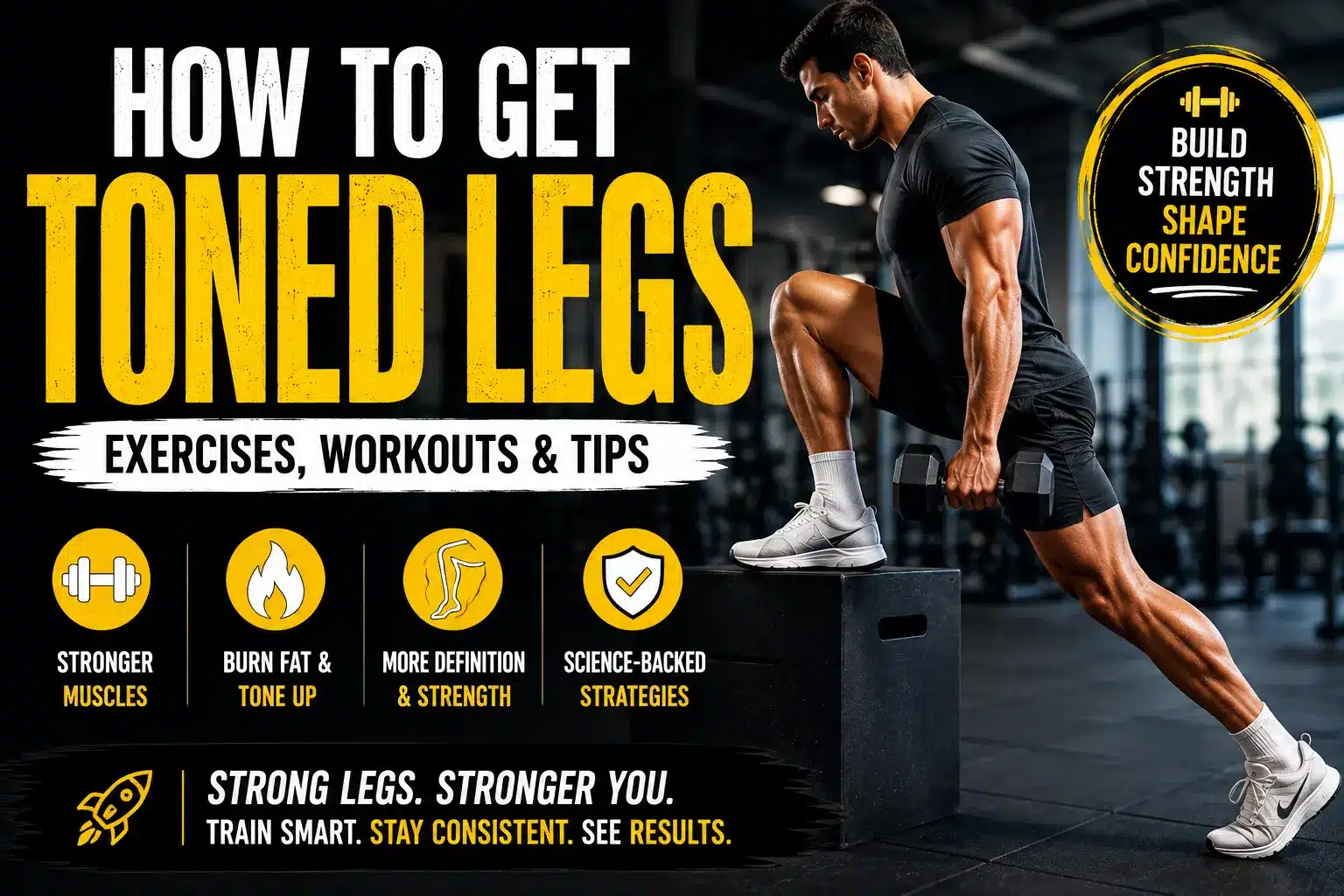


💡Key Takeaways: Toned Legs at a Glance
- “Toned” legs are not a special type of muscle. A more defined appearance generally comes from developing or maintaining leg muscle while managing overall body composition.
- Resistance training is the foundation. Squats, lunges, split squats, hip-hinge movements, step-ups, bridges, and calf raises can progressively strengthen the major lower-body muscles.
- Cardio supports the goal but does not replace strength training. Walking, running, cycling, and other aerobic activities can improve fitness and increase overall physical activity.
- Consistency beats extreme workouts. A practical plan combines progressive leg training, regular movement, adequate nutrition, and recovery over time.
Quick Reference: What Actually Helps Tone Your Legs?
| Goal | What to prioritize | Practical starting point |
|---|---|---|
| Build stronger leg muscles | Progressive resistance training | 2+ sessions/week |
| Improve muscle definition | Strength training + appropriate body composition | Train major leg muscles consistently |
| Increase daily activity | Walking and other aerobic movement | Build toward 150–300 min moderate activity/week |
| Improve cardiovascular fitness | Walking, running, cycling or similar cardio | Choose intensity you can sustain |
| Train at home | Bodyweight, bands and household-safe equipment | 2–3 structured sessions/week |
| Track progress | Strength, repetitions, measurements and photos | Compare trends over several weeks |
WHO recommends that adults accumulate 150–300 minutes of moderate-intensity aerobic activity or 75–150 minutes of vigorous activity per week, plus muscle-strengthening activity involving the major muscle groups on at least 2 days per week.
If your goal is specifically toned legs, however, you do not need to turn every workout into a cardio session. The better strategy is to give the leg muscles a progressive strength stimulus while using regular movement and cardio to support overall fitness and body composition.
What Does It Actually Mean to Have Toned Legs?
Toned legs are simply legs with a visible degree of muscular definition; “toning” is not a separate physiological type of training. The appearance is influenced by the amount and development of muscle beneath the skin, overall body-fat levels, genetics, and where your body naturally stores fat.
That distinction matters because many people approach “toning” as if they need a completely different workout from someone trying to become stronger.
They don’t.
Resistance training can improve muscle strength and development, while regular physical activity supports cardiovascular fitness and overall health. The 2026 American College of Sports Medicine position stand reviewed evidence from 137 systematic reviews and supports progressive resistance training as an effective way to improve muscle strength, hypertrophy, power, endurance, and physical function in healthy adults.
So the practical goal is not to find a magical “toning exercise.”
It is to create the right combination of muscle stimulus, regular movement, nutrition, and recovery.
Is “Toning” the Same as Building Muscle?
No. “Toning” describes an appearance, while building muscle describes a physiological adaptation. You can improve the appearance of your legs by maintaining or developing muscle and, when appropriate, reducing overall body fat.
This is why endless high-repetition exercises are not automatically better for definition.
A stronger approach is to progressively challenge the muscles with exercises you can perform safely and consistently.
Can You Get Toned Legs Without Getting Bulky?
Yes, you can train for stronger and more defined legs without following a bodybuilding-style program designed specifically for maximal muscle size. Muscle growth depends on factors such as training stimulus, volume, resistance, nutrition, genetics, and training history.
You also should not interpret normal post-workout muscle fullness as permanent muscle gain.
A hard leg workout can temporarily make muscles look or feel fuller. That short-term effect is not the same thing as substantial long-term hypertrophy.
The practical answer is simple:
Do not avoid resistance training because you want definition. Use resistance training intelligently.
How Do You Get Toned Legs?
You get more defined legs by combining progressive resistance training with regular physical activity and appropriate nutrition, not by performing endless “toning” exercises. Resistance training provides the direct stimulus for the leg muscles, while walking, running, cycling, and other aerobic activities contribute to overall fitness and energy expenditure. WHO recommends adults accumulate 150–300 minutes of moderate aerobic activity or 75–150 minutes of vigorous activity weekly, alongside muscle-strengthening activity involving the major muscle groups on at least two days.
For a practical toned-leg goal, think in four levers:
| Lever | What it does | What to do |
|---|---|---|
| Resistance training | Develops and maintains leg muscle | Train the lower body progressively |
| Regular movement | Improves activity levels and fitness | Walk, cycle, run, or stay active |
| Nutrition | Supports training and body-composition goals | Eat appropriately for your goal |
| Recovery | Allows adaptation after training | Sleep and allow hard-trained muscles to recover |
The mistake is treating these as competing strategies.
You don’t have to choose between strength training and cardio. They solve different parts of the problem.
Do You Need Strength Training to Tone Your Legs?
Yes, if your goal includes noticeably stronger and more defined leg muscles, resistance training should be the foundation. Squats, lunges, split squats, hip-hinge movements, step-ups, bridges, and calf exercises can progressively challenge the major muscles of the lower body.
Doing the same 15 bodyweight squats every morning may initially feel challenging. Once your body adapts, the same stimulus becomes easier. You then need to increase the challenge through resistance, repetitions, range of motion, exercise difficulty, or another appropriate progression.
Current ACSM evidence supports progressive resistance training as an effective method for improving muscle strength and development.
Coach’s cue: don’t chase the sensation of burning muscles. Chase controlled repetitions that become gradually harder over time.
Do You Need Cardio to Get Toned Legs?
Cardio is useful, but it does not replace resistance training for developing leg muscle. Walking, running, cycling, and similar activities can improve cardiovascular fitness and increase overall physical activity, while resistance training provides the more direct stimulus for muscular development.
WHO explicitly includes activities such as walking and cycling in its overall physical activity recommendations and recommends combining aerobic activity with muscle-strengthening activity.
That gives us a much cleaner strategy:
Strength training → build/maintain the muscle.
Cardio and daily movement → improve fitness and activity.
Nutrition → support the body-composition goal.
You don’t need to turn every leg workout into a calorie-burning competition.
Can You Lose Fat Only From Your Legs?
No exercise can reliably tell your body to remove fat specifically from your thighs, calves, or another chosen area. Leg exercises can strengthen the underlying muscles, but changes in body fat depend on overall energy balance and individual patterns of fat storage.
If reducing body fat is appropriate for your goal, the strategy is broader:
- Create an appropriate, sustainable nutrition approach.
- Continue resistance training to support muscle.
- Maintain regular physical activity.
- Give the process enough time to produce measurable change.
Don’t judge your progress solely by whether one part of your legs looks different from one week to the next.
What Matters More: Fat Loss, Muscle, or Both?
For a visibly defined appearance, both muscle development and body composition can matter, but their relative importance differs from person to person. Someone with substantial muscle but higher body fat may need a different strategy from someone already lean who lacks lower-body muscle.
| Starting point | Main priority |
|---|---|
| Little leg muscle + higher body fat | Build strength while improving overall body composition |
| Reasonable muscle + higher body fat | Maintain/build muscle while pursuing sustainable fat loss |
| Lean but lacking definition | Progressive resistance training |
| Already muscular | Maintain or refine training according to the desired physique |
| Beginner | Build consistency before optimizing details |
There is no universal “toning workout” that produces the same appearance on every body.
The training principle stays constant: give the muscles a useful stimulus, progress it, and stay consistent.
What Are the Best Exercises for Toned Legs?
The best exercises for toned legs are movements that train the major lower-body muscles and can be progressively made more challenging. A well-rounded selection should cover the squat, lunge, hip-hinge, hip-extension and calf patterns rather than relying on dozens of similar leg exercises. Current ACSM evidence supports progressive resistance training for improving muscle strength, size and physical function.
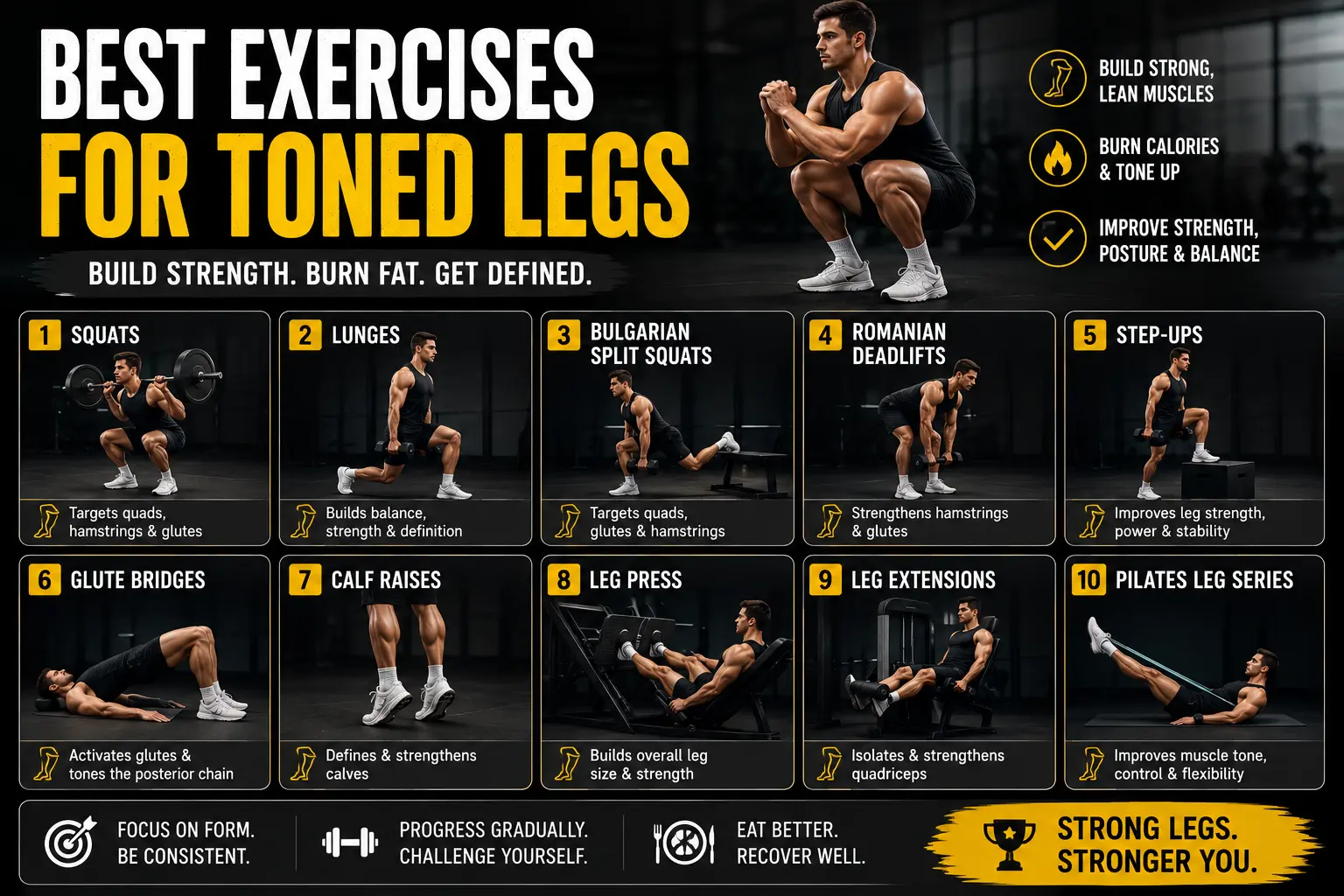
We’re going to keep the exercise section compact and purposeful. You don’t need 30 movements. You need a handful of exercises that cover the major functions of the lower body and give you room to progress.
| Movement pattern | Best exercise examples | Main muscles |
|---|---|---|
| Squat | Squat, chair squat | Quadriceps, glutes |
| Lunge | Reverse lunge, split squat | Quads, glutes, hamstrings |
| Hip hinge | Romanian deadlift, single-leg deadlift | Hamstrings, glutes |
| Hip extension | Glute bridge | Glutes, hamstrings |
| Step pattern | Step-up | Quads, glutes, calves |
| Calf work | Calf raise, relevé | Gastrocnemius, soleus |
Are Squats Good for Toned Legs?
Yes. Squats are one of the most useful lower-body exercises for building stronger, more defined legs because they train the quadriceps and glutes while coordinating movement at the hips, knees and ankles. They are also easy to scale from a beginner bodyweight squat to a loaded variation.
How to do a basic squat
- Stand with your feet approximately hip- to shoulder-width apart.
- Brace your midsection before descending.
- Push your hips back and bend your knees.
- Lower under control while keeping your feet firmly planted.
- Drive through the floor to stand.
Coach’s cue: Imagine you’re trying to spread the floor apart with your feet as you stand. It helps create active tension instead of simply dropping through the movement.
Make it easier
Use a chair squat. Lower toward a stable chair and stand again without collapsing into the seat.
Make it harder
Progress from:
Bodyweight squat → goblet squat → heavier loaded squat
The objective is not to make every repetition dramatic. It is to make the training stimulus gradually more demanding.
Research Insight
A 2026 American College of Sports Medicine position stand reviewed 137 systematic reviews involving more than 30,000 participants and concluded that progressive resistance training improves muscle strength, hypertrophy, power, endurance and physical function in healthy adults. The review also found that different resistance-training prescriptions can work, meaning there is no single “magic” load or exercise required for muscle development.
Are Lunges Better Than Squats for Toned Legs?
Neither is universally “better.” Lunges complement squats by training one leg at a time, challenging balance and coordination while strengthening the quadriceps and glutes. They are particularly useful when you want your program to include unilateral lower-body work.
Start with a reverse lunge if you’re new to lunges.
- Stand tall with your feet stable.
- Step one foot backward.
- Lower your body under control.
- Push through the front foot.
- Return to the starting position.
Coach’s cue: Think “drop straight down”, rather than throwing your front knee forward.
Once reverse lunges become comfortable, you can progress to walking lunges or loaded variations.
Are Bulgarian Split Squats Good for Toned Legs?
Yes. Bulgarian split squats provide a demanding single-leg training stimulus for the quadriceps and glutes while also challenging balance and hip stability. They are an excellent progression when ordinary lunges no longer provide enough challenge.
You don’t need heavy weights initially.
Start with bodyweight and use a wall or other stable support if balance is the limiting factor.
Coach’s cue: Lower slowly enough that you could pause at the bottom without wobbling. Then drive upward through the entire front foot.
If the rear-foot position feels awkward, use a regular split squat first.
Can Romanian Deadlifts Help Tone Your Legs?
Yes. Romanian deadlifts are particularly useful for the hamstrings and glutes because they train the hip-hinge pattern rather than relying mainly on knee bending. They give your program an important posterior-chain movement that squats and lunges don’t fully replace.
The movement should come primarily from your hips.
The basic pattern
- Hold the weight close to your thighs.
- Soften your knees.
- Push your hips backward.
- Keep the weight close to your legs.
- Stop when your hamstrings are substantially stretched.
- Drive your hips forward to stand.
Coach’s cue: Imagine there is a wall behind you and you’re trying to push your hips into that wall.
Don’t chase the floor.
Your range of motion ends when maintaining your position becomes difficult.
Are Step-Ups Good for Toned Legs?
Yes. Step-ups are a practical unilateral exercise that trains the quadriceps and glutes while challenging balance and coordination. They are particularly useful for home workouts because you need only an appropriately stable step or platform.
How to perform them
- Place your entire working foot on a stable platform.
- Lean slightly forward from the hips.
- Drive through the elevated foot.
- Stand tall on the platform.
- Lower under control.
Avoid using a high step simply to make the exercise look harder.
Coach’s cue: Imagine you’re pushing the platform down and away from you with the working foot.
Progress by increasing resistance, repetitions or platform height only when your technique remains controlled.
Do Glute Bridges Help Create More Defined Legs?
Yes. Glute bridges strengthen the gluteal muscles and train hip extension, making them a useful complement to squats, lunges and hip-hinge exercises. They are also accessible for beginners and require little or no equipment.
Lie on your back with your feet planted and knees bent.
Then:
- Brace your trunk.
- Drive through your feet.
- Lift your hips.
- Squeeze the glutes at the top.
- Lower slowly.
Coach’s cue: Don’t think about lifting your hips as high as possible. Think about bringing your belt buckle toward your ribs while keeping your lower back from taking over.
When bodyweight becomes easy, add a resistance band or appropriate external load.
Should You Train Your Calves for Toned Legs?
Yes. Calf raises train the gastrocnemius and soleus, helping develop strength and muscular definition around the lower leg. Calf work also gives the exercise selection better coverage because many leg routines focus heavily on the thighs and neglect the lower leg.
Start with:
Two-leg calf raises → single-leg calf raises → loaded calf raises
Perform the lowering phase slowly instead of bouncing.
Coach’s cue: Think about pushing the floor away through the ball of your foot, then lowering your heel under control.
Can Pilates Exercises Help Tone Your Legs?
Yes. Pilates-style movements can be useful for muscular endurance, control and lower-body coordination, especially when they complement rather than replace progressive resistance training. Side-lying leg lifts, controlled leg circles, pliés and relevés can add variety without turning the article into a separate Pilates program.
This is where we incorporate the current “lean sculpting” interest without making an unsupported claim that Pilates creates uniquely long or lean muscles.
Use Pilates-style work as an accessory:
- Side leg raises
- Controlled leg circles
- Pliés
- Relevés
- Glute-focused floor work
The key distinction:
Pilates can be part of a toned-leg routine; it isn’t a physiological shortcut around resistance training.
How Many Leg Exercises Do You Actually Need?
You do not need all 15 exercises in one workout. A productive session can be built from one squat pattern, one unilateral movement, one hip-hinge or hip-extension movement, and calf work, with additional exercises added according to your goals and training level.
A simple session might look like:
- Squat: primary knee-dominant movement
- Reverse lunge: unilateral work
- Romanian deadlift: posterior chain
- Glute bridge: hip extension
- Calf raise: lower-leg work
That is already enough movement variety to build a useful lower-body session.
The next question isn’t:
“What other exercise can I add?”
It’s:
“How will I make these exercises progressively more challenging?”
The 2026 ACSM position stand emphasizes progressive resistance training and found that resistance training improves muscle strength, size, power, endurance, and physical function.
This is the principle we’ll carry into the next section: sets, reps, frequency and progression.
Key Takeaways
You don’t need 15 leg exercises in every workout. Build your routine around a squat, unilateral movement, hip hinge or hip-extension exercise, and calf work. Then progressively increase the challenge rather than constantly adding new exercises.
How Many Sets and Reps Should You Do for Toned Legs?
There is no special “toning” rep range. For a more defined lower body, use enough resistance and training volume to challenge the muscles, then gradually increase the difficulty. A practical starting point is 2–3 sets per exercise, with roughly 8–15 controlled repetitions for most compound leg movements and higher repetitions for smaller accessory exercises.
The important variable is not whether you perform exactly 10, 12, or 15 repetitions. It is whether the exercise remains sufficiently challenging and whether your training progresses over time.
A practical starting framework
| Exercise type | Sets | Reps | Main purpose |
|---|---|---|---|
| Squats / split squats | 2–3 | 8–15 | Strength + muscle development |
| Lunges / step-ups | 2–3 | 8–15 each leg | Unilateral strength |
| Romanian deadlifts | 2–3 | 8–15 | Hamstrings + glutes |
| Glute bridges | 2–3 | 10–15 | Hip extension |
| Calf raises | 2–3 | 12–20 | Lower-leg strength |
| Band/accessory work | 2–3 | 12–20 | Muscular endurance + additional volume |
These are programming starting points, not biological rules. Your training history, exercise selection, available resistance, recovery, and goals should determine how you progress.
Research Insight
The current ACSM position stand on resistance training reviewed 137 systematic reviews and concluded that resistance training improves muscle strength, hypertrophy, power, endurance and physical function. The broader takeaway is more important than any single repetition prescription: progressive resistance training works across different training approaches, so there is no magic “toning” number of reps.
How Often Should You Train Your Legs?
Training your major muscle groups at least twice per week is a strong general starting point for healthy adults. WHO recommends muscle-strengthening activities involving all major muscle groups on 2 or more days per week, alongside regular aerobic activity.
For someone specifically working toward toned legs, two focused lower-body sessions can be enough to build a consistent foundation.
You could structure your week like this:
| Day | Activity |
|---|---|
| Monday | Lower-body strength |
| Tuesday | Walking / cardio |
| Wednesday | Recovery or easy movement |
| Thursday | Lower-body strength |
| Friday | Walking / cardio |
| Saturday | Optional activity |
| Sunday | Recovery |
You don’t have to train your legs hard every day.
In fact, repeatedly hammering the same muscles can make it harder to maintain quality sessions.
Key Takeaways
Two good leg sessions beat five rushed ones. Start with a manageable schedule, make the exercises progressively harder, and give your legs enough recovery to perform well again.
How Do You Progress a Toned-Leg Workout?
Progress your leg workout by gradually increasing the challenge rather than constantly replacing exercises. You can add resistance, perform more controlled repetitions, increase the number of sets, improve range of motion, or move to a more demanding variation.
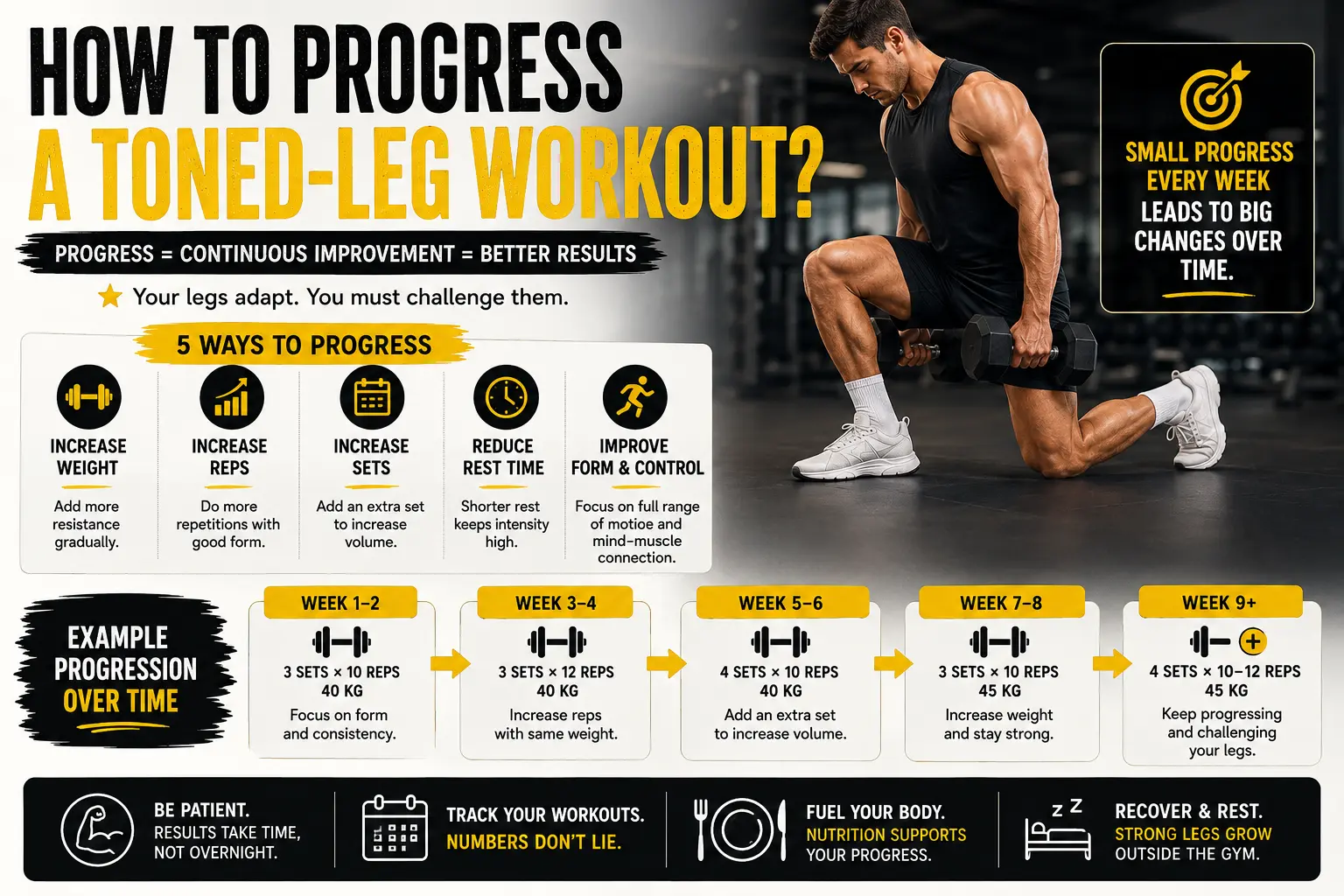
A simple progression might look like:
Bodyweight squat → more repetitions → goblet squat → heavier goblet squat
Or:
Reverse lunge → more controlled repetitions → dumbbell reverse lunge → heavier dumbbells
The key is to change one variable at a time when possible.
When Should You Increase Resistance or Repetitions?
Increase the challenge when you can consistently complete the upper end of your planned repetitions with solid technique and still have room to perform the movement safely. Don’t add weight simply because a calendar says it is “progression week.”
Use this sequence:
- Own the technique.
- Reach the top of your target rep range.
- Increase resistance slightly or choose a harder variation.
- Return toward the lower end of the rep range.
- Build the repetitions again.
For example:
Goblet squat — 10 kg × 10 reps
→ eventually 10 kg × 15 reps
→ increase to 12 kg × 8–10 reps
→ gradually build back toward 12–15 reps.
That’s progressive overload without turning every workout into a test of maximum strength.
Coach’s Note
If your last few repetitions look completely different from your first few, don’t add weight yet. A heavier dumbbell is not progress if your knees, hips or back have to compensate for it. Clean movement comes first; additional load comes second.
WHO’s current recommendations also emphasize gradually building physical activity, particularly for people starting from lower activity levels.
The real goal of progression
Don’t ask:
“How many exercises can I do today?”
Ask:
“Can I perform this movement better or more challenging than I could a few weeks ago?”
That shift is what turns a collection of leg exercises into an actual toned-leg training program.
How Long Does It Take to Get Toned Legs?
There is no fixed timeline for toned legs because visible definition depends on your starting muscle mass, body composition, training history, genetics, nutrition, and consistency. You may notice improved strength and exercise control before obvious visual changes.
A better expectation is to track progress over weeks and months, not judge your legs every few days.
Can You Get Toned Legs in 30 Days?
You can make measurable progress in 30 days, but a dramatic transformation is not a realistic promise. Use the first month to establish consistent training, improve technique, and begin progressively increasing the challenge.
Track:
- Resistance or repetitions
- Exercise technique
- Leg measurements, if useful
- Consistent progress photos
- How your clothes fit
Key Takeaways
Don’t chase a “30-day toned legs” promise. Chase measurable improvements in strength, consistency and body composition.
Can Exercise Reduce the Appearance of Cellulite on Your Legs?
Exercise may improve the appearance of cellulite by strengthening underlying muscle and supporting healthy body composition, but it cannot guarantee that cellulite will disappear. Cellulite is not simply excess body fat; its appearance is influenced by the structure of connective tissue beneath the skin.
This is why losing weight does not automatically eliminate cellulite, and why lean, fit people can still have visible cellulite.
Can Strength Training Improve Cellulite Appearance?
It can help make the legs look firmer by developing the muscles underneath the skin. Squats, lunges, step-ups, Romanian deadlifts and glute bridges are useful choices because they train large lower-body muscle groups.
Foam rolling, massage and compression garments may have specific recovery or comfort uses, but they should not be presented as proven cellulite-removal methods.
Research Insight
Cellulite is considered a multifactorial condition involving subcutaneous tissue and connective-tissue structure. Exercise can improve muscle development and body composition, but no exercise reliably removes cellulite completely.
Bottom line: aim for stronger, better-conditioned and more defined legs, rather than promising cellulite-free skin.
What Should You Eat for Toned Legs?
Your diet should support muscle recovery while matching your overall body-composition goal. Protein provides amino acids needed for muscle repair, while carbohydrates support training and fats contribute to overall nutritional adequacy.
For active adults, a commonly cited evidence-based protein range is approximately 1.4–2.0 g/kg/day, although individual needs vary.
Prioritize:
- Protein-rich foods
- Vegetables and fruit
- Whole-food carbohydrate sources
- Healthy fats
- Adequate fluids
If reducing body fat is part of your goal, use a sustainable calorie deficit, rather than drastically cutting food and undermining your training.
You don’t need a “toning diet.”
You need nutrition that supports the result you’re actually pursuing.
What Mistakes Stop Your Legs From Looking More Defined?
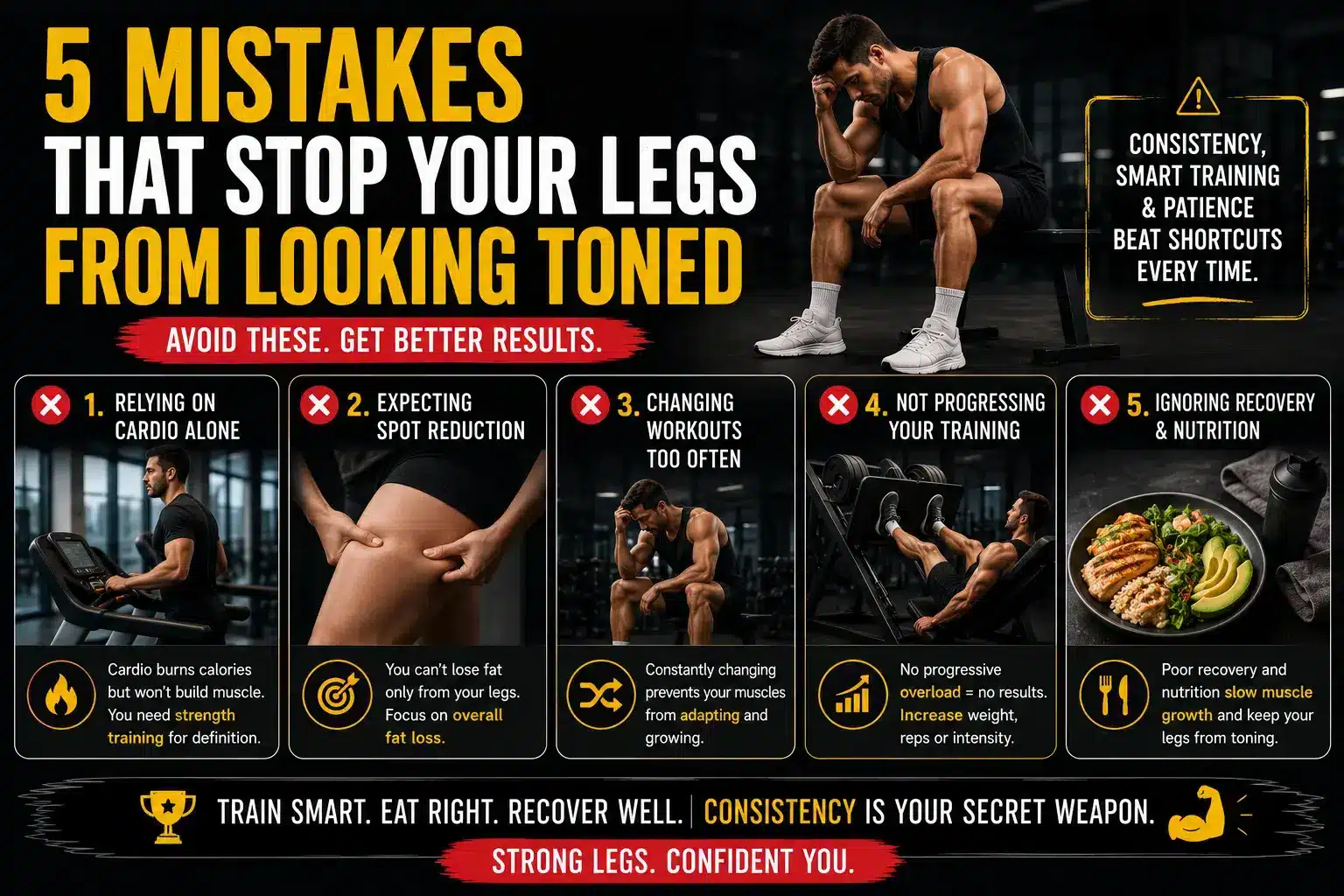
The most common mistakes are relying only on cardio, avoiding resistance training, expecting spot reduction, constantly changing workouts, and never increasing the training challenge.
Are You Relying on Cardio Alone?
Cardio improves fitness and activity levels, but progressive resistance training provides a more direct stimulus for developing leg muscle.
Are You Expecting Spot Reduction?
You cannot reliably choose where your body loses fat. Training your thighs does not guarantee that fat will be lost specifically from your thighs.
Are You Changing Workouts Too Often?
Your muscles need a repeated stimulus to adapt. Changing exercises every few days can make progression difficult to measure.
Are You Training Without Progressing?
If the same exercise remains equally easy for months, the stimulus may no longer be challenging enough.
Coach’s Takeaway
Don’t add more exercises when you actually need more progression. Before adding another movement, ask whether you can increase the resistance, repetitions, control or difficulty of the exercises you’re already doing.
How Can You Recover Between Leg Workouts?
Recovery allows your body to adapt to training, so hard leg sessions should be balanced with adequate rest, sleep, nutrition, and easier activity. You do not need to train your legs hard every day to make them more defined.
A practical approach is:
- Leave recovery time between demanding lower-body sessions.
- Sleep adequately.
- Eat enough protein and overall nutrients.
- Use walking or easy movement on recovery days.
- Reduce training volume temporarily if performance and recovery deteriorate.
Stretching or foam rolling can be included if they help you feel better, but they are not substitutes for recovery itself.
A Simple 4-Week Toned-Leg Workout Plan
A four-week plan should focus on consistency first, then gradually increase the training challenge. Two structured lower-body sessions per week are enough to establish a practical foundation while allowing room for walking or other cardio.
| Week | Strength training | Cardio / movement | Progression |
|---|---|---|---|
| 1 | 2 leg sessions | 2–3 walking sessions | Learn technique |
| 2 | 2 leg sessions | 2–3 sessions | Add repetitions |
| 3 | 2 leg sessions | 2–3 sessions | Add resistance where appropriate |
| 4 | 2–3 sessions | 2–3 sessions | Increase resistance or exercise difficulty |
Sample strength session
| Exercise | Sets × Reps |
|---|---|
| Squat | 3 × 8–12 |
| Reverse lunge | 3 × 8–12/leg |
| Romanian deadlift | 3 × 8–12 |
| Glute bridge | 2 × 12–15 |
| Calf raise | 2–3 × 12–20 |
Rest between demanding sessions rather than repeating the same workout every day.
Frequently Asked Questions
How Do I Tone My Legs?
Combine progressive resistance training with regular physical activity and nutrition appropriate to your body-composition goal. Focus on squats, lunges, hip-hinge movements, step-ups, bridges and calf exercises, then progressively increase the challenge.
How Can I Tone Up My Legs Fast?
There is no safe shortcut that guarantees rapid toning of legs. Consistent resistance training, regular movement and appropriate nutrition produce more sustainable results than extreme workouts or crash diets.
What Is the Best Exercise to Tone Legs?
There is no single best exercise. Squats, lunges, split squats, Romanian deadlifts, step-ups, bridges and calf raises each train different parts of the lower body and work better as a balanced program.
Does Walking Tone Your Legs?
Walking can strengthen and condition the legs, especially when performed briskly or on inclines, but it does not replace progressive resistance training for muscle development. Use walking as a complement to strength training.
Will Running Tone My Legs?
Running can improve leg conditioning and cardiovascular fitness, but running alone does not guarantee a visibly toned appearance. Pair running with resistance training if muscle definition is a priority.
How Long Does It Take to Tone Legs?
There is no universal timeline. Strength and exercise performance may improve before visible changes, while definition depends on muscle development, body composition, genetics, nutrition and consistency.
Can Flabby Legs Become Toned?
You can improve leg strength, muscle development and body composition, which may make the legs appear firmer and more defined. The amount of change depends on your starting point and individual physiology.
Conclusion
Toned legs come from building or maintaining muscle while improving overall body composition—not from one magical exercise. Make progressive lower-body resistance training the foundation, add regular walking or other cardio, eat appropriately for your goal, and give your body enough recovery.
You don’t need dozens of exercises.
You don’t need to train your legs every day.
And you don’t need a “30-day miracle.”
Choose effective movements, progressively challenge them, stay active, recover well, and measure your progress over time. That is the practical route to stronger, more defined legs.