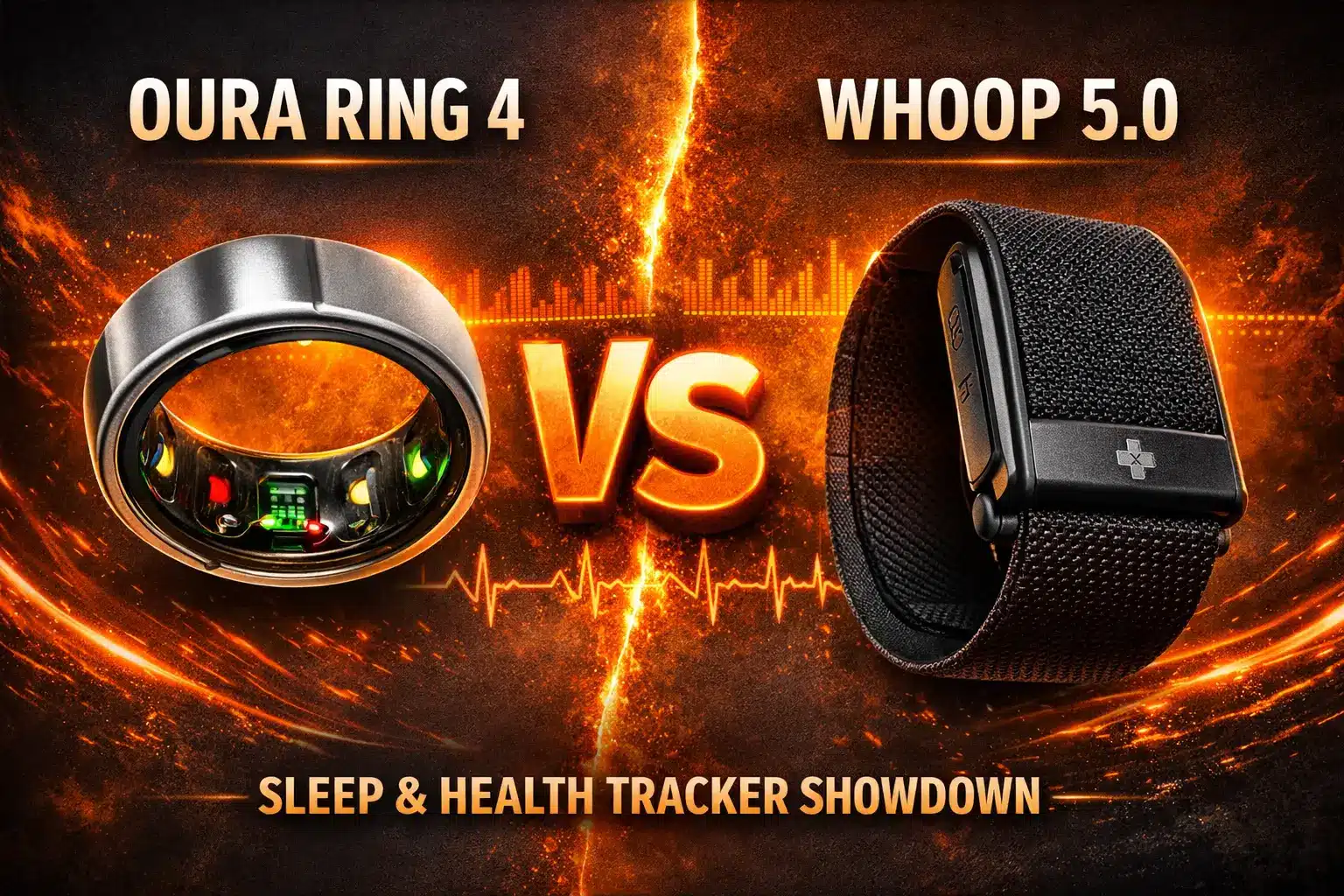


Wearable technology has officially entered its Longevity Era. We’re no longer just counting steps or burning calories; we are managing sleep architecture, circadian rhythm alignment, and long-term biological resilience.
That’s why the head-to-head comparison between Oura Ring 4 vs. WHOOP 5.0 has intensified. Both platforms promise clinical-grade health insights in screen-free form factors, but they are built for entirely different user profiles and physical demands.
If you are looking to optimize your sleep quality, manage recovery strain, and make a smart financial investment without falling into subscription traps, this guide breaks down the underlying sensor technology, algorithm accuracy, 3-year ownership costs, and real-world durability.
Quick Takeaways (30-Second Summary)
Choose Oura Ring 4 if: You want invisible 24/7 sleep tracking, discrete temperature monitoring, and a sleek titanium ring that blends into formal settings with a low ongoing monthly fee ($5.99/mo).
Choose WHOOP 5.0 if: You lift heavy barbells, do CrossFit, or play contact sports where wearing a metal finger ring poses a pinch/degloving safety risk, and your primary goal is tracking cardiovascular strain and athletic recovery readiness.
Quick Comparison: 2026 Specs At A Glance
While both devices operate screen-free to minimize digital distractions and prevent notification fatigue, their physical hardware architectures couldn’t be more different.
The Oura Ring 4 packs multi-wavelength optical PPG sensors into an ultra-lightweight titanium ring body engineered for 24/7 passive wear. In contrast, the WHOOP 5.0 utilizes an Any-Wear™ module that can be worn via a wrist strap, bicep band, or integrated directly into specialized compression garments.
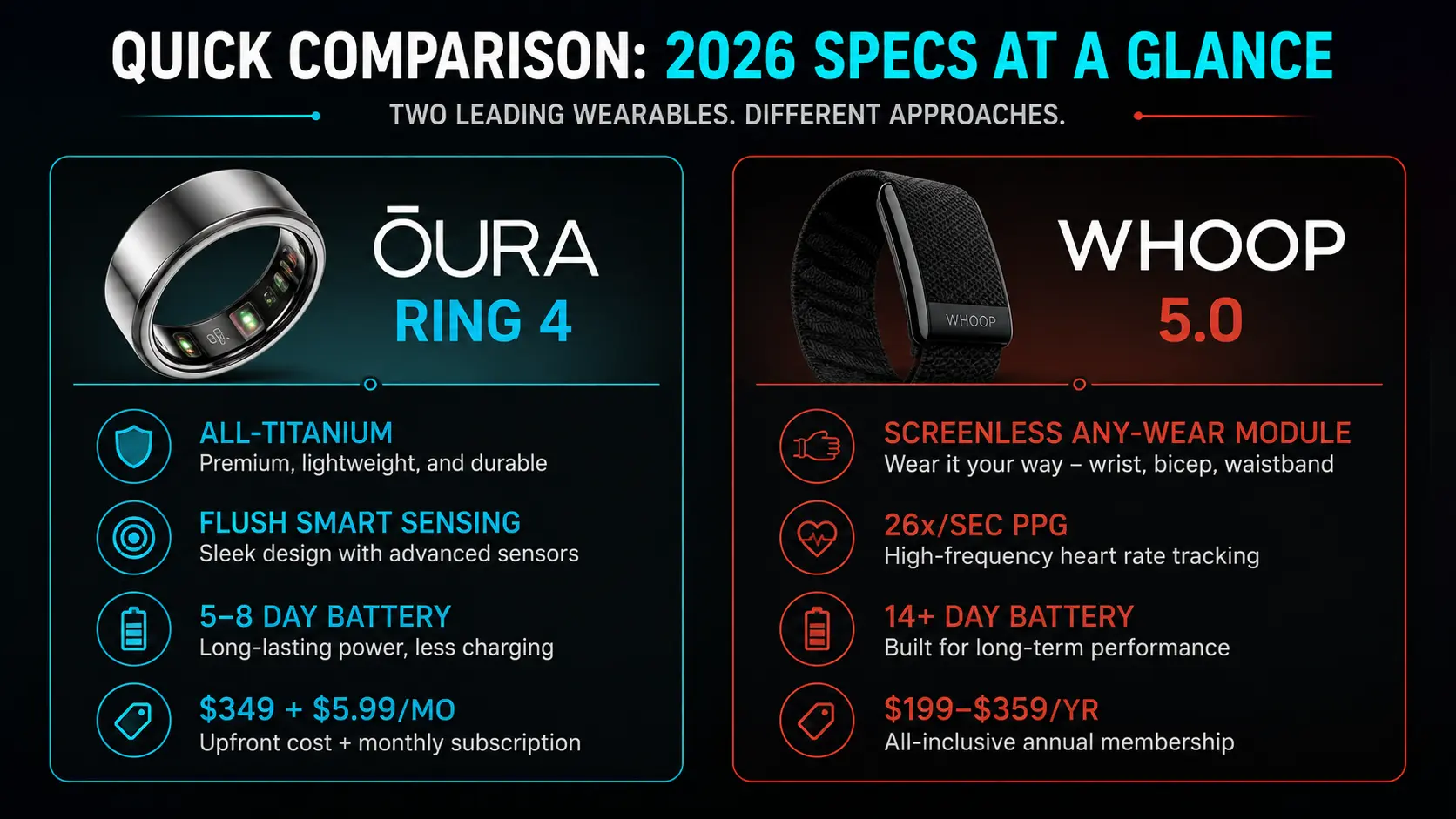
| Hardware & Spec Metric | Oura Ring 4 | WHOOP 5.0 (Base / MG Edition) |
| Form Factor | All-Titanium Smart Ring (Sizes 4–15) | Screenless Any-Wear™ Modular Sensor |
| Wearable Placement | Finger (Dominant or Non-Dominant Index/Middle) | Wrist, Bicep, Torso (WHOOP Body Garments) |
| Weight & Dimensions | 3.3g – 5.2g | ~2.88mm thickness | ~26.5 grams | 34.7mm x 24mm x 10.6mm |
| New 2026 Features | AI Oura Advisor & Recessed Smart Sensing | Healthspan (WHOOP Age), ECG & Blood Pressure Trends |
| Core Signature Metric | Circadian Rhythm & Sleep Staging Optimization | High-Frequency Strain & Recovery Precision Coaching |
| Battery Life | 5 to 8 Days (Single Charge) | 14+ Days (Standard) / Up to 30 Days (w/ PowerPack) |
| Water Resistance | 100 meters (328 feet / 10 ATM) | IP68 Submersible up to 10 meters |
| Upfront Hardware Cost | $349 (One-time purchase) | $0 (Included with membership tier) |
| Subscription Fee | $5.99 / month (or $69.99 / year) | $199/yr (One), $239/yr (Peak), $359/yr (Life/MG) |
| 3-Year Total Cost | ~$558.97 | ~$597.00 – $1,077.00 (Depending on tier) |
Key Hardware Upgrades for 2026
Oura Ring 4: Recessed Smart Sensing Platform
The standout hardware innovation in the Oura Ring 4 is the transition to Recessed Smart Sensing technology. Previous generations used raised interior epoxy bumps to press PPG sensors into the skin.
Oura Ring 4 smooths out these interior bumps, embedding multi-wavelength LEDs flush against the titanium inner wall. This not only dramatically improves wearing comfort during overnight sleep, but it also increases signal path quality by up to 120%, resulting in a 30% reduction in nocturnal blood oxygen (SpO2) dropout gaps.
WHOOP 5.0: Enhanced Sensor Array And 14-Day Power Efficiency
WHOOP 5.0 delivers a 7% reduction in physical module size compared to its predecessor while packing a redesigned processor that operates with 10x greater power efficiency.
Sampling biometrics 26 times per second, WHOOP 5.0 pushes standard battery intervals to 14+ full days on a single charge. Furthermore, the premium WHOOP 5.0 MG edition introduces hardware-level conductive clasp elements, enabling on-demand, single-lead ECG heart screenings and blood pressure trend estimations.
Finger Ring vs. Fabric Strap Friction
The Oura Ring 4 Advantage: Weighing under 5 grams, the Oura Ring 4 feels essentially invisible during everyday activities, office work, and sleep. It requires no washing, doesn’t trap moisture against the skin, and looks like premium jewelry.
The WHOOP 5.0 Advantage: Because finger rings experience severe metal-on-metal friction during dumbbell, kettlebell, or barbell strength training, and present a dangerous ring-pinch risk, WHOOP’s fabric band (or bicep sleeve) is infinitely superior for heavy strength athletes, combat sports practitioners, and high-impact training.
Sleep Optimization Tips: How These Devices Actually Improve Sleep
To rank for sleep optimization, basic sleep duration or total hours in bed are no longer enough. Modern sleep architecture research focuses on how efficiently your body enters, maintains, and recovers during essential Deep Sleep (Slow-Wave Sleep) and REM (Rapid Eye Movement) stages.
The gold standards for high-quality sleep are adenosine clearance, circadian rhythm alignment, and thermal regulation. Both the Oura Ring 4 and WHOOP 5.0 are built around this shift.
Sleep Architecture: Oura Ring 4 vs. WHOOP 5
| Sleep Pillar | Physiological Goal | Oura Ring 4 Approach | WHOOP 5.0 Approach |
| Circadian Alignment | Sync body clock with sleep window | Smart Sensing chronotype mapping & bedtime range prompts | Sleep Consistency Tracking (% variation in sleep onset) |
| Adenosine Clearance | Flush metabolic sleep pressure | Sleep Efficiency and nocturnal RHR stabilization timing | Dynamic Sleep Need algorithm tied to daily strain |
| Thermal Regulation | Prevent micro-awakenings | Continuous skin temp trends tagged to lifestyle habits | Recovery Suppression alerts triggered by thermal spikes |
No Wearable? Use the 90-Minute Biological Rule
If you don’t use a high-end tracker, you can align your sleep manually using our free Sleep Calculator. Human sleep naturally cycles through Light-Deep-REM stages in 90-minute blocks. Timing your wake-up time to coincide with the end of a 90-minute cycle reduces sleep inertia, leaving you refreshed without an expensive device.
Protect and Align Your Circadian Rhythm
Your circadian rhythm is your body’s master clock. It governs melatonin secretion, cortisol timing, core body temperature, and daily energy levels. When this rhythm is misaligned, even by 60 to 90 minutes, sleep quality drops sharply.
Oura Ring 4 uses its upgraded Smart Sensing platform to map your ideal sleep window with much higher precision than earlier generations. Instead of relying on rigid bedtime rules, it evaluates three continuous metrics:
- Heart Rate Decline Timing: Tracks how early in the night your resting heart rate reaches its baseline.
- Core Body Temperature Baselines: Detects the physiological cooling shift that signals natural sleepiness.
- Sleep Efficiency History: Calculates actual time asleep versus time spent tossing and turning.
Why Circadian Optimization Matters
Sleeping outside your biological window causes:
- Elevated Sleep Onset Latency: Staring at the ceiling waiting to drift off.
- Suppressed REM Sleep: Reduced emotional processing and memory consolidation.
- Fragmented Sleep Cycles: Increased nighttime micro-awakenings.
Support Adenosine Clearance for Deeper Sleep
Adenosine is the neurochemical “sleep pressure” that builds up while you are awake and flushes out during slow-wave deep sleep. Incomplete adenosine clearance causes morning brain fog, even after 8 hours in bed.
Both devices track indicators that correlate with adenosine clearance:
- Oura Ring 4 Focus: Evaluates the duration of uninterrupted deep sleep and alerts you if late-night meals or alcohol delayed your body’s recovery window.
- WHOOP 5.0 Focus: Links adenosine clearance directly to daily physical and nervous system load. If yesterday’s strain was high, WHOOP’s algorithm automatically increases your Sleep Need target for the night.
Detect and Reduce Micro-Overheating Events
Micro-overheating refers to subtle, brief increases in skin temperature that fragment REM and deep sleep without fully waking you up.
Both devices detect these thermal deviations, but approach them differently:
- Oura Ring 4 (Behavioral Patterning): Identifies environmental lifestyle triggers, helping you determine whether overnight heat spikes stem from late eating, alcohol, or room temperature.
- WHOOP 5.0 (Recovery Impact): Quantifies how thermal stress suppresses your next-day Recovery Score, proving that minor bedroom overheating directly impairs physical readiness.
Practical Takeaway: Which Sleep Approach Wins?
| Lifestyle & Sleep Goal | Best Matching Wearable | Primary Reason |
|---|---|---|
| Predictable, Calm, Long-Term Sleep Habits | Oura Ring 4 | Focuses on passive biological alignment, non-intrusive ring comfort, and chronotype habits. |
| Maximal Athletic Recovery Under Heavy Strain | WHOOP 5.0 | Focuses on dynamic recovery engineering, adjusting sleep targets based on workout strain. |
Sleep Tracking And HRV Accuracy: Oura Ring 4 vs. WHOOP 5.0
When evaluating Oura Ring 4 sleep accuracy against WHOOP 5.0 HRV precision, accuracy is less about which device collects more volume of raw data and more about how consistently that data reflects your true biological baselines over time.
In 2026, the gold standard for wearable sleep tracking is no longer perfect sleep-stage labeling on a single isolated night. Instead, search algorithms and physiological research evaluate four structural factors:
- Wearable Sensor Stability: Maintaining flush skin contact throughout active REM and toss-and-turn sleep.
- Motion Artifact Reduction: Filtering out movement noise during involuntary body shifts.
- Continuous HRV Baseline Tracking: Measuring Heart Rate Variability trends over multi-day windows rather than erratic single-night spikes.
- Deviation Detection: Identifying meaningful physiological stress, illness, or recovery signals relative to your personal baseline.
Biometric Accuracy & Hardware
| Accuracy & Metric Category | Oura Ring 4 Performance | WHOOP 5.0 Performance |
| Primary PPG Sensor Technology | Recessed multi-wavelength Smart Sensing optical LEDs | High-frequency 5-LED optical PPG array (26x/sec sampling) |
| Motion Artifact Suppression | High (Finger Base): Flush titanium inner wall minimizes ring rotation | Very High (Bicep/Body): Suppresses wrist flexion interference |
| Polysomnography (PSG) Correlation | ~88% agreement in total sleep time & deep sleep staging | ~90%+ agreement in total sleep time & REM/SWS staging |
| HRV Sampling Window | Multi-night baseline smoothing (Low psychological anxiety) | Last Deep Sleep cycle sampling (High-sensitivity strain reaction) |
| Best Clinical Use Case | Long-term sleep architecture & passive longevity tracking | Athletic recovery precision & high-intensity strain coaching |
Oura Ring 4: Passive Longevity Accuracy
Oura Ring 4 addresses one of the most overlooked causes of biometric error in smart rings: physical sensor movement during sleep.
By eliminating raised epoxy interior bumps and introducing a completely flush titanium inner wall, the ring rests evenly against the finger throughout the night. This design eliminates micro-rotations—the leading cause of optical photoplethysmography (PPG) dropout gaps and erratic HRV readings.
Multi-Night HRV Baselines vs. Single-Night Spikes
Rather than reacting to single-night Heart Rate Variability drops, Oura evaluates multi-night HRV baselines. This long-term trend approach helps users:
- Detect Chronic Stress: Differentiates between a single poor night of sleep and systemic autonomic nervous system burnout.
- Monitor Illness Recovery: Tracks body temperature deviations and resting heart rate (RHR) stabilization to forecast immune response.
- Support Psychological Sustainability: Contextualizes temporary HRV dips without causing health anxiety or alarmist alerts.
Sleep Stage Reliability And Form Factor
Oura Ring 4 excels at measuring Sleep Onset Latency, tracking uninterrupted slow-wave sleep, and monitoring long-term REM proportions. While no finger-worn sensor replaces a clinical 12-channel Polysomnography (PSG) lab test, Oura’s directional trend reliability leads the consumer ring market.
- Ideal User Profile: Side sleepers, light sleepers, corporate executives, and individuals prioritizing circadian alignment, sleep consistency, and passive longevity.
WHOOP 5.0: High-Frequency Recovery Precision
WHOOP 5.0 approaches accuracy through raw computational power, collecting optical heart rate and biometric data 26 times per second.
This continuous, high-density sampling lets WHOOP’s revised algorithm capture micro-fluctuations in heart rate, rapid autonomic nervous system shifts, and acute physiological stress responses.
HRV Sensitivity And Athletic Strain Matching
WHOOP measures HRV during your final Deep Sleep cycle to establish an uncorrupted cardiovascular baseline. Its recovery algorithm reacts rapidly to:
- Training Load & Muscle Strain: Adjusts daily readiness targets based on previous workouts.
- Alcohol & Systemic Stress: Quantifies immediate HRV suppression caused by late-night drinking or overtraining.
- Recovery Readiness: Provides prescriptive coaching instructions on whether to push or rest.
Any-Wear™ Placement & Signal Fidelity
WHOOP’s accuracy depends heavily on sensor placement. Worn on the wrist, heavy wrist flexion during barbell lifting or high-impact functional fitness can introduce motion artifacts. Transferring the module to a WHOOP Bicep Band or compression body-wear drastically suppresses motion noise, yielding clinical-grade heart rate accuracy.
- Ideal User Profile: Competitive athletes, CrossFit practitioners, weightlifters, and high-performance individuals seeking daily recovery feedback.
Key Distinction: Sleep Quality Trends vs. Daily Strain Recovery
- Oura Ring 4 measures whether your sleep habits, thermal regulation, and circadian rhythms are building long-term biological resilience.
- WHOOP 5.0 measures how last night’s sleep architecture dictates your immediate physical output capability today.
Practical Accuracy Verdict
| Target Goal | Best Matching Device | Primary Accuracy Advantage |
|---|---|---|
| Passive Longevity & Sleep Consistency | Oura Ring 4 | Stable, low-noise sensor contact for reliable multi-week sleep & HRV trends. |
| High-Intensity Strain & Adaptive Coaching | WHOOP 5.0 | High-frequency 26x/sec sampling that adapts instantly to daily workouts. |
The Hidden Cost of Health: Subscription Fatigue And 3-Year Ownership Analysis
In 2026, buyers no longer evaluate health wearables purely on physical sensors or sleek app designs. Pricing psychology and long-term financial commitment now play a decisive role, especially as subscription fatigue continues to rise across mobile apps, fitness platforms, and continuous monitoring tools.
At first glance, the Oura Ring 4 and WHOOP 5.0 may appear to carry comparable long-term price tags. In reality, their fundamental pricing architectures create vastly different user experiences, psychological pressures, and ongoing commitment demands.
3-Year Cost of Ownership (Realistic Breakdown)
| Financial Metric | Oura Ring 4 (Titanium Base) | WHOOP 5.0 (Base / Peak Tier) | WHOOP 5.0 (Life / MG Tier) |
| Upfront Hardware Cost | $349.00 (One-time purchase) | $0.00 (Included with sub) | $0.00 (Included with sub) |
| Month 1 Cost | $349.00 + $0 (1st Month Free) | Included in annual plan | Included in annual plan |
| Ongoing Subscription Fee | $5.99 / month (or $69.99 / year) | $199.00 / year (One) / $239 / yr (Peak) | $359.00 / year (Life) |
| Year 1 Total | $348.99 | $199.00 – $239.00 | $359.00 |
| Year 2 Cumulative | $418.98 | $398.00 – $478.00 | $718.00 |
| Year 3 Cumulative Total | ~$488.97 – $558.97 | ~$597.00 – $717.00 | ~$1,077.00 |
Financial Breakdown: While WHOOP 5.0 boasts a lower entry barrier in Year 1 ($199 vs. $349), Oura Ring 4 becomes the more economical choice by Year 3. Over a standard 36-month lifecycle, WHOOP’s annual renewals cost between $40 and $518 more than Oura’s hardware + low-tier membership model.
Ownership vs. Access: Why It Matters Psychologically
The psychological difference between buying a physical asset and renting access to a service changes how users interact with their health data.
| Psychological Dimension | Oura Ring 4 (Asset Model) | WHOOP 5.0 (SaaS Model) |
|---|---|---|
| Asset Rights | You own the hardware. The ring remains physical property regardless of billing status. | You rent access. The strap is a gateway to an ongoing SaaS subscription. |
| Subscription Pause Impact | Basic daily readiness scores remain viewable; hardware operates normally. | Total shutdown. Data logging stops, app locks out, and hardware deactivates. |
| User Pressure | Low pressure. Encourages calm, long-term health observation over years. | High pressure. Users feel obligated to “earn” or justify the $200–$360 annual fee. |
Oura’s Asset Ownership Model
Oura Ring 4 feels like a permanent piece of personal technology. If you choose to pause your $5.99/month subscription:
- The physical ring still functions on your finger.
- Primary daily Scores (Sleep, Readiness, and Activity) remain accessible.
- The device retains its identity, aesthetic, and functional value as a discrete health monitor.
This model fosters long-term, low-pressure usage—ideal for individuals tracking long-term longevity, baseline HRV trends, and sleep consistency.
WHOOP’s Membership-Dependent Model
WHOOP 5.0 operates purely as a Service (SaaS). If your annual membership lapses:
- App access and biometric data logging lock down completely.
- The physical wrist module becomes effectively inactive.
- Users face constant friction to continuously “justify” the ongoing annual expense.
This high-accountability model works exceptionally well for elite athletes in active training blocks, but often creates subscription fatigue for lifestyle users.
Subscription Fatigue: A Growing Trend
Subscription fatigue isn’t just about money; it is about mental load and health anxiety.
Modern health tracking users report three major friction points with high-tier subscription platforms:
- “Wasted Money” Guilt: Missing a workout or taking a necessary week-long recovery break feels like wasting paid subscription days.
- Rest-Day Anxiety: High-frequency daily scoring can make rest days feel like “failures” rather than necessary physiological resets.
- Continuous Optimization Burnout: Constantly striving to optimize strain scores can lead to overtraining and app fatigue.
For these users, Oura’s lighter $5.99/month subscription feels far more sustainable. It emphasizes steady lifestyle patterns over daily perfection, helping users stay passively engaged without constant self-optimization pressure.
WHOOP, by contrast, thrives on engagement intensity. Its value increases the more closely you follow its strain, recovery, and sleep-need recommendations, empowering disciplined athletes but overwhelming casual users.
Value Alignment: Which Model Fits Your Lifestyle?
| User Persona | Recommended Model | Primary Reason |
|---|---|---|
| Longevity & Healthspan Seekers | Oura Ring 4 | Low-friction 24/7 wear with minimal monthly fees and long-term baseline trends. |
| Busy Professionals & Executives | Oura Ring 4 | Passive sleep & stress tracking that doesn’t demand high-intensity daily workout logging. |
| Competitive & Functional Athletes | WHOOP 5.0 | High-accountability strain coaching where performance improvements justify the annual fee. |
| High-Stress Performance Cycles | WHOOP 5.0 | Immediate, high-frequency recovery feedback during intense training or work blocks. |
Key Takeaways
The real decision isn’t which device is cheaper on day one; it comes down to a fundamental question:
Do you want a wearable that quietly supports your health baselines, or a service that actively pushes you to perform?
- Oura’s cost model supports long-term consistency, calm observation, and lower financial pressure.
- WHOOP’s cost model supports active accountability, athletic strain, and high-intensity coaching.
Sleep Earbuds: Alternatives Worth Knowing in 2026
As sleep technology evolves, more users find finger rings uncomfortable during sleep or fabric body straps too restrictive. This has driven massive growth in sleep-focused earbuds, a category designed not to monitor long-term physiological trends, but to optimize sleep initiation, noise isolation, and environmental control.
To understand where sleep earbuds fit, and where they fall short, it helps to analyze how they complement wearables like Oura Ring 4 and WHOOP 5.0 in a complete 2026 sleep ecosystem.
| Category | Environmental Control | Biometric Monitoring |
| Primary Device | Sleep Earbuds / Audio | Oura Ring 4 / WHOOP 5.0 |
| Core Functions | • Active & Passive Noise Masking • Neural Entrainment & Pink Noise • Rapid Sleep Onset Induction | • Continuous HRV & Sleep Staging • Circadian & Temperature Baselines • Long-Term Recovery Engineering |
The Core Benefits of Sleep Earbuds
Sleep earbuds are engineered around a single primary objective: helping you fall asleep faster and preventing micro-awakenings caused by environmental noise.
1. Active & Adaptive Noise Masking
Unlike standard consumer noise-canceling earbuds that block daytime traffic, dedicated sleep earbuds (such as the Ozlo Sleepbuds and Soundcore Sleep A30) combine ultra-thin side-sleeper silicone profiles with adaptive sound masking.
Rather than relying purely on Active Noise Cancellation (ANC), which can introduce uncomfortable ear-canal pressure during overnight wear, sleep earbuds overlay steady, research-backed acoustic frequencies over sudden external sounds.
- Snoring Partners: Dampens erratic high-frequency breathing spikes.
- Urban & Traffic Noise: Smooths out environmental city noise.
- Irregular Household Sounds: Minimizes nighttime disruptions that fragment REM and Deep sleep stages.
2. Neural Entrainment & Acoustic Pink Noise
Modern sleep earbuds leverage specialized audio profiles to tune brainwave activity during sleep onset:
- Pink Noise: Features deeper, lower-frequency sounds than white noise (similar to steady rain or ocean waves). Clinical trials show pink noise helps synchronize brain waves during slow-wave sleep, indirectly supporting adenosine clearance and reducing sleep inertia.
- Binaural Beats: Delivers slightly different audio frequencies to each ear, nudging the brain into relaxed Alpha and Delta wave states to accelerate sleep latency reduction (falling asleep faster).
Where Sleep Earbuds Fall Short
Despite their immediate environmental benefits, sleep earbuds are not a replacement for health-tracking wearables.
| Critical Feature Gap | Sleep Earbuds (Ozlo / Soundcore) | Oura Ring 4 / WHOOP 5.0 |
|---|---|---|
| Autonomic Nervous System Tracking | No HRV, RHR, or Stress Metrics | Full Continuous Tracking |
| Biological Architecture Analysis | Basic motion/time estimation only | Clinical-Grade Staging & SpO2 |
| Thermal & Circadian Insights | None | Skin Temp & Chronotype Mapping |
| Long-Term Healthspan Coaching | None | Prescriptive Strain & Sleep Need |
The Core Difference:
- Sleep Earbuds act as an environmental intervention to help you fall asleep.
- Oura Ring 4 & WHOOP 5.0 act as diagnostic engines to help you understand, measure, and sustain long-term sleep quality.
Best Use Case: Complement, Not Replace
For many high-stress individuals, shift workers, and frequent travelers, the most effective recovery strategy is a layered approach:
Sleep Earbuds (Environment / Onset) ──► Oura 4 / WHOOP 5.0 (Biometrics) ──► Total Sleep Optimization
- Layer 1 (Environmental Control): Wear sleep earbuds to block ambient room noise and initiate rapid relaxation through pink noise.
- Layer 2 (Biometric Tracking): Wear Oura Ring 4 or WHOOP 5.0 to continuously track HRV stabilization, sleep efficiency, and next-day recovery scores.
Oura vs. WHOOP vs. Sleep Earbuds: Strategic Ecosystem Comparison
| Tool Category | Primary Operational Role | Best For | Hardware Focus |
| Oura Ring 4 | Long-Term Sleep & Healthspan Trends | Passive longevity, circadian alignment, daytime stress | All-titanium ring, flush Smart Sensing PPG |
| WHOOP 5.0 | Recovery & Athletic Strain Optimization | Athletes, high-intensity workouts, cardiovascular load | Screenless Any-Wear™ wrist/bicep strap |
| Sleep Earbuds | Environmental Control & Sleep Onset | Snoring noise support, insomnia, side-sleeping comfort | Ultra-compact memory-foam / silicone buds |
Practical Takeaway for Readers
- If your main struggle is falling asleep due to noise, anxiety, or racing thoughts, sleep earbuds offer immediate relief.
- If your main goal is improving recovery, tracking health baselines, and optimizing sleep architecture, earbuds alone are insufficient.
That is where Oura Ring 4 and WHOOP 5.0 remain dominant: they don’t just help you sleep—they help you understand why you sleep the way you do and how to build long-term biological resilience.
Final Verdict: Which One Should You Buy?
Buy Oura Ring 4 if:
You want the most discreet, low-stress wearable that helps you sleep better, track long-term health trends, and age more gracefully.
Buy WHOOP 5.0 MG if:
You train hard, manage heavy workloads, or want continuous cardiovascular trend insights alongside performance-focused recovery coaching.
The Simple Truth
- Oura optimizes how you live
- WHOOP optimizes how you perform
Choose based on the life you’re building—not just the data you want to see.
FAQs
What’s the main difference between Oura Ring 4 and WHOOP 5.0?
The Oura Ring 4 focuses on holistic sleep and longevity tracking, prioritizing circadian rhythm insights, temperature trends, and passive wellness metrics with a discreet titanium ring form factor. WHOOP 5.0 emphasizes performance and recovery, offering high-frequency sensor sampling, dynamic strain-based sleep recommendations, and advanced cardiovascular trend tracking (including ECG and blood pressure insights in 2026 models). The core difference is long-term health trends vs. adaptive performance coaching.
Do Oura Ring and WHOOP 5.0 track sleep the same way?
Both wearables monitor sleep stages, heart rate variability (HRV), and sleep efficiency, but they differ in focus. Oura tends to offer trend-based sleep pattern insights and simple readiness scores, while WHOOP links sleep results to recovery and daily strain, often including sleep debt calculations and recovery targets based on prior activities. Users often find Oura’s results easier to interpret for general sleep health, while WHOOP’s metrics are deeper for performance tuning.
Which is more accurate at tracking sleep and recovery?
Wearables like Oura Ring and WHOOP use photoplethysmography (PPG) and motion sensors to estimate sleep and HRV. Independent reviewers note that both devices have good overall precision for total sleep time and readiness/recovery trends, although neither matches clinical EEG measurements. Oura generally performs slightly better at sleep staging trends, while WHOOP’s high sampling rate gives sensitive insights into recovery changes — making them both reliable in different ways.
Can you use Oura Ring 4 or WHOOP 5.0 without a subscription?
Oura Ring 4 can be used at a basic level without an active subscription, but advanced features like readiness insights, trends, and longevity metrics require ongoing membership access. WHOOP 5.0 requires a membership for any data access, meaning the device relies entirely on the subscription model and loses full functionality if the membership lapses. This difference affects long-term cost and how users interpret the value of each wearable.