

Quick Takeaways
- A daily mobility routine doesn’t need to be long. A focused 10-minute sequence can cover the body’s major movement areas.
- This full-body mobility routine targets the spine, hips, shoulders, and ankles.
- Move slowly and with control rather than forcing a deeper range.
- Use it as a morning mobility routine, daily movement break, or standalone mobility session.
- Before a workout, prioritize dynamic, controlled movements rather than fatiguing stretches.
- Consistency matters more than duration. Five minutes is better than skipping movement because you cannot spare 10.
- The goal is better movement and control, not simply becoming more flexible.
Quick Reference: 10-Minute Mobility Routine
| Time | Focus Area | Exercise | Main Purpose |
|---|---|---|---|
| 1 min | Spine | Cat-Cow | Spinal movement |
| 1 min | Upper back | Thread the Needle | Thoracic rotation |
| 2 min | Hips | 90/90 Hip Switches | Hip rotation and control |
| 2 min | Hips & legs | World’s Greatest Stretch | Hip, hamstring and thoracic mobility |
| 1 min | Ankles | Ankle Rocks | Ankle dorsiflexion |
| 1 min | Shoulders | Shoulder CARs | Controlled shoulder mobility |
| 1 min | Lower body | Controlled Squat | Hip, knee and ankle movement |
| 1 min | Balance & hips | Single-Leg Hinge | Hip control and balance |
What Is a Daily Mobility Routine?
A daily mobility routine is a short sequence of controlled movements designed to help you actively move and control your joints through their available range of motion. It can be performed as a standalone session, a morning movement practice, or as targeted preparation for exercise.
A daily mobility routine does not have to be complicated or lengthy. It can combine movements for several major areas, such as the hips, spine, shoulders, and ankles, depending on where you feel restricted and what your day or training requires.
The word daily also does not mean you must perform an identical routine every day. Your mobility needs can change with your activity, work demands, training schedule, and recovery. A runner may emphasize the ankles and hips, while someone who spends hours sitting may need more movement through the hips and thoracic spine.
The most useful routine is therefore specific enough to address your movement needs but simple enough to perform consistently.
Is Mobility the Same as Stretching or Flexibility?
No. Mobility, flexibility, and stretching are related but describe different aspects of movement. Mobility is your ability to actively control movement through a joint’s available range; flexibility generally refers to the range available through passive movement or tissue extensibility, while stretching is a method used to influence flexibility and range of motion.
What Is Mobility?
Mobility is the ability to actively move and control a joint through a usable range of motion. It requires more than simply reaching a position; you need enough control to move into and out of that position.
For example, your hip may have enough passive range to reach a deep squat, but if you cannot actively control that position, your usable mobility may be more limited.
What Is Flexibility?
Flexibility is primarily concerned with how much range of motion is available around a joint, particularly through passive movement. It can be influenced by muscles, tendons, connective tissues, joint structure, and nervous-system factors.
Flexibility can therefore contribute to mobility, but having greater flexibility does not automatically mean having better movement control.
What Makes Mobility Different From Stretching?
Stretching is a technique; mobility is the broader movement capacity you are trying to develop or maintain. Static stretching holds a position, while dynamic mobility exercises move deliberately through a range of motion.
ACSM recognizes both flexibility and mobility exercises within exercise programming and distinguishes different stretching approaches, including static and dynamic methods.
For a daily mobility routine, this is why the emphasis should be on controlled movement rather than trying to force every joint farther into a stretch.
Research Insight
ACSM’s current framework treats flexibility and neuromotor fitness as distinct components of physical fitness while recognizing that different exercise modes can influence multiple components
Why Should You Do a Daily Mobility Routine?
A daily mobility routine can help you maintain usable movement, control, and range of motion for everyday activities and exercise. Mobility work is not a replacement for strength or cardiovascular training. Instead, it complements them by giving you regular opportunities to move joints and body regions that may otherwise spend much of the day in limited positions.
How Can Mobility Support Everyday Movement?
Mobility supports everyday movement by helping you move through positions you regularly use, such as squatting, reaching, turning, walking, and bending. A short mobility routine can give your hips, spine, shoulders, and ankles more regular movement practice.
The goal is not to force every joint into its maximum range. Instead, focus on controlled movement that feels comfortable and relevant to your daily activities.
For example, ankle mobility can matter when you squat or climb stairs. Hip mobility can contribute to comfortable walking and bending. Thoracic movement helps you rotate and reach. Shoulder mobility supports overhead and reaching tasks.
Mobility also works alongside strength, balance, and coordination. These qualities collectively contribute to functional movement and independence.
Can Mobility Help You Move Better During Workouts?
Yes, mobility work can complement your workouts by preparing joints and movement patterns for the demands of exercise. A mobility exercise routine may be particularly useful when your training repeatedly requires positions such as deep squats, lunges, overhead movements, or rotation.
For example, a controlled ankle-rocking drill can prepare the ankles for squatting, while hip switches can introduce controlled hip rotation before lower-body training.
Keep the intensity appropriate for the session. Before training, prioritize controlled movement rather than exhausting yourself with long or aggressive stretches.
Mobility should also support your training rather than replace it. Strength training remains important for developing the muscular capacity needed to control movement and perform daily activities.
Why Do Desk Workers Often Need More Movement?
Desk workers often need more movement because prolonged sitting keeps the body in relatively fixed positions for long periods. Hours at a computer can leave the hips, shoulders, and upper back feeling stiff, especially when regular movement breaks are limited.
A daily mobility routine can provide one structured movement break, but it should not be the only movement you get.
Try pairing mobility with simple habits:
- Stand and move during work breaks.
- Walk briefly between tasks or calls.
- Change position regularly instead of remaining seated for hours.
- Add a few shoulder, spine, or hip movements during longer desk sessions.
ACSM recommends finding ways to reduce prolonged sitting and add movement throughout the day, including movement breaks during computer work.
How Do You Choose the Right Mobility Exercises for Your Body?
Choose mobility exercises based on the movements you need, the areas that feel restricted, and the demands of your activities or training. There is no single best mobility exercise for everyone. A full-body mobility routine can cover the major joints, while targeted drills make more sense when one movement or area consistently feels limited.
What Should You Mobilize for a Deeper Squat?
For a deeper squat, start by assessing your ankles and hips, then consider your upper back and overall squat control. Limited ankle dorsiflexion can be associated with reduced squat depth, while hip mobility also contributes to how comfortably you reach the bottom position.
Useful choices include:
- Ankle rocks: Practice moving the knee forward while keeping the heel grounded.
- 90/90 hip switches: Train controlled hip rotation on both sides.
- Controlled squats: Practice the actual movement while staying within a comfortable range.
- Thoracic mobility drills: Useful when upper-back movement limits your ability to maintain your preferred squat position.
Don’t assume that a deeper squat is automatically better. Your comfortable depth depends on your anatomy, strength, balance, and technique.
What Should You Mobilize If You Sit All Day?
If you sit for long periods, prioritize movement for the hips, thoracic spine, and shoulders rather than trying to stretch everything. Long periods of sedentary work can leave these areas spending much of the day in relatively fixed positions.
A practical mobility exercise routine might include:
- Cat-Cow: gentle spinal movement.
- Thread the Needle: thoracic rotation.
- 90/90 Hip Switches: controlled hip rotation.
- Shoulder CARs: controlled shoulder movement.
- Ankle Rocks: movement after prolonged sitting.
You can also break up sitting with short walks and frequent position changes. A 10-minute mobility workout should complement these habits, not replace them.
Which Areas Matter Most for Running and Strength Training?
For running, prioritize the ankles, hips, and lower-body movement control; for strength training, match mobility work to the positions your exercises require. Runners have different needs depending on training volume, history, and individual movement patterns, so there is no universal mobility sequence.
| Activity | Useful areas to assess | Example mobility work |
|---|---|---|
| Running | Ankles, hips, thoracic spine | Ankle rocks, hip switches, thoracic rotation |
| Squatting | Ankles, hips, upper back | Ankle rocks, 90/90 switches, controlled squats |
| Deadlifting | Hips, hamstrings, spine | Hip hinges, controlled hip mobility, thoracic movement |
| Overhead training | Shoulders, thoracic spine | Shoulder CARs, thoracic extension |
| General strength training | Full body | Balanced full-body mobility routine |
The best approach is restriction-first, not exercise-first. If a movement feels limited, identify which area may be contributing, then choose one or two appropriate drills. Keep the movement controlled and reassess rather than piling on more exercises.
What Is the Best 10-Minute Full-Body Mobility Routine?
This 10-minute mobility routine combines controlled movements for the spine, hips, ankles, shoulders, lower body, and balance. The sequence is designed to give you a practical full-body mobility routine without equipment. Move slowly, stay within a comfortable range, and focus on control rather than forcing flexibility.
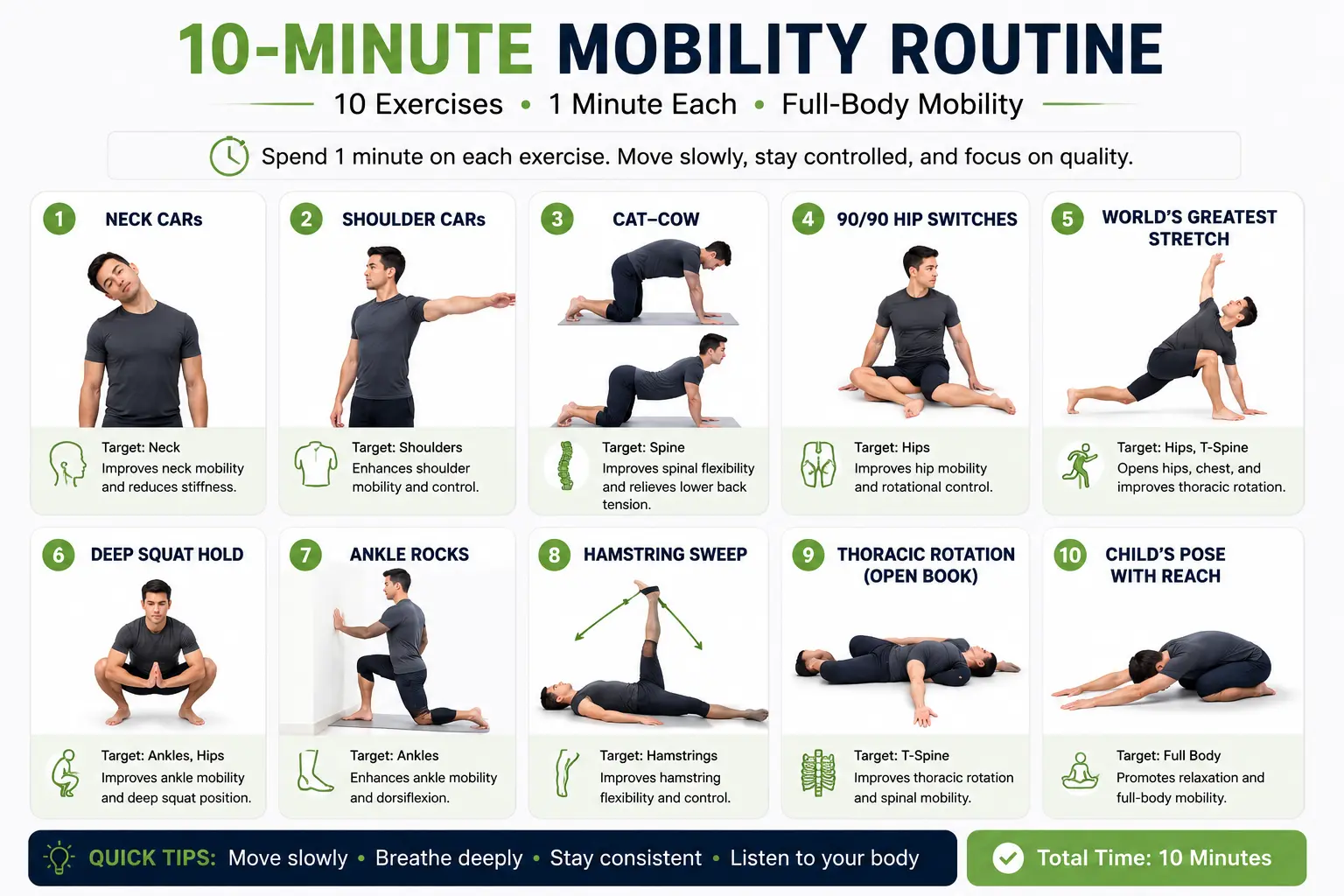
Minute 1: Cat-Cow for Spinal Mobility
Cat-Cow uses gentle spinal flexion and extension to move the spine through a comfortable range.
How to do it:
- Start on your hands and knees.
- Slowly arch your spine as you lift your chest.
- Reverse the movement by rounding your spine.
- Continue smoothly for one minute.
Keep the movement controlled rather than trying to create the biggest possible arch or round.
Focus: Move through the spine comfortably and coordinate the movement with relaxed breathing.
Minute 2: Thread the Needle for Thoracic Rotation
Thread the Needle adds controlled rotation through the upper and middle back.
How to do it:
- Begin on all fours.
- Reach one arm underneath your body.
- Rotate your chest gently toward the floor.
- Return to the starting position and switch sides.
- Continue alternating for one minute.
Avoid forcing the shoulder toward the floor. The goal is controlled thoracic rotation.
Focus: Keep your hips relatively stable while your upper back rotates.
Minutes 3–4: 90/90 Hip Switches
90/90 hip switches train controlled internal and external hip rotation while challenging your ability to control the pelvis. The original routine uses this movement to address hip rotation that is often missed by basic stretching.
How to do it:
- Sit with both legs bent and positioned in a 90/90 configuration.
- Keep your torso as upright as comfortable.
- Slowly rotate your knees from one side to the other.
- Use your hands for support if needed.
- Continue switching sides for two minutes.
Don’t force your knees toward the floor. Reduce the range if you feel uncomfortable pinching.
Beginner option: Place a hand behind you for additional support while learning the movement.
Minutes 5–6: World’s Greatest Stretch
The World’s Greatest Stretch combines several positions into one dynamic mobility sequence for the hips, legs, and upper body.
How to do it:
- Step one foot forward into a lunge.
- Place your hands near the front foot.
- Lower your hips comfortably.
- Rotate your upper body and reach one arm upward.
- Return to the starting position and switch sides.
Move continuously rather than holding each position for a long time.
Focus: Use a comfortable range and maintain control throughout the transition.
Minute 7: Ankle Rocks
Ankle rocks train controlled forward movement at the ankle while keeping the heel grounded.
How to do it:
- Stand facing a wall or use another stable support.
- Place one foot slightly forward.
- Keep the heel on the floor.
- Slowly drive the knee forward over the foot.
- Return and repeat before switching sides.
Don’t allow the heel to lift or the foot to collapse inward.
Focus: Smooth ankle movement, especially through dorsiflexion.
Minute 8: Shoulder CARs
Shoulder CARs use slow, controlled circles to explore the shoulder’s available range of motion.
How to do it:
- Stand tall with your arm by your side.
- Slowly raise the arm.
- Move it through a controlled circular path.
- Return to the starting position.
- Repeat on the opposite side.
Keep the movement deliberate. Don’t turn the exercise into a fast arm circle.
Focus: Control the entire movement instead of chasing the largest possible circle.
Minute 9: Controlled Squat
A controlled squat brings your hip, knee, and ankle mobility together in a practical movement pattern.
How to do it:
- Stand with your feet around shoulder-width apart.
- Brace gently and keep your chest comfortable.
- Lower into a squat as far as you can control.
- Pause briefly if comfortable.
- Stand smoothly and repeat.
Keep your heels grounded. If your heels rise or your balance becomes difficult, reduce the depth or widen your stance slightly.
The goal is quality of movement, not maximum depth.
Minute 10: Single-Leg Hinge and Balance
The single-leg hinge combines hip movement with balance and control, making it a useful way to finish the sequence. The original routine uses a bodyweight single-leg RDL to combine balance, hip hinging, and lower-body control.
How to do it:
- Stand tall with your feet together.
- Shift your weight onto one leg.
- Hinge forward from the hips while extending the other leg behind you.
- Keep your hips as level as possible.
- Return to standing with control.
- Switch legs and repeat.
Use a wall or chair for support if balance is challenging.
Focus: Keep the movement slow and controlled rather than trying to reach the floor.
Key Takeaways
This 10-minute mobility sequence covers the major movement areas without requiring equipment. You do not need to force every exercise to its maximum range. Controlled, repeatable movement is the priority.
Can Beginners Do This Daily Mobility Routine?
Yes. Beginners can use this daily mobility routine, but they should start with comfortable ranges, slower movements, and simple modifications. You do not need advanced flexibility to begin. The objective is to learn how each movement feels and gradually improve control over the range you already have.
What Should Beginners Change?
Beginners should reduce the range, slow the pace, and use support when necessary. There is no need to perform every exercise exactly as demonstrated in its most advanced form.
For this routine:
- Use your hands for support during 90/90 hip switches.
- Reduce the rotation during Thread the Needle.
- Take a shorter stance during the World’s Greatest Stretch.
- Hold a wall or sturdy surface during single-leg hinges.
- Perform controlled squats to a depth you can maintain comfortably.
- Make shoulder circles smaller during Shoulder CARs.
Start with quality rather than completing a specific number of repetitions. As the movements become familiar, gradually explore a larger range.
How Far Should You Move Into a Stretch?
Move into a stretch only as far as you can control comfortably, without sharp pain, pinching, or forcing the joint. Mobility training is not a test of how far you can push your body.
A mild pulling or stretching sensation can occur during some movements. However, back off if you experience sharp, intense, or worsening discomfort.
For dynamic mobility exercises, avoid bouncing or using momentum to force additional range. Slow transitions give you more control and make it easier to recognize when a movement feels wrong.
Simple rule: If you have to sacrifice control to reach a deeper position, the range is probably too large for that repetition.
What If You Cannot Reach the Full Range?
If you cannot reach the full range, work within the range you currently control and modify the exercise rather than forcing the position. Limited range does not mean you cannot benefit from a mobility routine.
For example, you can:
- Reduce the range: move only as far as comfortable.
- Use support: a wall, chair, or your hands can improve balance.
- Change the position: adjust your stance or joint angle.
- Slow down: slower movement makes control easier.
- Progress gradually: increase range only when the current version feels stable.
Your two sides may also differ. That is normal; don’t force the tighter side to match the more mobile side immediately.
Should You Do Mobility in the Morning, Before a Workout, or After It?
The best time for mobility depends on what you want from the session. A morning mobility routine can help you start the day with movement, while a pre-workout mobility workout routine should prepare you for specific training demands. After training, lower-intensity mobility can provide a gentle way to keep moving.
| Timing | Best use |
|---|---|
| Morning | General movement and stiffness |
| Before training | Dynamic, task-specific preparation |
| After training | Lower-intensity mobility work |
| During work | Short movement breaks |
Morning Mobility Routine
Morning is a practical time for mobility when you want to break up overnight inactivity and start moving. Keep the sequence comfortable and progressive rather than immediately pushing into deep ranges.
Your 10-minute routine works well here because it moves through several major areas without requiring equipment.
Before a Workout
Before training, choose dynamic mobility movements that resemble the positions and movements you are about to perform. For example, ankle rocks can fit before squatting, while hip switches may be useful before lower-body training.
Avoid turning your mobility workout routine into a fatiguing session. You should finish feeling prepared to train, not tired from the warm-up.
After a Workout
After training, keep mobility work relaxed and controlled rather than treating it as another intense workout. You can repeat selected movements from the routine at an easier pace or focus on areas that received substantial movement during your session.
You do not need to complete the entire 10-minute sequence after every workout.
During Work
Short movement breaks can complement your main mobility routine when your workday involves prolonged sitting. Stand up, walk briefly, change position, or perform a few comfortable mobility movements.
This approach spreads movement throughout the day instead of relying on one session to compensate for many hours of inactivity.
Quick Guide:
Use morning mobility for general movement, pre-workout mobility for preparation, post-workout mobility for gentle movement, and workday mobility breaks to interrupt prolonged sitting.
Can You Do Mobility Exercises Every Day?
Yes, you can generally do mobility exercises every day when the movements are controlled, appropriate for your ability, and not causing pain. Daily mobility routines do not need to be identical, either. You can adjust the exercises according to your activities, training, and areas that feel restricted.
For a daily mobility routine:
- Keep the intensity moderate.
- Stay within a comfortable range.
- Prioritize control over depth.
- Reduce volume when you are fatigued or recovering from hard training.
- Change exercises when your movement needs change.
A 10-minute session can be enough for a regular movement practice, but shorter sessions also have value when time is limited.
Key point: Daily mobility should feel like movement practice, not another demanding workout.
How Do You Progress a Daily Mobility Routine?
Progress a daily mobility routine by improving control and range before adding more volume or complexity. Mobility training does not need to become longer or harder every week. The goal is to gradually make your existing movements smoother, more controlled, and comfortable.
Should You Add More Time, Reps, or Range First?
Increase range gradually before adding substantial time or repetitions. If you can perform an exercise comfortably with good control, explore a slightly larger range on future sessions.
A simple progression is:
- Improve control: slow down and remove unnecessary momentum.
- Increase range: move slightly farther while maintaining control.
- Add repetitions: perform more quality repetitions if useful.
- Increase time: spend longer on movements that need additional practice.
You do not need to progress every exercise simultaneously. If your ankle mobility is limited but your shoulder movement feels unrestricted, prioritize the ankle work.
When Should You Make an Exercise More Difficult?
Make an exercise more difficult when the current version feels controlled, repeatable, and comfortable. Difficulty can come from greater range, less external support, slower movement, or a more demanding variation.
For example, a beginner may perform 90/90 hip switches with hand support before gradually reducing that support. A supported single-leg hinge can progress toward an unsupported version as balance improves.
How Can You Track Your Mobility Progress?
You can track mobility progress with smartphone apps that analyze movement, range of motion, and symmetry. Instead of relying only on written notes, apps can use your phone camera to establish a baseline and compare movement over time.
For example, Yogger uses video-based AI analysis to measure joint angles, range of motion, movement quality, and left-right symmetry. It also supports side-by-side video comparisons and saved assessments.
Pliability offers a three-minute camera-based mobility assessment that produces a mobility score and allows users to retest later.
These tools are particularly useful if you want measurable feedback rather than relying entirely on how flexible you feel.
What Simple Mobility Tests Can You Track?
Choose two or three movements that match your goals rather than testing everything. Useful options include:
| Goal | Simple test |
|---|---|
| Ankle mobility | Knee-to-wall movement |
| Hip mobility | 90/90 position or hip switch |
| Squat mobility | Controlled squat depth |
| Shoulder mobility | Controlled overhead reach |
| Balance and hip control | Single-leg hinge |
What Are the Most Common Daily Mobility Mistakes?
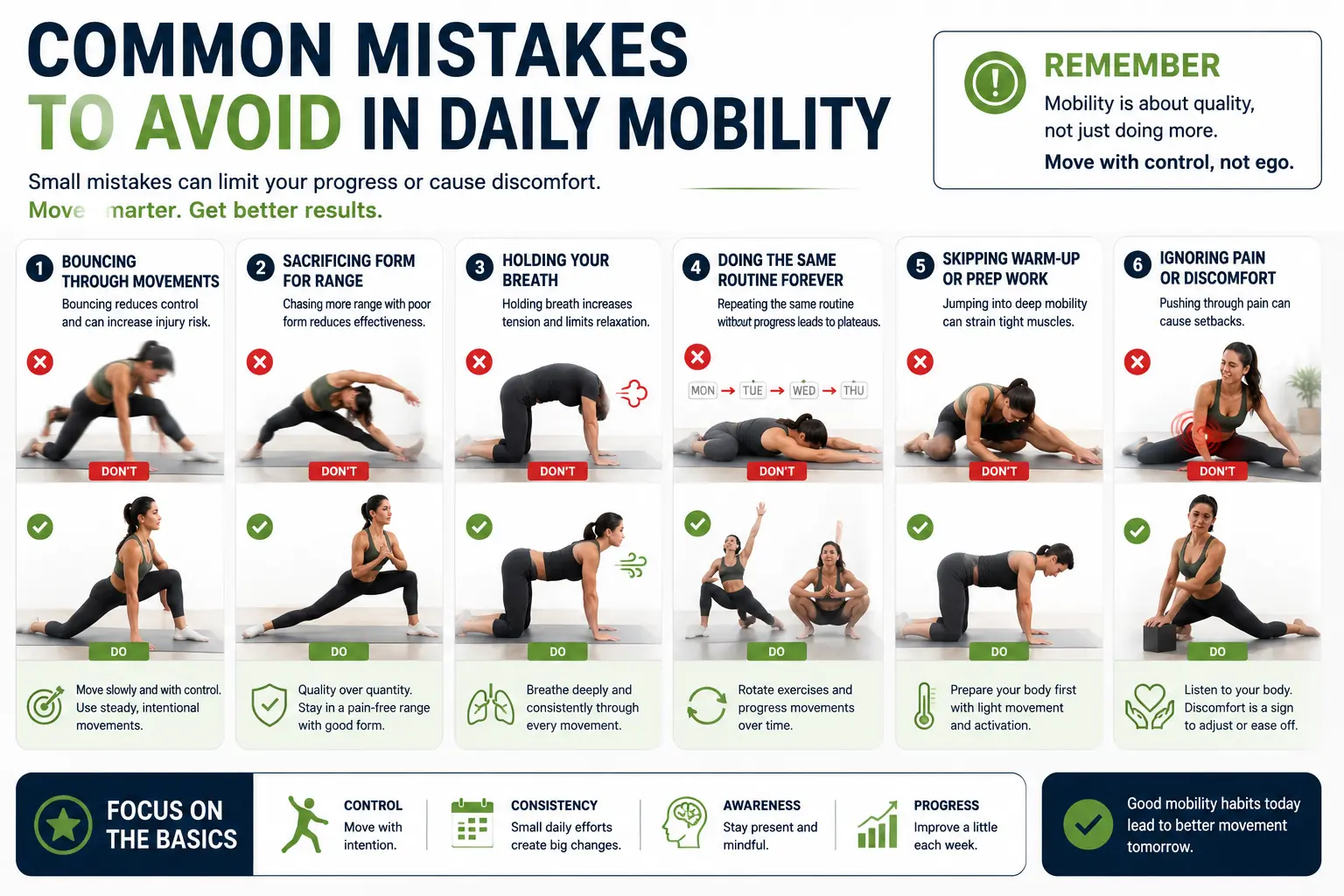
The most common mobility mistakes are forcing range, moving without control, doing too much, and ignoring differences between sides. A good daily mobility routine should make movement more controlled and repeatable, not turn every session into a flexibility challenge.
Are You Stretching Instead of Controlling the Range?
Mobility requires active control, not simply reaching a deeper stretch. If you rely on momentum or passive positions without controlling the movement, you may be practicing flexibility rather than mobility.
Slow down and actively guide each repetition through the range you can manage.
Are You Forcing End Range?
You should not force a joint into its maximum range to make a mobility exercise more effective. Stop or reduce the range if you feel sharp pain, significant pinching, or loss of control.
A smaller, controlled range is preferable to a deeper position that causes compensation.
Are You Doing Too Many Exercises?
More mobility exercises are not automatically better. A few well-chosen movements can cover your needs without turning a 10-minute routine into a long workout.
Start with the areas and movements most relevant to your daily activities or training.
Are You Ignoring One Side?
Always compare both sides rather than automatically assuming they have identical mobility. If one side feels different, work within its comfortable range and avoid aggressively forcing it to match the other side.
Key Quick Takeaways
Prioritize control, comfort, consistency, and relevance. Your mobility routine should support movement, not become another source of fatigue or irritation.
Can Mobility Exercises Help With Chronic Pain?
Mobility exercises may be part of an exercise-based approach for some people with chronic pain, but they should not be presented as a treatment or guaranteed pain-relief solution. Evidence supports exercise as part of chronic pain management, while the appropriate approach depends on the type of pain, underlying condition, abilities, and individual response.
A gentle mobility routine may help you stay physically active and practice comfortable movement. However, evidence for flexibility or stretching alone is more limited than evidence for broader exercise programmes.
If you have persistent or unexplained pain, an injury, numbness, weakness, or symptoms that worsen with movement, seek advice from a qualified healthcare professional rather than using a mobility routine as self-treatment.
Frequently Asked Questions
What Is the Best Daily Mobility Routine?
A full-body mobility routine that covers your main movement restrictions is a good starting point. Prioritize controlled movements for the hips, spine, shoulders, and ankles.
How Long Should a Mobility Routine Take?
There is no required duration. Five to 10 minutes can work well for a daily practice, while longer sessions may be useful when you have specific mobility goals.
Can mobility replace stretching?
No. Mobility and flexibility overlap but are not identical. Mobility emphasizes controlled movement through available range, while stretching primarily targets flexibility.
How quickly can mobility improve?
Progress varies considerably. Track the same movements periodically rather than expecting a fixed timeline. Improvements may appear as better control, smoother movement, or increased comfortable range.
Final Takeaway
A daily mobility routine works best when it is simple, controlled, and easy to repeat. You do not need an hour-long session or advanced flexibility. Ten focused minutes can give you a practical full-body movement practice, while shorter sessions can still add movement to your day.
Use the routine consistently, adapt exercises to your needs, and progress gradually. Most importantly, let mobility complement your strength training, cardio, walking, and normal daily activity—not replace them.
Start with the 10-minute routine, learn your movement limits, and build from there.