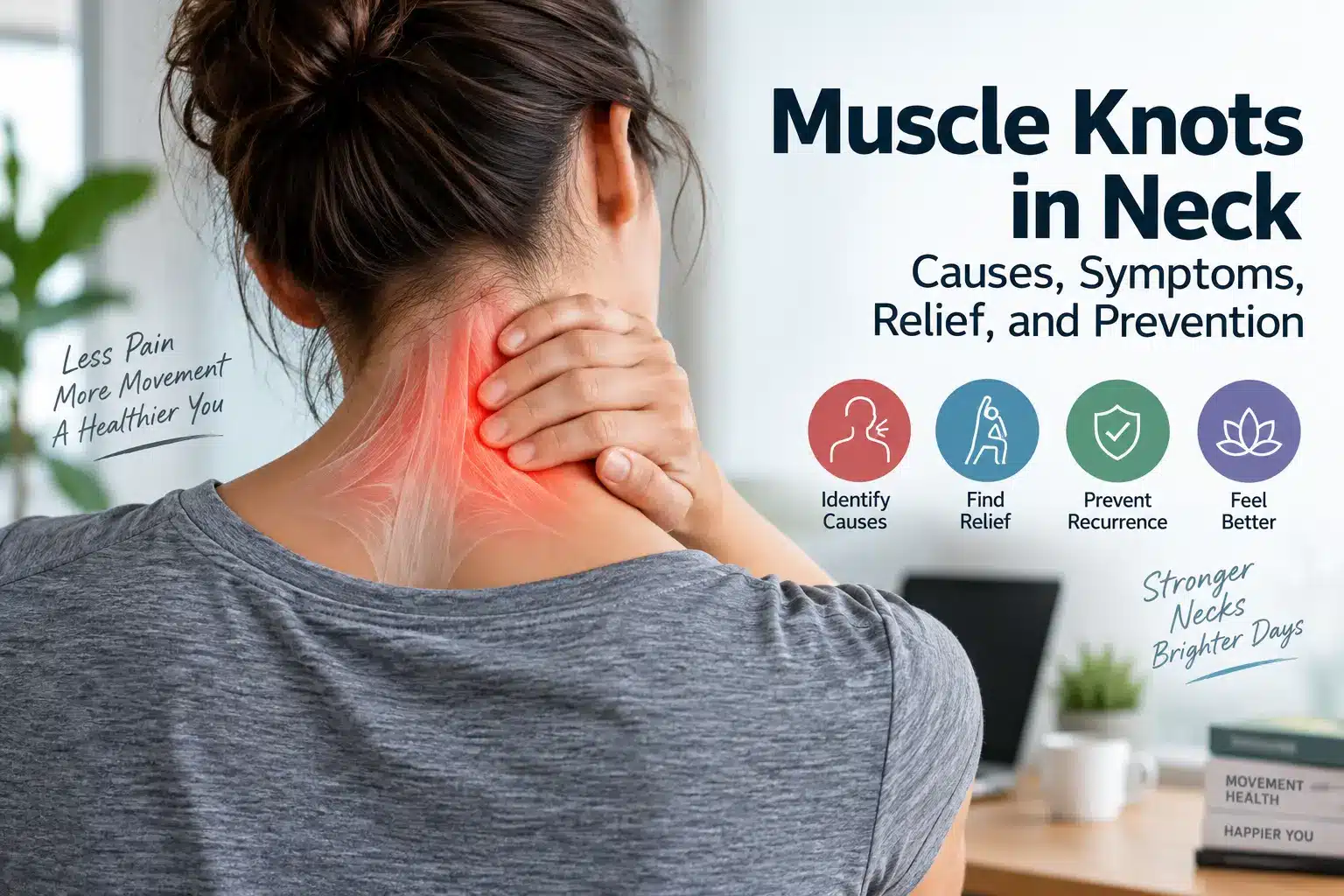


Muscle knots in neck can feel like a tight, tender, or sensitive spot that makes normal movement uncomfortable. It may cause localized neck pain, stiffness, or reduced movement, and sometimes discomfort can spread into the shoulder or head. Although people commonly call these areas “stress knots”, “knots” or “trigger points,” the underlying mechanism is not completely understood.
Quick Takeaways
- A neck muscle knot usually feels like a tight, tender spot within the muscle.
- It may cause stiffness or make turning your head uncomfortable.
- Common triggers include prolonged positions, muscle overuse, stress, and limited movement.
- A painful spot is not automatically a simple muscle knot, especially when nerve symptoms are present.
A neck knot can appear after a long day at a desk, an unfamiliar workout, prolonged phone use, poor sleeping position, or a period of stress. Sometimes you notice it immediately; other times, the area simply feels increasingly tight as the day progresses.
The term “muscle knot” is commonly used to describe a painful or sensitive area within a muscle, often associated with what clinicians may call a trigger point. These areas can feel firm or lumpy when touched, although there is not necessarily a literal knot in the muscle tissue.
The important point is not whether you can physically “untie” a knot. The practical goal is to reduce pain and sensitivity, restore comfortable movement, and address whatever is repeatedly irritating the area.
What Does a Muscle Knots in Neck Feel Like?
A neck muscle knot may feel like:
- A firm, tight, or unusually sensitive spot
- A dull ache or localized soreness
- Tightness when turning or tilting your head
- Pain that becomes more noticeable when you press the area
- Stiffness after sitting or staying in one position
- Discomfort that extends toward the upper shoulder or head
Some trigger points can also produce referred pain, meaning the painful sensation is felt somewhere other than the exact spot being pressed. This is one reason neck and upper-shoulder muscle tension can sometimes be associated with headaches.
| Normal Muscle Knot Symptoms | “Red Flag” Emergency Signals (See a Doctor Immediately) |
|---|---|
| Dull, aching pain localized in neck/shoulder | Sudden sharp pain radiating down arms with numbness/tingling |
| Tightness that responds to heat or massage | Dizziness, high fever, or difficulty swallowing |
| Pain during specific neck rotations | Loss of strength in hands or arms |
Research Insight
Research has found substantial variation in how myofascial trigger points are identified during physical examination, and there is no universally accepted reference standard for diagnosing them. This supports describing a neck knot as a practical symptom term rather than claiming that every tender spot represents a specific, confirmed tissue abnormality.
Where Do Neck Muscle Knots Usually Form?
Neck muscle knots commonly develop in the muscles around the back and sides of the neck, upper shoulders, and upper back. The upper trapezius and other muscles that support and move the head and shoulder region can become particularly tense when you stay in one position for long periods.
You may notice a knot:
- Along the upper shoulder near the base of the neck
- At the back or side of the neck
- Around the upper shoulder blade region
- Near the base of the skull
- Along muscles that feel tight after prolonged sitting or repetitive activity
The location can provide a clue, but it does not confirm the cause. Neck pain can also arise from joints, nerves, ligaments, discs, injuries, or other conditions.
Key Takeaways
A neck muscle knot is best thought of as a painful or sensitive area of muscle tension, not a literal lump that must be forcibly “broken up.” Gentle movement, appropriate self-care, and correcting the trigger are usually more useful than aggressive pressure.
What Causes Muscle Knots in the Neck?
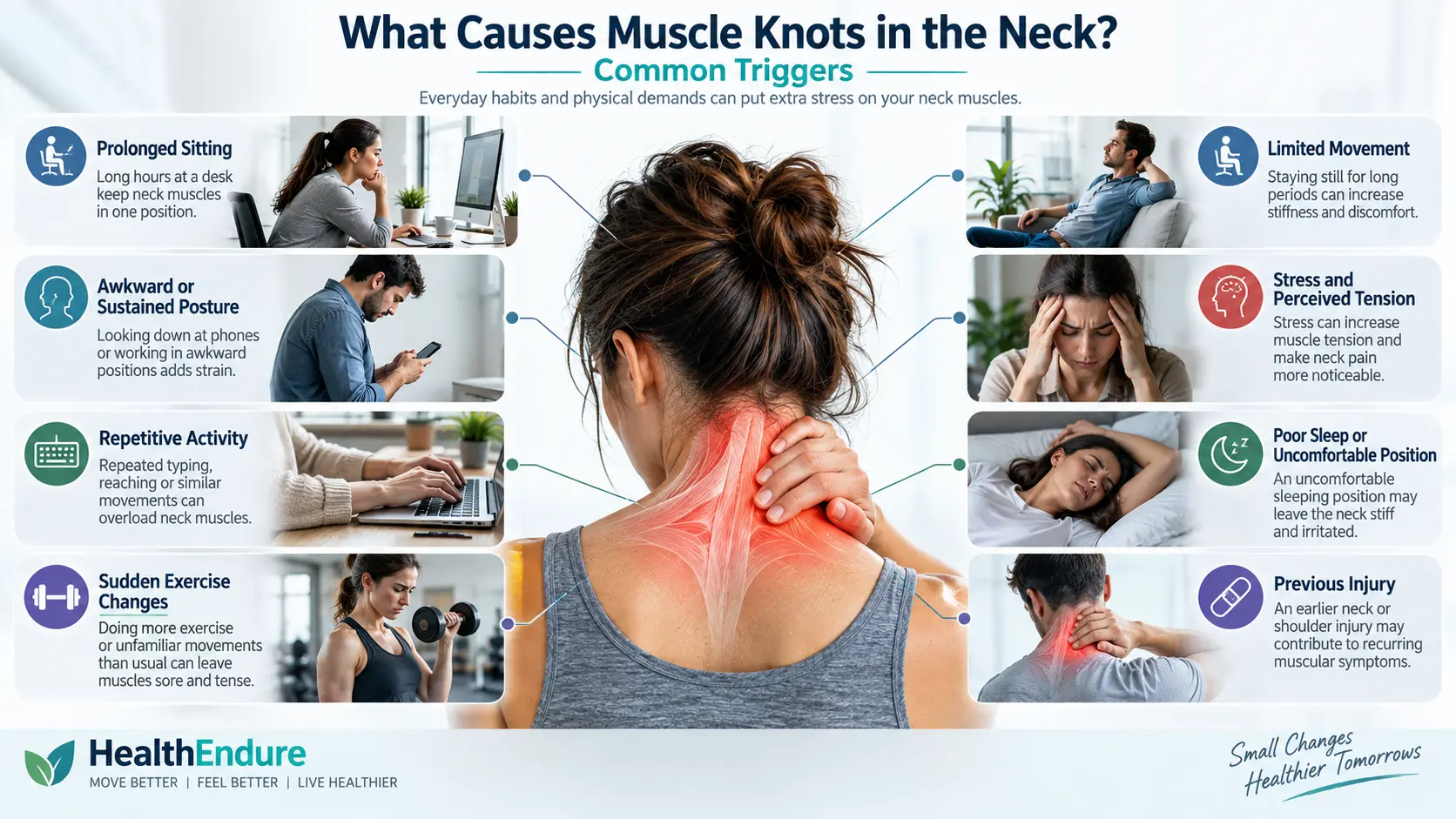
Muscle knots in the neck usually develop when muscles are repeatedly loaded, held in one position for too long, or exposed to more stress than they can comfortably tolerate. Prolonged or awkward postures, repetitive activity, sudden increases in exercise, limited movement, and psychological stress can all contribute to neck and shoulder muscle tension.
The cause is often not one single event. A neck knot may develop gradually when several small triggers occur together, for example, spending hours at a computer, sleeping poorly, feeling stressed, and then exercising with already-tired muscles.
The Most Common Triggers
Several everyday habits and physical demands can increase the likelihood of developing a tight or painful area in the neck.
| Trigger | How it may contribute |
|---|---|
| Prolonged sitting | Keeps the neck and shoulder muscles working in a sustained position. |
| Awkward or sustained posture | Places continuous demand on muscles that support the head and neck. |
| Repetitive activity | Repeated lifting, reaching, typing, or other movements can overload certain muscles. |
| Sudden exercise changes | Doing more exercise or unfamiliar movements than usual can leave muscles sore and tense. |
| Limited movement | Staying still for long periods can increase stiffness and discomfort. |
| Stress and perceived tension | Stress can increase muscle tension and may contribute to neck pain. |
| Poor sleep or an uncomfortable sleeping position | May leave the neck feeling stiff or irritated when you wake. |
| Previous injury | An earlier neck or shoulder injury may contribute to recurring muscular symptoms. |
Research on first-episode neck pain identifies awkward or sustained postures at work among the important physical risk factors, while perceived muscular tension and other psychosocial factors can also contribute.
Research Insight
A systematic review examining myofascial trigger points in people with neck and shoulder disorders found that trigger points were reported across several conditions, but the evidence had important methodological limitations. This means common triggers should be considered contributors rather than proof that a particular posture or activity has caused a specific “knot.”
Practical Tip
Look for patterns rather than blaming one habit. If your neck knot repeatedly appears after long computer sessions, stressful days, certain workouts, or poor sleep, that pattern is more useful than simply treating the painful spot each time.
3. How Do You Get Rid of a Muscle Knot in Neck?
Most uncomplicated neck muscle knots can be managed initially with gentle movement, comfortable stretching, appropriate heat or cold, and cautious self-massage. The goal is not to force the muscle to “release,” but to reduce discomfort and gradually restore normal movement. Evidence-based neck-pain guidelines support staying active and using exercise, self-management, and appropriate manual therapy rather than prolonged rest.
Key Takeaways
- Start with gentle movement rather than complete rest.
- Use heat or cold based on what feels more comfortable.
- Stretch only within a comfortable range.
- Massage can help some people, but aggressive pressure can aggravate symptoms.
- If symptoms include numbness, weakness, severe pain, or other warning signs, stop self-treatment and seek medical assessment.
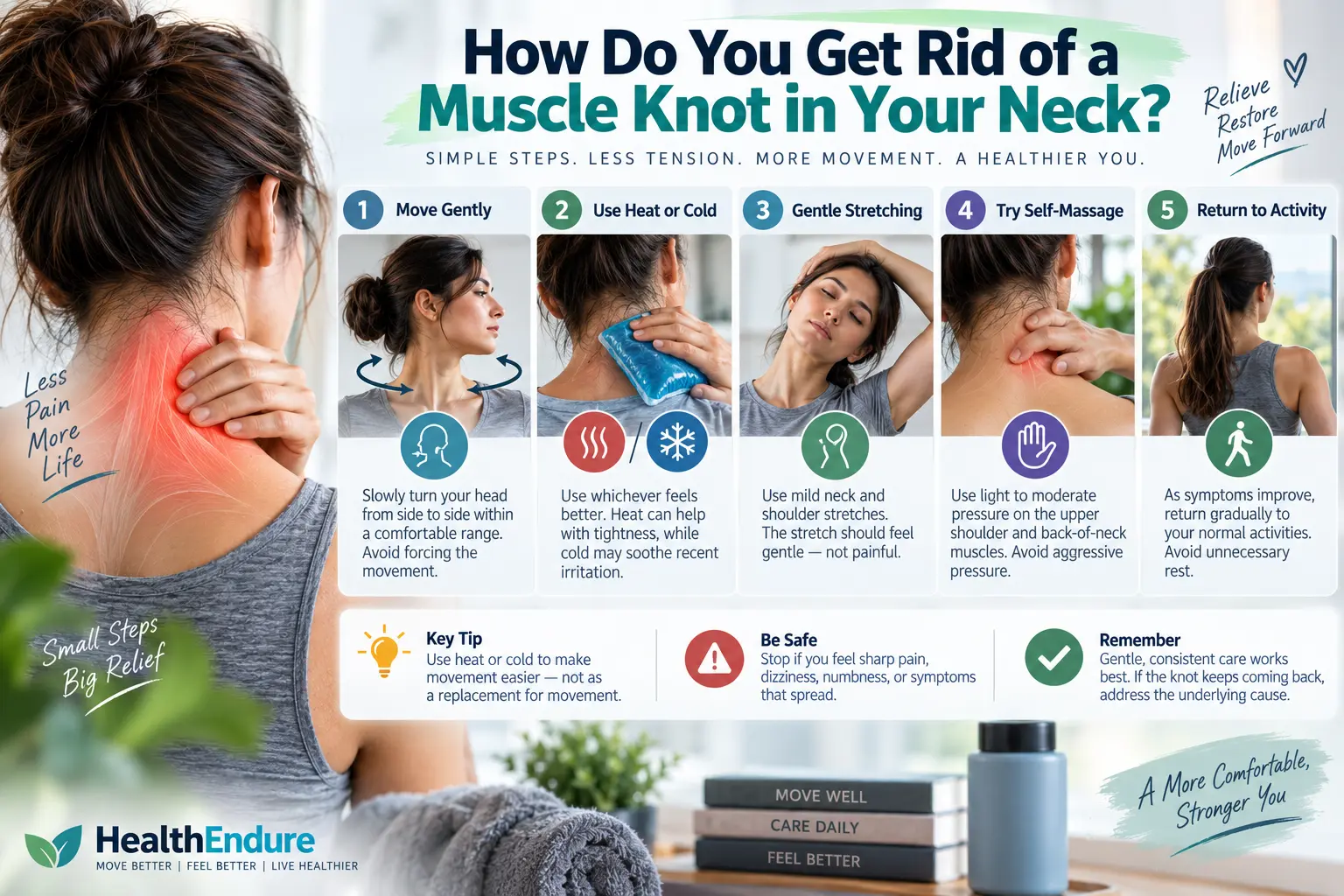
What Should You Try First for a Neck Muscle Knot?
When these stress knots in neck appears after sitting, working, exercising, or sleeping awkwardly, begin with movement rather than immediately digging into the painful spot.
A Simple 5-Step Neck Knot Relief Protocol
1. Move gently.
Slowly turn your head from side to side within a comfortable range. Avoid forcing the movement or repeatedly testing the painful position.
2. Try heat or cold.
Use whichever provides better short-term comfort. A warm shower or heating pad may feel soothing when the muscles feel tight. Cold may feel more comfortable when the area feels acutely irritated.
3. Add gentle stretching.
Once movement feels easier, use a mild neck or shoulder stretch. The stretch should create gentle tension—not sharp pain.
4. Try careful self-massage.
Light-to-moderate pressure around the upper shoulder and back-of-neck muscles may reduce tenderness. Do not aggressively press into the front or vulnerable side of the neck.
5. Return gradually to normal activity.
As symptoms settle, resume ordinary movement instead of protecting the neck unnecessarily.
Research Insight
Clinical practice guidelines for neck pain support maintaining activity and using exercise or range-of-motion exercises as part of conservative management. For uncomplicated neck pain, activation and self-management are generally preferred over prolonged inactivity.
Should You Use Heat or Ice for a stress knots in neck?
Either may provide short-term comfort, but there is no need to force yourself to use one simply because it is considered the “right” treatment.
| If your neck feels… | You might try | Practical approach |
|---|---|---|
| Tight, stiff, or tense | Heat | Warm shower or comfortable heating pad |
| Recently irritated after activity | Cold | Brief cold application wrapped in a cloth |
| Better with warmth | Heat | Use it as a comfort measure before movement |
| Better with cold | Cold | Use it if it reduces discomfort |
| Unclear | Either | Try one and judge your response |
Heat should feel comfortably warm, never burning. If using a heating pad, avoid falling asleep with it against your skin.
Cold should also be wrapped rather than placed directly against the skin. Stop if the skin becomes excessively numb, painful, or discolored.
The purpose of heat or cold here is mainly symptom relief, not to physically dissolve a muscle knot.
Practical Tip
Use heat or cold to make movement easier, not as a replacement for movement. If warmth reduces stiffness enough to let you move comfortably, use that opportunity for gentle mobility.
Can Massage or Myofascial Release Help a Neck Knot?
Gentle massage may temporarily reduce neck pain and tenderness, particularly when combined with other forms of self-care. Research on therapeutic massage for neck pain suggests benefits for short-term symptoms, although evidence for lasting effects is less certain.
For self-massage, use your fingertips or a massage ball against accessible muscles around the upper shoulder and upper back.
Try this approach:
- Find a tender but tolerable area in the muscle.
- Apply gentle pressure.
- Hold or slowly massage the area for a short period.
- Relax the pressure.
- Move the neck gently afterward.
- Stop if symptoms become sharper or start spreading.
Do not aggressively press the front or side of the neck, especially over areas where you can feel strong pulses or where pressure produces dizziness, tingling, or unusual symptoms.
Safety Note
More pressure is not necessarily better. Stop self-massage if it produces sharp, electrical, burning, spreading, or worsening pain, numbness, dizziness, or weakness.
Which Gentle Exercises Can Help a Stiff, Knotted Neck?
Gentle exercises can help restore comfortable movement without repeatedly irritating the affected muscles. The following movements should remain slow, controlled, and pain-limited.
Chin Tuck
Sit or stand upright and gently draw your chin backward, as though making a small double chin.
- Hold briefly.
- Relax.
- Repeat several times.
- Do not tilt your head downward.
Common mistake: pushing the head backward forcefully or tightening the jaw.
Gentle Neck Rotation
- Slowly turn your head toward one shoulder until you feel a comfortable stretch or mild restriction.
- Return to the center and repeat on the other side.
- Do not force the final few degrees of movement.
Gentle Side Stretch
- Keep your shoulders relaxed while slowly bringing one ear toward the corresponding shoulder.
- Stop when you feel a mild stretch along the opposite side of the neck.
- Do not pull your head down with your hand.
Shoulder Rolls and Scapular Movement
- Slowly roll the shoulders backward and downward, then relax.
- You can also gently draw the shoulder blades toward each other without shrugging.
- These movements can be useful when prolonged desk work has left the neck and upper shoulders feeling stiff.
Clinical guidelines support range-of-motion and exercise-based approaches for uncomplicated neck pain, although the appropriate exercise depends on the individual and the underlying cause.
Key Takeaways
The best way to deal with a recurring neck knot is not to press harder, it is to identify why the area keeps becoming irritated. Relief and prevention work together: calm the symptoms first, then address the pattern that keeps bringing them back.
How Long Do Muscle Knots in the Neck Last?
A mild neck muscle knot may settle as the irritation decreases and normal movement returns, but there is no reliable universal number of days that applies to every knot. Duration depends on what triggered the symptoms, how severe they are, whether the area continues to be irritated, and whether another source of neck pain is involved. Persistent myofascial pain can become more difficult to manage when contributing factors are not addressed.
- Acute Knots: 1 to 3 days with rest and heat therapy.
- Chronic Knots: 2 to 6 weeks if linked to ongoing posture issues or stress.
Can a Neck Muscle Knot Go Away on Its Own?
Yes, some neck muscle knots improve without professional treatment. If the discomfort follows prolonged sitting, an unfamiliar activity, or a temporary increase in muscle workload, reducing the aggravating activity while maintaining gentle movement may be enough.
You can support recovery by:
- Keeping the neck gently mobile.
- Taking regular breaks from prolonged positions.
- Using heat or cold for short-term comfort.
- Returning gradually to normal activity.
- Avoiding aggressive stretching or massage.
- Addressing the activity or habit that triggered the symptoms.
Improvement should generally mean that pain becomes less intense, movement becomes easier, and the area becomes less sensitive.
A knot does not necessarily need to disappear completely before you resume normal activity. In many cases, excessive protection of the neck can lead to more stiffness and reduced confidence in movement.
Practical Tip
Track function, not just the lump-like sensation. If you can turn your head more comfortably, tolerate normal activity better, and experience less pain, those are useful signs of improvement.
Why Is My Knot Still There After Several Days?
If a neck knot remains after several days, that does not automatically mean something is seriously wrong. The muscle may still be exposed to the same trigger, or the original problem may involve more than localized muscle tension.
Consider whether you are still:
- Spending long periods in the same position.
- Repeating the activity that initially irritated the area.
- Avoiding movement because you are afraid of pain.
- Sleeping in a position that aggravates your symptoms.
- Applying increasingly aggressive massage or stretching.
- Experiencing symptoms that extend beyond the original tender area.
Persistent symptoms deserve more attention when they are not gradually improving, repeatedly return, interfere with normal activities, or develop alongside neurological symptoms.
Research Insight
Myofascial pain in the head and neck can involve localized tenderness, stiffness, pain with movement, and restricted movement. Persistent symptoms may also be influenced by contributing physical and psychosocial factors, so treatment is not always as simple as releasing one tender spot.
How Can You Prevent Muscle Knots From Coming Back?
Preventing recurring neck muscle knots starts with reducing the patterns that repeatedly overload your neck and upper shoulders. Instead of trying to maintain a perfect posture all day, focus on regular movement, sensible workload, comfortable workstation positioning, adequate recovery, and strengthening exercises that suit your needs. Research suggests workplace modifications and strengthening can help reduce neck pain, although the evidence is not uniform.
How Can You Fix the Habits That Trigger Neck Knots?
Start by identifying when the knot usually appears. If it develops after several hours at your computer, repeatedly lifting, long phone use, or a particular workout, modify that pattern rather than repeatedly treating the resulting pain.
Focus on these habits:
- Change position regularly: Avoid staying in one sitting or standing position for prolonged periods.
- Set up your workstation comfortably: Keep your screen and keyboard positioned so you do not constantly reach or crane your neck.
- Build neck and upper-body strength: Gradual strengthening can improve tolerance to everyday workloads.
- Vary repetitive activities: Alternate tasks when possible rather than repeatedly loading the same muscles.
- Keep moving: Gentle movement throughout the day can help prevent stiffness.
- Prioritize recovery: Sleep, rest between demanding activities, and gradual increases in exercise all matter.
- Address recurring stress-related tension: If stressful periods consistently coincide with neck tightness, relaxation and movement breaks may be useful.
Research Insight
A systematic review and meta-analysis of workplace interventions found evidence that neck strengthening and tailored workstation modifications may reduce neck pain in office workers, although the authors rated the overall evidence as low quality and called for better research.
What Is a Simple Daily Routine for Preventing Neck Knots?
You do not need a complicated stretching program. A practical daily approach is to move, reposition, and relax throughout your day.
| Part of the day | Simple action |
|---|---|
| During work | Change position and move your neck and shoulders periodically. |
| During long sitting | Stand, walk briefly, or perform gentle shoulder movement. |
| After demanding activity | Allow the muscles to recover before repeating the same workload. |
| During exercise | Increase training gradually rather than making sudden jumps in workload. |
| Before bed | Use comfortable positioning and gentle mobility if your neck feels stiff. |
Regular movement is more useful than obsessing over a single “perfect” posture. Workplace research also suggests that task variation and perceived muscular tension are relevant factors in the development of neck pain among office workers.
Key Takeaways
The best prevention strategy is consistency, not perfection. Move regularly, vary your workload, build appropriate strength, and correct the habits that repeatedly trigger your neck symptoms.
FAQs About Muscle Knots in the Neck
Can a muscle knot cause a headache?
Neck and shoulder muscle trigger points can be associated with referred head pain and headaches in some people. However, not every headache associated with neck discomfort is caused by a muscle knot. Persistent, severe, unusual, or changing headaches deserve appropriate medical evaluation. Research has found associations between active trigger points in certain head and neck muscles and tension-type headache characteristics
Can a neck knot cause pain down your arm?
A neck muscle problem can sometimes produce referred discomfort, but pain traveling down the arm, especially with numbness, tingling, or weakness, should not automatically be labelled a muscle knot. Those symptoms can indicate nerve involvement and warrant assessment when persistent or progressive.
When should you see a doctor for a neck knot?
Seek medical assessment if symptoms persist without improvement, repeatedly return, significantly interfere with daily activities, or occur with neurological symptoms such as numbness, tingling, weakness, balance problems, or progressive loss of sensation. Significant trauma, fever, or other concerning systemic symptoms also warrant evaluation.
Bottom Line
A muscle knot in the neck is usually best approached with gentle movement, appropriate symptom relief, and attention to the trigger behind the tension.
Remember these four points:
- Move gently: Avoid prolonged rest and keep the neck comfortably mobile.
- Treat symptoms sensibly: Heat, cold, stretching, and cautious massage may provide relief.
- Fix the pattern: Repeated knots often require changes in workload, movement, workstation habits, or recovery.
- Know the warning signs: Numbness, weakness, spreading neurological symptoms, significant trauma, fever, or worsening symptoms should not be dismissed as a simple knot.
Final Takeaways
Do not focus only on “releasing” the knot. Focus on restoring comfortable movement and preventing the irritation from returning. If the symptoms do not improve or do not behave like ordinary muscular discomfort, get them assessed rather than repeatedly treating the same spot.
Medical Disclaimer
The information provided in this article is intended for general educational and informational purposes only and is not a substitute for professional medical advice, diagnosis, or treatment. Muscle knots and neck pain can have different causes, and information that may be appropriate for one person may not be appropriate for another. HealthEndure does not guarantee that the information provided is appropriate for your individual health needs. Always consult a qualified healthcare professional for advice regarding your personal medical concerns.