


Task paralysis isn’t laziness.
If you’ve ever sat frozen on the couch, knowing exactly what you need to do but feeling completely unable to start, you’re not broken. You’re experiencing a real neurological response, not a character flaw.
This guide will help you understand why your brain shuts down, why motivation disappears, and how to restart yourself gently, without shame, pressure, or toxic productivity advice.
TL;DR: What to Do When Task Paralysis Hits
- Task paralysis is not procrastination.
- Your brain is overwhelmed, not unmotivated.
- Starting feels harder than doing because the activation energy is too high.
- Small physical actions work better than “trying harder.”
- You don’t need discipline. You need the right conditions.
If that already feels relieving, keep reading…
“Why Am I Stuck?” The Feeling No One Explains
You’re not avoiding the task.
You’re not enjoying scrolling.
You’re not being lazy.
You’re stuck.
People describe task paralysis in the same painful ways:
- “I want to do it, but I can’t move.”
- “I know it’s important, but my brain feels offline.”
- “The more I think about it, the heavier I feel.”
- “I keep scrolling even though I hate it.”
This experience is extremely common in people with ADHD and other neurodivergent brains. But it also happens during burnout, digital overload, chronic stress, and emotional exhaustion.
What makes it worse is the shame that follows. You start telling yourself that you should be able to do this, that everyone else manages just fine, and that something must be wrong with you. Nothing is wrong with you. Your brain has gone into a protective shutdown mode.
Task Paralysis vs Procrastination (Why Most Advice Fails)
| Aspect | Procrastination | Task Paralysis |
|---|---|---|
| Ability to start | You want to start, but can’t | You want to start but can’t |
| Primary cause | Emotional avoidance, boredom, resistance | Executive dysfunction, low dopamine, overload |
| Body response | Mild discomfort or avoidance | Freeze response, mental shutdown |
| Effect of pressure | Often helps (deadlines push action) | Often worsens paralysis |
| Common advice | “I don’t feel like it.” | Needs activation-energy reduction |
| Typical feeling | “I feel stuck and frozen.” | “I feel stuck and frozen” |
Most online productivity advice fails because it treats task paralysis and procrastination as the same problem. They are not. Confusing the two leads to frustration, self-blame, and advice that doesn’t work, especially for people dealing with ADHD task paralysis or executive dysfunction.
Procrastination usually means you can start a task, but you choose not to. The delay is often emotional or situational in nature. You might procrastinate because the task feels boring, uncomfortable, unclear, or emotionally charged. Importantly, the ability to initiate action is still available.
For example, someone procrastinating might think, “I’ll start after one more video,” or “I don’t feel like doing this right now.” When pressure increases, such as a deadline or external accountability, they are usually able to push themselves into action.
Task paralysis is fundamentally different. With task paralysis, the desire to act is present, but the brain does not initiate movement. You may sit at your desk, open your laptop, or stare at a task list while feeling increasingly anxious and frustrated. This is not avoidance; it’s a neurological freeze response. The initiation system feels offline.
People experiencing task paralysis often report thoughts like:
- “I know what I need to do, but I can’t make myself start.”
- “Even opening the document feels overwhelming.”
- “The harder I try, the more stuck I feel.”
Research in ADHD and executive function consistently shows that task initiation relies heavily on dopamine activity in the prefrontal cortex. When dopamine levels are low, due to ADHD, burnout, decision fatigue, sleep deprivation, or chronic stress, the brain struggles to generate enough activation energy to begin a task.
In simple terms, the brain wants the result, but the internal “start signal” never fires.
Studies on executive dysfunction also show that increasing pressure or self-criticism can worsen task paralysis, not fix it. When the brain is already overloaded, adding urgency, guilt, or negative self-talk increases cognitive load and deepens the freeze response. This explains why advice like “just start,” “try harder,” or “use willpower” often makes people feel worse instead of better.
This distinction matters because the solutions are different.
Procrastination often responds to motivation tools, deadlines, rewards, or accountability. Task paralysis requires reducing friction, lowering activation energy, simplifying decisions, and supporting the nervous system. That might mean starting with movement instead of thinking, breaking tasks into micro-actions, or using external supports like body doubling or a dopamine menu.
Recognizing that you are experiencing task paralysis, not procrastination, is often the first moment of relief. It reframes the problem from a personal failure to a brain-state issue that can be worked with, not fought against.
Executive Dysfunction
Imagine your brain as an airport.
Your ideas are planes.
Your tasks are destinations.
Executive function is the air traffic controller.
When everything works well, planes land and take off smoothly. With executive dysfunction, too many planes arrive at once. The controller becomes overwhelmed. Everything freezes. The planes are still there. The controller just can’t coordinate them.
Executive dysfunction affects starting tasks, switching between tasks, organizing steps, and regulating effort. It has nothing to do with intelligence, talent, or work ethic.
The Real Villain: Activation Energy (The “Start Button” Problem)
Activation energy is the energy required to begin an action, not to finish it. This is why finishing a task can feel easy once you start, but starting feels impossible.
Activation energy becomes high when dopamine is low, when tasks feel too big or vague, when past failures are remembered, or when your brain is already tired from constant stimulation. When your brain senses that starting will cost too much energy, it aborts. Scrolling feels easier, so your brain chooses that instead.
The 3 Types of Task Paralysis (How to Recognize Yours)
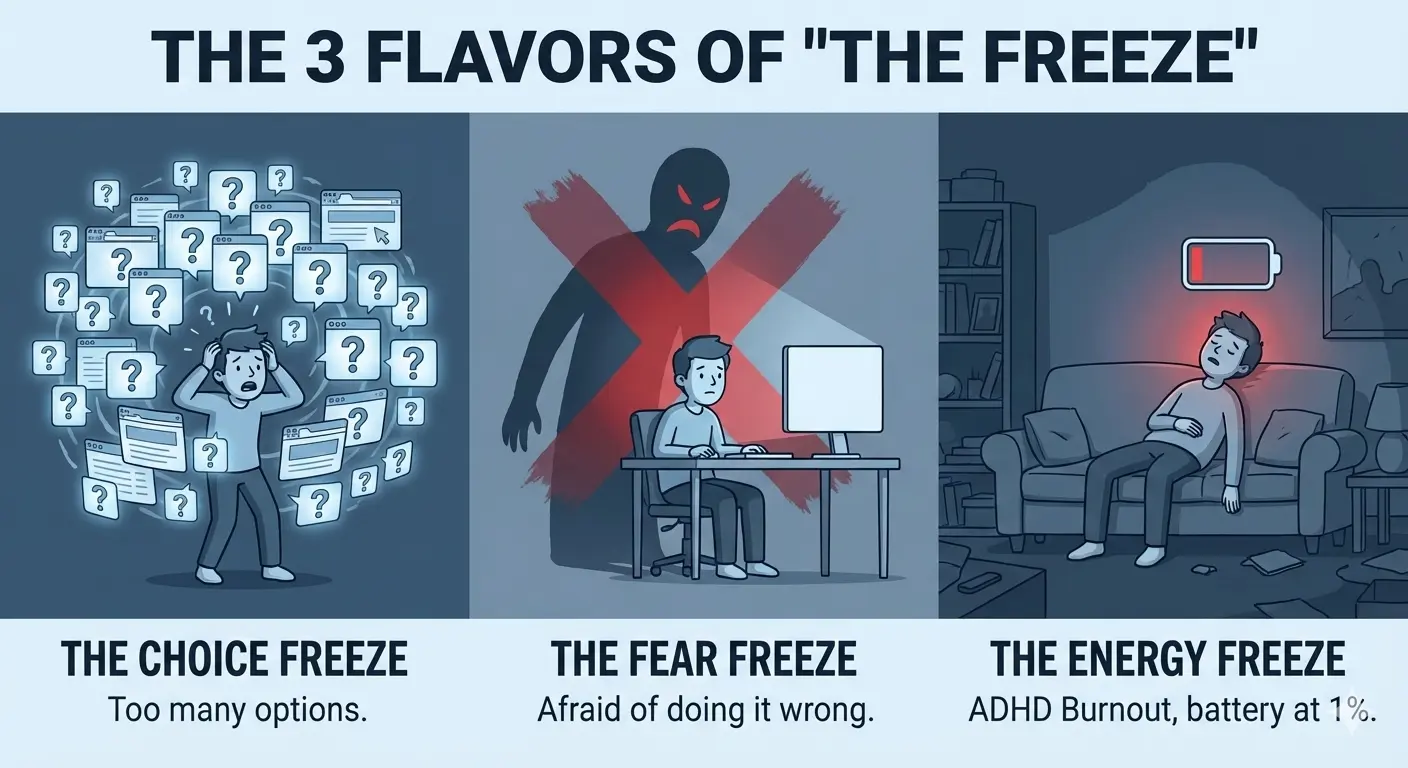
Task paralysis doesn’t always feel the same. In fact, most people experience it in three distinct forms, often overlapping. Understanding which type you’re dealing with helps you respond correctly instead of forcing the wrong solution.
Choice Paralysis: When Too Many Options Shut You Down
Choice paralysis happens when your brain is faced with too many decisions at once. Multiple browser tabs, long to-do lists, unfinished notes, or vague goals like “catch up on work” overwhelm the executive system. Instead of choosing one path, the brain freezes and chooses nothing.
This often looks like:
- Opening your laptop and immediately feeling stressed
- Jumping between tasks without starting any
- Staring at a to-do list that feels heavy and confusing
Research on decision fatigue shows that the brain has a limited capacity for choice-making. Neurodivergent brains, in particular, burn through this capacity faster. When too many options compete for attention, the brain enters a protective shutdown to avoid making the “wrong” choice.
The result is task paralysis—not because you don’t care, but because your brain can’t prioritize under load.
Energy Paralysis: When Your Brain Battery Is Empty
Energy paralysis happens when your mental and nervous-system resources are depleted. ADHD burnout, poor sleep, emotional stress, prolonged screen time, and digital overload all contribute to this state.
In energy paralysis, the problem is not clarity or desire; it’s fuel.
People in this state often say:
- “I know what to do, but I have no energy to start.”
- “Everything feels heavy, even simple tasks.”
- “I just need to lie down for a minute.”
From a neurological perspective, this state is associated with low dopamine and high cognitive fatigue. The brain prioritizes rest and safety over effort. Trying to “push through” often backfires, increasing shutdown and frustration.
This is why energy paralysis requires rest, sensory regulation, or dopamine support, not stricter schedules or pressure.
Fear Paralysis: When Perfectionism Locks You in Place
Fear paralysis is driven by perfectionism, past failures, or fear of negative outcomes. The task feels heavy because doing it “wrong” feels emotionally unbearable.
This type of paralysis is common in people who:
- Overthink every step before starting
- Feel intense pressure to get things right
- Avoid tasks where expectations feel unclear
In fear paralysis, your brain is trying to protect you from emotional pain. Unfortunately, the protection strategy is avoidance through freeze. Psychological research shows that anticipatory anxiety increases cognitive load, making task initiation harder. The more you imagine everything that could go wrong, the less access your brain has to action.
This is why reassurance, reframing, and reducing the emotional stakes of a task are more effective than motivation tricks.
Why Most People Experience All Three
Most people don’t experience just one type of task paralysis. They experience a blend.
For example:
- Digital overload creates energy paralysis
- A long to-do list creates choice paralysis
- High expectations create fear paralysis
Together, they compound into a powerful freeze response.
Recognizing this mix is important because it shifts the goal from “trying harder” to removing friction. Once you identify which type is dominant in the moment, you can choose the right intervention—simplifying choices, restoring energy, or lowering emotional pressure.
Task paralysis is not a personal failure. It’s a signal that your brain needs support, not force.
How to Break Task Paralysis Right Now
When you’re frozen, thinking harder usually makes task paralysis worse. This happens because paralysis is not a logic problem—it’s a nervous system state. When the brain senses overwhelm or threat, it shifts into a freeze response. In this state, reasoning, planning, and self-talk become far less effective.
Research in cognitive neuroscience shows that during stress or overload, activity in the prefrontal cortex (the part responsible for planning and decision-making) decreases, while survival-oriented brain systems take over. That’s why trying to “think your way out” of task paralysis often leads to more frustration. The fastest way out is not better thoughts, but a state change—something physical, sensory, or external that lowers activation energy.
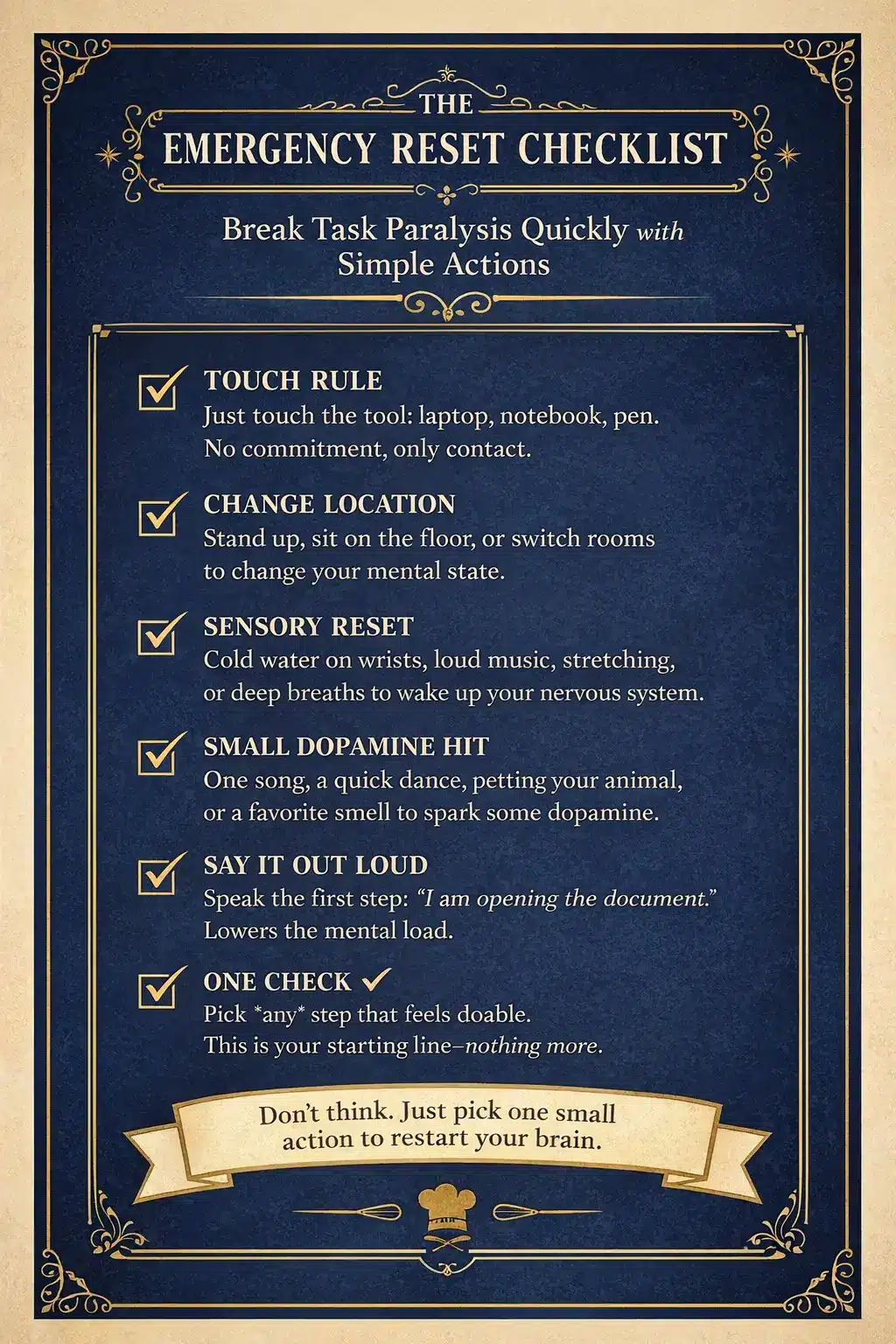
Start With the Touch Rule (Lower the Barrier to Zero)
The touch rule means you do not do the task. You only touch the tool.
- Touch the laptop.
- Open the notebook.
- Hold the pen.
That’s it.
This works because the brain treats commitment as expensive, but contact as safe. Behavioral psychology shows that once physical contact with a task begins, resistance drops sharply. Even micro-actions reduce the perceived size of the task and lower activation energy. For someone experiencing ADHD task paralysis, touching the tool is often the difference between staying frozen and accidentally starting.
Change Your Physical Environment (Interrupt the Freeze Loop)
Task paralysis is highly state-dependent. Your brain associates locations with mental patterns. If you’ve been frozen at your desk or on the couch, staying there reinforces the stuck feeling.
Simple changes help:
- Stand up instead of sitting
- Sit on the floor instead of a chair
- Move to a different room
- Face a window or wall instead of a screen
Studies on embodied cognition show that physical posture and environment directly influence mental flexibility. Even small movements signal to the nervous system that something has changed—often enough to break the freeze.
Use Sensory Input to Wake the Nervous System
When your brain is stuck, sensory input reaches faster than logic.
Cold water on your wrists, stretching your arms, loud music for 30–60 seconds, or even one slow, deep breath can rapidly shift your physiological state. These actions stimulate the nervous system and increase alertness without requiring decision-making.
Research on stress regulation shows that sensory grounding techniques can reduce freeze responses more effectively than cognitive strategies in the moment. That’s why these techniques feel surprisingly effective when “trying harder” doesn’t.
Give Yourself a Dopamine Micro-Hit Before the Task
Low dopamine is one of the biggest contributors to task paralysis. When dopamine is low, the brain perceives effort as disproportionately costly. A dopamine micro-hit is not a reward binge. It’s a small, intentional boost designed to raise dopamine just enough to begin.
Examples include:
- One favorite song
- A 30-second movement break
- Petting your dog or cat
- Smelling something you enjoy (coffee, essential oil, soap)
Neuroscience research shows that even brief positive stimuli can increase motivation signals temporarily. This is often all the brain needs to cross the activation threshold and start.
Externalize the Task (Get It Out of Your Head)
Abstract thoughts are heavy. Spoken actions are lighter. When a task lives only in your head, it feels large and undefined. Saying it out loud or writing one simple sentence externalizes it and reduces cognitive load.
Try saying:
“I am opening the document.”
“I am writing one sentence.”
“I am replying to one email.”
Studies on verbal processing show that speaking actions aloud engages different neural pathways than silent planning, making tasks feel more concrete and manageable. This is especially helpful for people with executive dysfunction, because it turns vague intention into a clear, bounded action.
Why These Techniques Work When Willpower Fails
All of these strategies share one goal: lowering activation energy. They do not rely on motivation, discipline, or positive thinking. They work by:
- Reducing the perceived size of the task
- Shifting the nervous system out of freeze
- Increasing dopamine slightly
- Making the first action physically and mentally safe
Task paralysis does not require force. It requires gentle momentum. Once the brain feels safe enough to start, motivation often follows naturally.
Overcoming the freeze response is as much about mental strategy as it is about biology. To build long-term psychological resilience against these cycles, our Bulletproof Mind ebook offers a comprehensive framework for mastering your focus and developing an unshakeable mindset
Decision Fatigue: Why Motivation Is Gone Before Noon
Every small decision costs mental energy. What to wear. What to eat. Where to start. Which task matters most. Neurodivergent brains burn through this fuel quickly. By midday, your brain runs out of decision-making power and shuts down. This looks like low motivation, but it’s actually depletion.
The solution is pre-deciding. Reduce decisions before they drain you. Use default meals, fixed work blocks, and pre-written task starters. Save your energy from brain fog, which actually matters.
Using a Dopamine Menu to Lower Activation Energy
When your brain is under-stimulated, it looks for cheap dopamine, like scrolling. A dopamine menu gives your brain better options. Instead of forcing yourself to work, you ask, “What’s the smallest dopamine-boosting action I can do first?”
Stretching for two minutes, making tea, or listening to one song can be enough to raise activation energy so you can begin. This is not a reward system. It’s a ramp.
Habit Stacking for a Neurodivergent Brain
Traditional habit stacking says, “After A, do B.” Neurodivergent brains respond better to “While doing A (stimulating), do B (boring).”
Listening to a podcast while doing dishes, playing music while answering emails, or using an audiobook while walking helps share dopamine instead of demanding more.
Digital Overload and Burnout
Infinite scrolling trains your brain to expect constant novelty and avoid sustained effort. Notifications fragment attention and increase fatigue. You don’t need a full dopamine detox. You need boundaries, not punishment.
One simple rule that helps many people is avoiding scrolling before their first intentional action of the day. Even one small action before social media can reduce paralysis significantly.
When the brain is stuck in a freeze response, it often gravitates toward high-stimulation digital environments to escape discomfort. If you find your screen time has shifted from a hobby into a compulsive loop, read our specialized guide on how to combat gaming addiction, which offers specific cognitive strategies to reclaim your focus and break the cycle of digital avoidance.
Why Body Doubling Works
Many people find it easier to work when someone else is present, even silently. This is called body doubling. Your brain mirrors the presence and focus of another person. It reduces internal noise and creates a sense of structure. Body doubling can be physical, like a library or coffee shop, or virtual, like coworking sessions.
A Healthier Way to Think About Productivity
Productivity is not a moral issue.
You are not lazy.
You are not broken.
You are responding to your environment and neurochemistry.
When you stop blaming yourself and start designing better conditions, everything changes. Progress comes from lowering activation energy, reducing decisions, supporting your nervous system, and choosing momentum over perfection.
Final Thoughts
Task paralysis is your brain asking for support, not discipline. Start smaller than feels reasonable. Move before you think. Design your environment to help you begin. You don’t need to become someone else to function. You just need tools that work with your brain.
Next Step
If task paralysis hits you often, download the free Dopamine Menu – Emergency Reset PDF and keep it visible for days when starting feels impossible.
Your brain doesn’t need fixing. It needs a gentler on-ramp.