

People often assume that sleeping longer automatically means sleeping better. But if you still wake up feeling tired, groggy, or mentally drained after a full night’s rest, the issue may not be sleep duration; it may be poor sleep quality and insufficient restorative sleep.
This is where core sleep becomes important.
Core sleep refers to the most restorative stages of sleep that help your body recover physically and mentally. During these sleep stages, your brain processes memories, regulates emotions, repairs tissues, supports immune function, and restores energy levels for the next day.
Many people also misunderstand the difference between sleep quantity and sleep quality. Sleeping for longer hours does not always guarantee restorative sleep, especially when important sleep stages become disrupted throughout the night.
Understanding how core sleep works, and how much of it you actually need, can help explain why some people wake up refreshed while others still feel exhausted despite getting 7–9 hours of sleep.
In this guide, you’ll learn what core sleep really means, how it compares to deep sleep and REM sleep, how much core sleep is considered healthy, and practical ways to improve your sleep quality naturally.
What is Core Sleep?
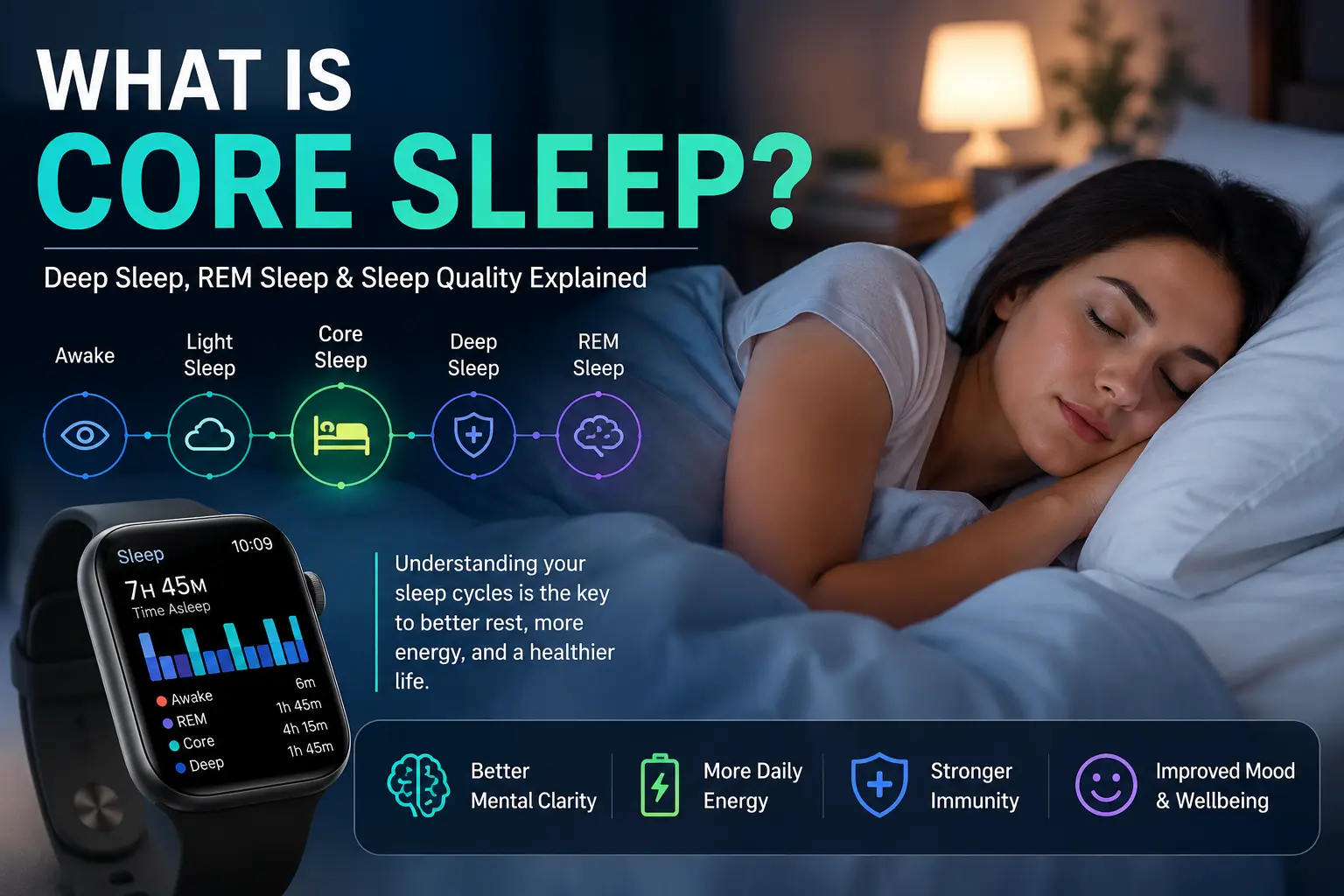
Core sleep refers to the most restorative portion of your sleep cycle that supports physical recovery, mental restoration, memory processing, hormone regulation, and overall sleep quality.
Although the term “core sleep” is widely used in sleep tracking apps and wellness discussions, it does not always have one universal scientific definition. In most cases, it generally describes the deeper and more restorative sleep stages that help your body and brain recover overnight.
Core sleep is closely connected to:
- Deep sleep (slow-wave sleep)
- REM sleep (rapid eye movement sleep)
- Healthy sleep cycles
- Restorative sleep quality
During these important sleep stages, your body performs several essential functions, including:
- repairing muscles and tissues
- strengthening the immune system
- consolidating memories
- regulating mood and stress hormones
- restoring mental focus and energy
This is why sleep quality often matters more than simply sleeping longer hours. A person can sleep for 8 hours but still wake up exhausted if their sleep cycles are repeatedly interrupted or if they are not getting enough restorative sleep.
Most healthy adults cycle through different sleep stages multiple times each night, with deeper restorative sleep usually occurring more during the first half of the night and REM sleep becoming longer toward the early morning hours.
Understanding how core sleep works can help you improve recovery, daytime energy, focus, and overall health.
Why the Term “Core Sleep” Confuses Many People
The term “core sleep” has become increasingly popular because of sleep tracking devices like the Apple Watch, Fitbit, Oura Ring, and other wearable health trackers. However, many people become confused because different apps and devices may define sleep stages differently.
In traditional sleep science, sleep is generally divided into:
- light sleep
- deep sleep
- REM sleep
Some sleep trackers use the label “core sleep” to describe lighter non-REM sleep stages, while others use it more broadly to represent restorative sleep overall. This is why your Apple Watch or sleep app may show “core sleep” separately from deep sleep and REM sleep.
The important thing to understand is that no wearable device can perfectly measure brain activity the same way a professional sleep study can. Most smartwatches estimate sleep stages using movement, heart rate, breathing patterns, and body signals rather than directly measuring brain waves.
Even though sleep trackers are not 100% accurate, they can still help identify patterns such as:
- poor sleep consistency
- fragmented sleep
- low sleep duration
- irregular recovery patterns
- frequent nighttime awakenings
Instead of obsessing over exact numbers, it is better to focus on your overall sleep quality, energy levels, recovery, and whether you consistently wake up feeling refreshed.
Understanding this confusion around “core sleep” helps you interpret sleep tracker data more realistically while focusing on improving restorative sleep overall.
The 4 Sleep Stages Explained
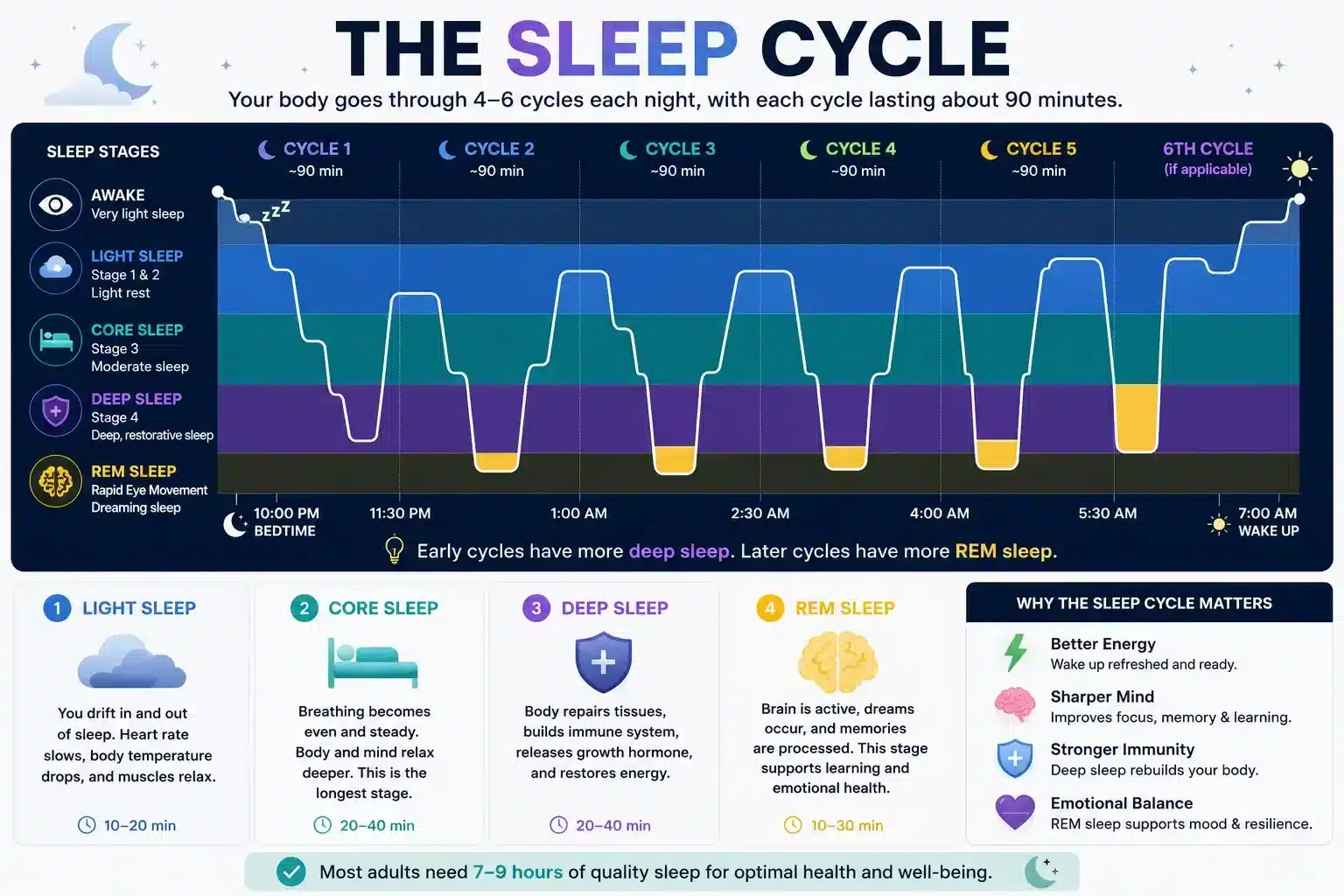
Your body moves through different sleep stages several times each night. Each stage plays a unique role in physical recovery, brain function, memory processing, and overall sleep quality.
A complete sleep cycle usually lasts around 90–110 minutes, and most people experience 4–6 sleep cycles per night.
Stage 1 (N1): Light Sleep
This is the transition stage between wakefulness and sleep. During this stage, your muscles begin to relax, your heart rate slows down, and brain activity starts shifting toward sleep mode.
Light sleep is easy to interrupt, which is why sudden noises or movement can quickly wake you up during this phase.
Stage 2 (N2): Core or Stable Sleep
Stage 2 sleep is considered a more stable form of light sleep and usually makes up the largest portion of total sleep time. Your body temperature drops, breathing slows, and brain activity becomes calmer.
Many sleep trackers and wearable devices often label this stage as “core sleep,” which is one reason people become confused about sleep stage terminology.
Although it is lighter than deep sleep, this stage still plays an important role in mental and physical recovery.
Stage 3 (N3): Deep Sleep
Deep sleep is the most physically restorative sleep stage. During this phase, your body focuses on muscle repair, tissue growth, immune system support, and physical recovery.
Brain waves slow significantly during deep sleep, making it harder to wake up. This stage is especially important for athletes, recovery, hormone balance, and overall energy restoration.
Low deep sleep is often associated with fatigue, poor recovery, and waking up feeling unrefreshed
REM Sleep: Rapid Eye Movement Sleep
REM sleep is the stage most strongly connected with dreaming, memory consolidation, emotional processing, and brain restoration.
During REM sleep, brain activity becomes highly active while the body remains temporarily relaxed to prevent physical movement during dreams.
REM sleep becomes longer during the second half of the night and plays a major role in learning, focus, mood regulation, and cognitive performance.
Together, these sleep stages work as a complete recovery system. Poor sleep quality, stress, alcohol, irregular schedules, or sleep disorders can interrupt these stages and reduce restorative sleep quality overall.
Core Sleep vs Deep Sleep vs REM Sleep
Many people use the terms core sleep, deep sleep, and REM sleep interchangeably, but they are not exactly the same thing. Understanding the differences between these sleep stages can help you better interpret your sleep quality and sleep tracker data.
Core sleep is often used as a broader term that refers to the restorative parts of sleep that support recovery, energy restoration, brain function, and overall health. However, some sleep trackers specifically label lighter non-REM sleep stages as “core sleep,” which creates confusion for many users.
Deep sleep, also known as slow-wave sleep, is the most physically restorative sleep stage. During deep sleep, the body focuses heavily on tissue repair, muscle recovery, immune function, and hormone regulation. This stage is especially important for physical recovery and feeling refreshed the next morning.
REM sleep (Rapid Eye Movement sleep) is more strongly associated with brain restoration, emotional regulation, memory consolidation, learning, and vivid dreaming. REM sleep becomes longer during the later sleep cycles, closer to morning.
While each sleep stage has a different function, healthy sleep depends on balanced sleep cycles working together throughout the night. Poor sleep habits, stress, alcohol, sleep apnea, or fragmented sleep can disrupt these stages and reduce overall restorative sleep quality.
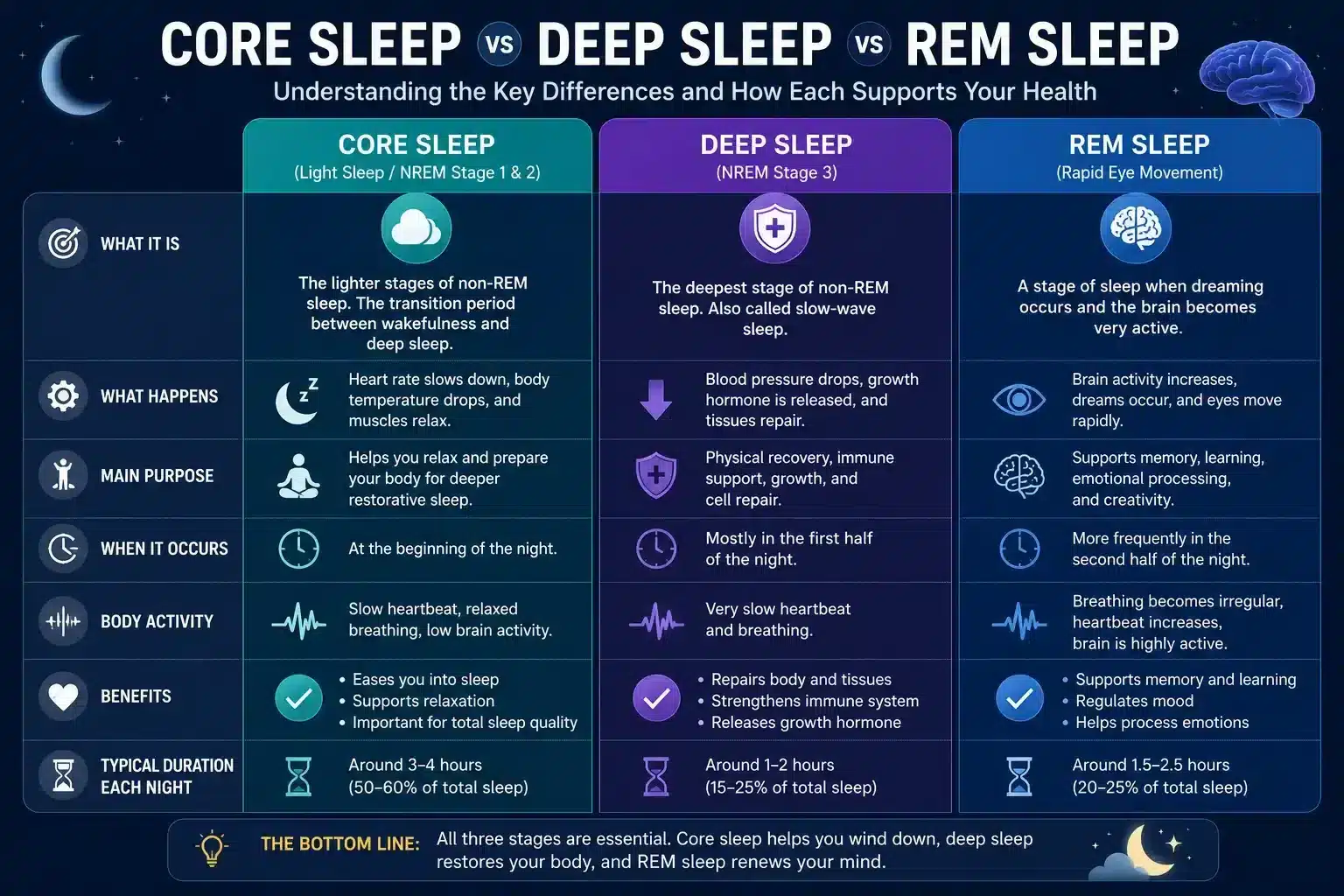
Quick Comparison of Core Sleep, Deep Sleep, and REM Sleep
| Sleep Stage | Main Function | Why It Matters |
|---|---|---|
| Core Sleep | General restorative sleep and stable sleep cycles | Supports overall recovery and sleep quality |
| Deep Sleep | Physical repair and recovery | Helps muscle repair, immune support, and energy restoration |
| REM Sleep | Brain restoration and emotional processing | Supports memory, learning, focus, and mood regulation |
Instead of focusing on only one sleep stage, improving your overall sleep quality and maintaining healthy sleep cycles is usually more important for long-term health and recovery.
How much core sleep do you need?
Most healthy adults need around 7–9 hours of total sleep per night, but not all sleep stages contribute equally to feeling fully rested and restored.
In general:
- Deep sleep usually makes up around 13–23% of total sleep
- REM sleep typically accounts for about 20–25%
- Light and stable sleep stages make up the remaining portion
For many adults, this means getting approximately:
- 1–2 hours of deep sleep
- 1.5–2 hours of REM sleep
- several hours of stable non-REM sleep cycles
However, sleep quality matters more than obsessing over exact numbers on a smartwatch or sleep tracker.
A person may technically sleep for 8 hours but still wake up exhausted if their sleep is repeatedly interrupted by stress, poor sleep habits, alcohol, sleep apnea, or irregular sleep schedules.
Several factors can also influence how much restorative sleep you need, including:
- age
- stress levels
- physical activity
- illness or recovery
- hormonal changes
- sleep consistency
Younger adults and physically active individuals often require more deep restorative sleep for muscle recovery, hormone regulation, and physical repair.
Older adults may naturally experience lighter sleep and reduced deep sleep, which can sometimes contribute to waking up more frequently during the night.
Instead of focusing only on sleep duration, it is better to focus on signs of healthy restorative sleep, such as:
- waking up refreshed
- stable daytime energy
- good mental focus
- balanced mood
- healthy recovery after activity
Consistently poor sleep quality or excessive daytime fatigue may indicate disrupted restorative sleep, even if total sleep hours appear normal.
| Sleep Stage | Average Healthy Range |
|---|---|
| Deep Sleep | 1–2 hours |
| REM Sleep | 1.5–2 hours |
| Total Sleep | 7–9 hours |
Signs You Are Not Getting Enough Restorative Sleep
Even if you sleep for 7–9 hours every night, poor sleep quality or disrupted sleep cycles can still leave you feeling physically and mentally exhausted.
When restorative sleep stages like deep sleep and REM sleep become fragmented, your body may struggle to recover properly overnight.
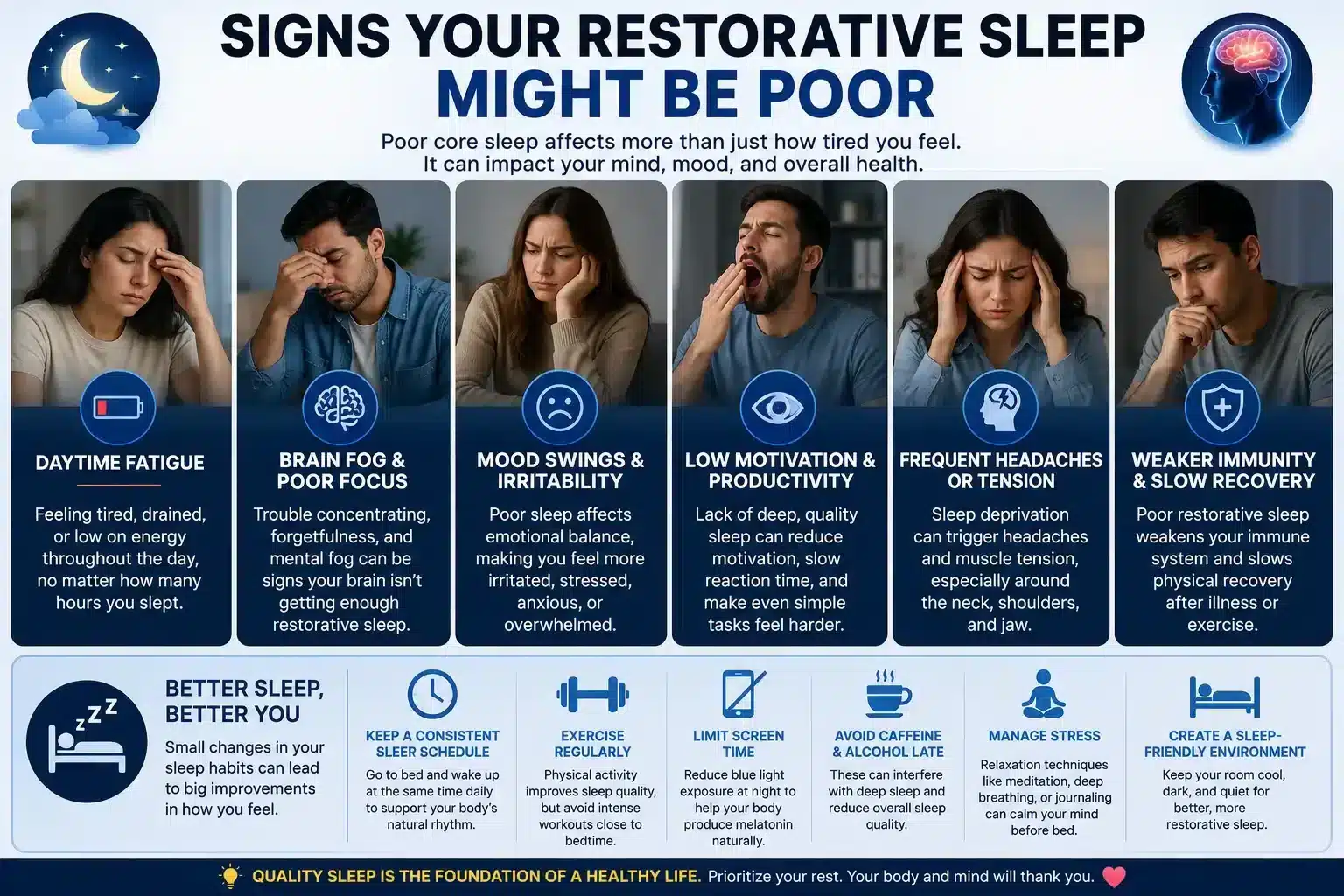
Some of the most common signs of poor restorative sleep include:
Waking Up Feeling Tired
One of the biggest warning signs is waking up feeling unrefreshed despite spending enough hours in bed. This often happens when sleep cycles are repeatedly interrupted during the night.
Brain Fog and Poor Concentration
Low-quality sleep can affect memory, focus, productivity, and mental clarity. Many people experience brain fog, slower thinking, or difficulty concentrating after poor restorative sleep.
Daytime Fatigue and Low Energy
Poor sleep quality can reduce physical recovery and energy restoration, leading to excessive daytime tiredness, low motivation, and afternoon energy crashes.
Mood Changes and Irritability
Sleep plays a major role in emotional regulation. Interrupted sleep and reduced REM sleep are commonly linked with irritability, stress sensitivity, anxiety, and mood swings.
Frequent Illness or Slow Recovery
Deep sleep supports immune function and physical repair. Inadequate restorative sleep may weaken immune defenses and slow recovery after exercise, illness, or stress.
Increased Stress and Cortisol Levels
Chronic sleep disruption can increase cortisol levels and make it harder for the body to properly regulate stress hormones, recovery, and overall energy balance.
If these symptoms continue for long periods, it may indicate poor sleep quality, sleep fragmentation, chronic stress, or an underlying sleep disorder affecting restorative sleep stages.
Why You Still Wake Up Tired Even After Sleeping
Sleeping for enough hours does not always guarantee restorative sleep. Many people still wake up tired because their sleep cycles are repeatedly disrupted throughout the night, preventing the body and brain from fully recovering.
Several factors can interfere with deep sleep and REM sleep quality, even if total sleep duration appears normal.
Sleep Fragmentation
Frequent awakenings during the night can interrupt restorative sleep stages and reduce overall sleep quality. Even small disruptions may prevent the body from staying in deep sleep long enough for proper recovery.
Stress and High Cortisol Levels
Chronic stress can keep the nervous system in a heightened state, making it harder to maintain healthy sleep cycles. Elevated cortisol levels are commonly associated with lighter sleep, nighttime awakenings, and waking up feeling unrested.
Poor Sleep Schedule
Irregular sleeping patterns, inconsistent bedtimes, and late-night screen exposure can disrupt your circadian rhythm and reduce restorative sleep quality.
Sleep Apnea and Breathing Problems
Sleep apnea is one of the most common causes of non-restorative sleep. Repeated breathing interruptions during sleep can prevent deep sleep and lower oxygen levels, often leading to excessive daytime fatigue and morning headaches.
Alcohol, Caffeine, and Late Meals
Alcohol may initially make you sleepy, but it often disrupts REM sleep later in the night. Excess caffeine, nicotine, or heavy meals close to bedtime can also interfere with healthy sleep cycles.
Underlying Health Conditions
Conditions such as anxiety, depression, chronic pain, hormonal imbalances, and restless leg syndrome may affect sleep quality and reduce restorative sleep.
If you regularly wake up exhausted despite getting enough sleep, focusing only on sleep duration may not solve the problem. Improving sleep quality and addressing disrupted sleep patterns is often more important than simply spending more hours in bed.
Benefits of Healthy Core Sleep
Healthy restorative sleep supports nearly every major system in the body, including brain function, emotional health, metabolism, immune function, and physical recovery.
When you consistently achieve balanced sleep cycles with adequate deep sleep and REM sleep, your body can recover more efficiently both physically and mentally.
Some of the most important benefits of healthy core sleep include:
Better Mental Focus and Memory
Deep sleep and REM sleep help the brain process information, strengthen memory, improve concentration, and support learning and cognitive performance.
Improved Physical Recovery
Restorative sleep supports muscle repair, tissue recovery, energy restoration, and healthy hormone production. This is especially important after exercise, illness, or periods of stress.
Stronger Immune Function
Healthy sleep helps regulate immune responses and supports the body’s ability to fight infections, inflammation, and physical stress.
Better Mood and Emotional Balance
REM sleep plays a major role in emotional regulation and stress recovery. Poor sleep quality is often associated with irritability, anxiety, mood swings, and mental fatigue.
Healthier Hormone and Energy Balance
Consistent restorative sleep helps regulate hormones connected with stress, appetite, metabolism, recovery, and overall energy levels.
Over time, improving sleep quality may support better daytime energy, mental clarity, recovery, productivity, and overall well-being.
How to Improve Core Sleep Naturally
Improving core sleep is not just about sleeping longer hours. It is about improving sleep quality, maintaining healthy sleep cycles, and reducing factors that interrupt restorative sleep.
Small daily habits can significantly improve deep sleep, REM sleep, recovery, and overall sleep quality over time.
Maintain a Consistent Sleep Schedule
Going to bed and waking up at the same time every day helps regulate your circadian rhythm and improves sleep cycle consistency. Irregular sleep schedules can disrupt restorative sleep stages and reduce sleep quality. Use our sleep calculating app to ascertain your ideal sleep schedule.
Reduce Screen Exposure Before Bed
Blue light from phones, tablets, and televisions may interfere with melatonin production and delay healthy sleep cycles. Reducing screen exposure 1–2 hours before bedtime may help improve sleep quality naturally.
Optimize Your Sleep Environment
A cool, dark, and quiet bedroom can improve restorative sleep. Comfortable bedding, blackout curtains, reduced noise, and proper room temperature may help support deeper sleep stages.
Manage Stress and Cortisol Levels
Chronic stress and elevated cortisol levels are strongly linked with poor sleep quality and nighttime awakenings. Relaxation techniques such as meditation, deep breathing, stretching, journaling, or mindfulness may help calm the nervous system before sleep.
Limit Alcohol, Heavy Meals, and Late Caffeine
Alcohol, caffeine, nicotine, and heavy meals close to bedtime can interfere with healthy sleep cycles and reduce REM sleep and deep sleep quality.
Get Morning Sunlight Exposure
Natural morning light helps regulate circadian rhythm and supports healthier melatonin production later at night. Regular sunlight exposure may help improve sleep consistency and overall restorative sleep quality.
Exercise Regularly
Regular physical activity is associated with better sleep quality and improved restorative sleep. However, intense exercise very close to bedtime may interfere with falling asleep for some individuals.
Address Underlying Sleep Disorders
Conditions such as sleep apnea, chronic insomnia, restless leg syndrome, anxiety, magnesium deficiency, or breathing problems may significantly reduce restorative sleep quality. Persistent sleep problems should be evaluated by a healthcare professional.
Improving sleep quality often requires consistency rather than quick fixes. Even small improvements in daily sleep habits can gradually lead to better recovery, daytime energy, focus, and overall well-being.
Frequently Asked Questions
What is considered healthy core sleep?
Healthy restorative sleep usually includes balanced sleep cycles with enough deep sleep, REM sleep, and stable non-REM sleep. Most adults need around 7–9 hours of total sleep with consistent sleep quality and minimal sleep interruptions.
Is core sleep the same as deep sleep?
No. Deep sleep is one specific stage of restorative sleep focused mainly on physical recovery and tissue repair. Core sleep is often used more broadly to describe restorative sleep stages overall, although some sleep trackers define it differently.
What does core sleep mean on Apple Watch?
On Apple Watch and some sleep trackers, “core sleep” often refers to lighter non-REM sleep stages rather than deep sleep itself. Sleep trackers estimate sleep stages using body signals such as movement, breathing, and heart rate.
How much deep sleep do adults need?
Most healthy adults usually get around 1–2 hours of deep sleep per night, although this can vary depending on age, stress levels, sleep quality, and overall health.
Why do I wake up tired after sleeping 8 hours?
Poor sleep quality, sleep fragmentation, stress, sleep apnea, irregular sleep schedules, or insufficient restorative sleep may cause fatigue even after sleeping for enough hours.
Can sleep trackers accurately measure sleep stages?
Sleep trackers can help identify general sleep patterns, but they are not perfectly accurate. Professional sleep studies remain the most reliable method for measuring sleep stages and diagnosing sleep disorders.
Is 2 hours of deep sleep enough?
For many adults, 1–2 hours of deep sleep per night falls within a healthy range. However, sleep quality and overall recovery are usually more important than focusing on exact numbers alone.
Does poor sleep quality affect brain function?
Yes. Poor restorative sleep can affect concentration, memory, mood, emotional regulation, mental clarity, and overall cognitive performance.
Conclusion
Core sleep plays an essential role in physical recovery, mental clarity, emotional balance, hormone regulation, and overall sleep quality. Understanding how sleep stages work, including deep sleep and REM sleep, can help explain why some people wake up refreshed while others still feel exhausted despite sleeping for enough hours.
Although sleep trackers and wearable devices have made sleep data more accessible, improving restorative sleep is ultimately about maintaining healthy sleep habits, consistent sleep cycles, stress management, and overall sleep quality rather than obsessing over exact numbers alone.
If you regularly experience fatigue, brain fog, poor concentration, or daytime sleepiness despite getting enough sleep, it may be worth evaluating your sleep quality and discussing persistent symptoms with a healthcare professional.
Even small improvements in sleep consistency, stress reduction, and nighttime habits can gradually support better recovery, energy, focus, and long-term well-being.