


Quick Takeaways: What Does 10000 Steps a Day Actually Do?
- 10,000 steps is a useful benchmark, not a magic number.
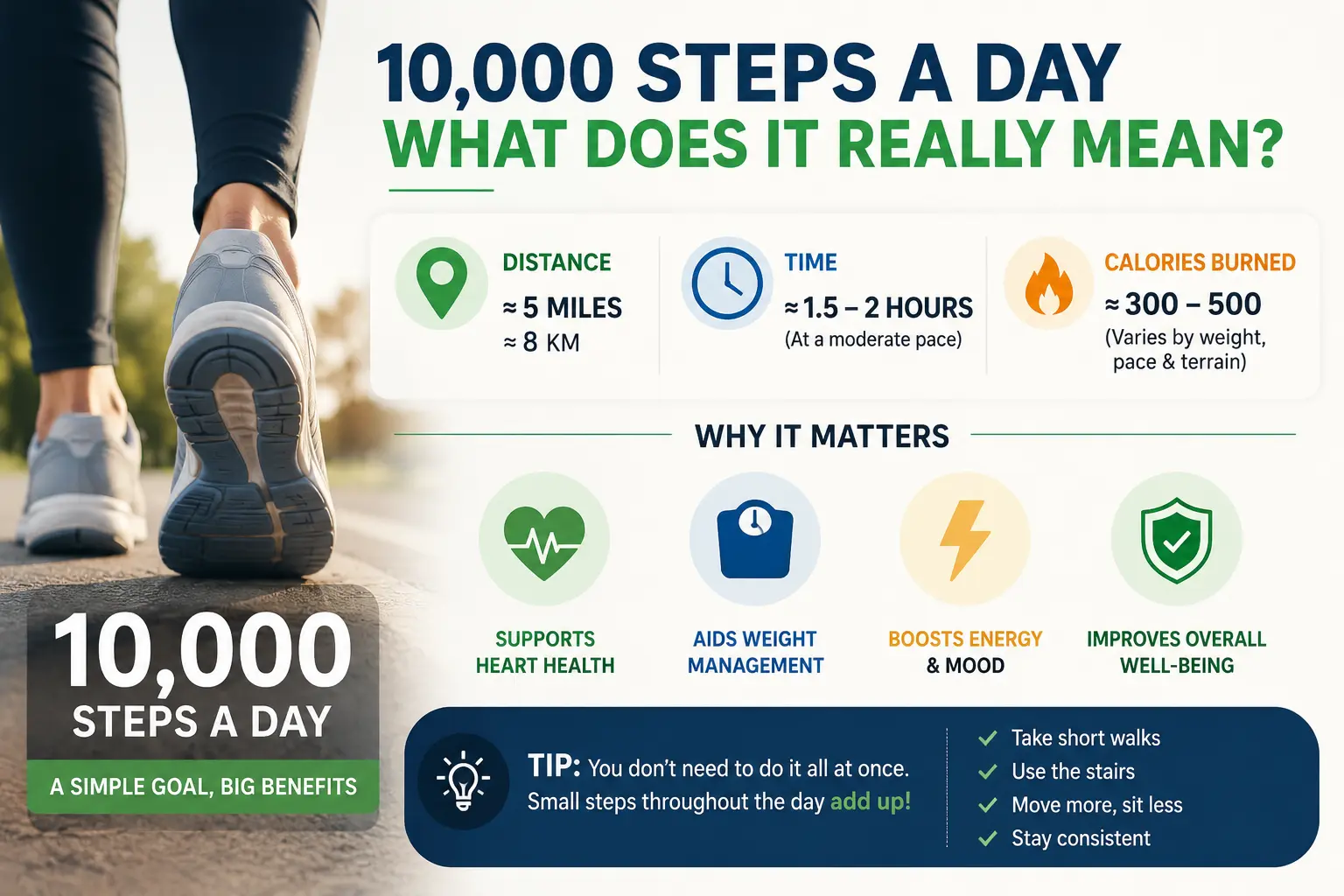
- For many adults, 10,000 steps is roughly 5 miles (8 km), but stride length changes the distance.
- It may take around 1.5–2 hours to accumulate 10,000 steps, depending on walking pace.
- Calories burned vary with body weight, pace, terrain, and individual factors.
- You don’t have to complete all 10,000 steps in one walk; spreading them throughout the day works.
- For health and weight management, consistency and your overall activity level matter more than hitting exactly 10,000 steps every day.
10000 Steps at a Glance: Distance, Time, Calories & Activity
| Question | Approximate answer |
|---|---|
| How far is 10,000 steps? | Roughly 5 miles / 8 km for an average stride |
| How long does it take? | Often around 1.5–2 hours, depending on pace |
| How many calories? | Average 300- 500 calories. Varies substantially with body weight, pace, and terrain |
| Is 10,000 necessary? | No; meaningful benefits occur below 10,000 |
| Can it help weight loss? | Yes, when it contributes to an appropriate overall energy balance |
| Must you walk it all at once? | No; steps can be accumulated throughout the day |
What Exactly Are 10000 Steps, and Why Did This Number Become a Goal?
10,000 steps is a popular daily movement benchmark, not a scientifically established minimum that everyone must reach. The number became widely associated with daily walking through the promotion of a Japanese pedometer campaign around the 1964 Tokyo Olympics. The health benefits come from being physically active, not from crossing an arbitrary 10,000-step threshold.
The number became popular first as an easy-to-remember activity target, while later research examined how different amounts of daily walking relate to health outcomes.
Is 10000 Steps Actually Based on Science?
Not as a mandatory threshold. Current evidence suggests that meaningful health benefits can occur at levels below 10,000 steps, although additional activity can yield further benefits.
Research Insight
The important variable is not the number 10,000 itself. Research increasingly examines step volume as a continuous measure of physical activity. Your health response depends on how active you are overall, how much you increase your movement, and the intensity and consistency of that activity, not simply whether your tracker displays 10,000.
10,000 steps can be an excellent goal, but 7,000, 8,000, or another sustainable number may also represent meaningful progress depending on where you start.
For someone currently averaging 3,000 steps, reaching 6,000 consistently may be a more meaningful first milestone than forcing 10,000 immediately. Conversely, someone already averaging 9,000 may benefit from increasing activity intensity or adding other forms of exercise rather than obsessing over another 1,000 steps.
How Far Is 10000 Steps in Miles and Kilometers?
10,000 steps is roughly 5 miles (8 kilometers) for an average adult, but the actual distance varies with stride length. A taller person with a longer stride may cover more ground with the same number of steps, while a shorter stride may require more steps to cover that distance.
How Many Miles Is 10,000 Steps?
For a commonly used average stride of about 0.8 meters, 10,000 steps works out to approximately 8 kilometers, or 4.97 miles. This is why the simple answer to “how many miles is 10,000 steps?” is usually about 5 miles.
However, treat 5 miles as an estimate, not a personal measurement. Your actual distance depends largely on how long each step is.
How Many Kilometers Is 10000 Steps?
Using the same approximate average stride, 10,000 steps equals about 8 kilometers. That conversion is useful for comparing step-count goals with walking routes, treadmill distances, or fitness-tracker measurements.
| Step count | Approximate distance* |
|---|---|
| 1,000 steps | ~0.8 km / 0.5 mile |
| 2,500 steps | ~2 km / 1.25 miles |
| 5,000 steps | ~4 km / 2.5 miles |
| 7,500 steps | ~6 km / 3.7 miles |
| 10,000 steps | ~8 km / ~5 miles |
Estimates based on an average stride of approximately 0.8 meters; individual distances may vary.
Why Doesn’t 10000 Steps Equal the Same Distance for Everyone?
Stride length is the main reason two people can record 10,000 steps while walking different distances. Height, leg length, walking mechanics, and pace can all influence stride length.
Imagine two people walking side by side. If one naturally takes longer strides, that person’s step counter may reach 10,000 after covering more ground. The other person may need additional steps to cover the same route.
Research Insight
Step count measures steps, not distance. A step counter can tell you how many times you moved your feet, but it does not automatically tell you how far you travelled unless it estimates stride length or uses another distance-measurement method.
What Is the Best Way to Know Your Own 10000 Steps Distance?
Measure your personal stride rather than relying entirely on the 5-mile estimate. Walk a known distance, record your steps, and use that relationship to estimate how far your own 10,000 steps would take you.
For practical purposes, though, about 5 miles (8 km) is a useful starting estimate when planning a 10,000-step walking day.
How Long Does It Take to Walk 10000 Steps?
While age and body weight affect total calorie burn, the time duration to complete 10,000 steps depends primarily on walking pace (speed) and stride length (height). Age can influence natural walking speed, while height dictates step length.
Here is a structured table to add directly to that section:
| Age Bracket | Average Height & Stride Length | Casual Pace (2.0 mph) | Average Pace (3.0 mph) | Brisk Pace (4.0 mph) |
| Young Adults (18–35 yrs) | ~5’7″ (2.2 ft stride) | ~2 hrs 5 mins | ~1 hr 25 mins | ~1 hr 03 mins |
| Middle-Aged Adults (36–55 yrs) | ~5’6″ (2.1 ft stride) | ~2 hrs 11 mins | ~1 hr 28 mins | ~1 hr 05 mins |
| Older Adults (56–70 yrs) | ~5’5″ (2.0 ft stride) | ~2 hrs 18 mins | ~1 hr 32 mins | ~1 hr 08 mins |
| Seniors (71+ yrs) | ~5’4″ (1.9 ft stride) | ~2 hrs 25 mins | ~1 hr 37 mins | ~1 hr 12 mins |
Can You Complete 10000 Steps Without Walking for Two Hours Straight?
Absolutely. Breaking 10,000 steps into several shorter walks is often more practical than scheduling one long session. You can accumulate steps through planned walks and everyday movement at work, at home, while running errands, or while commuting.
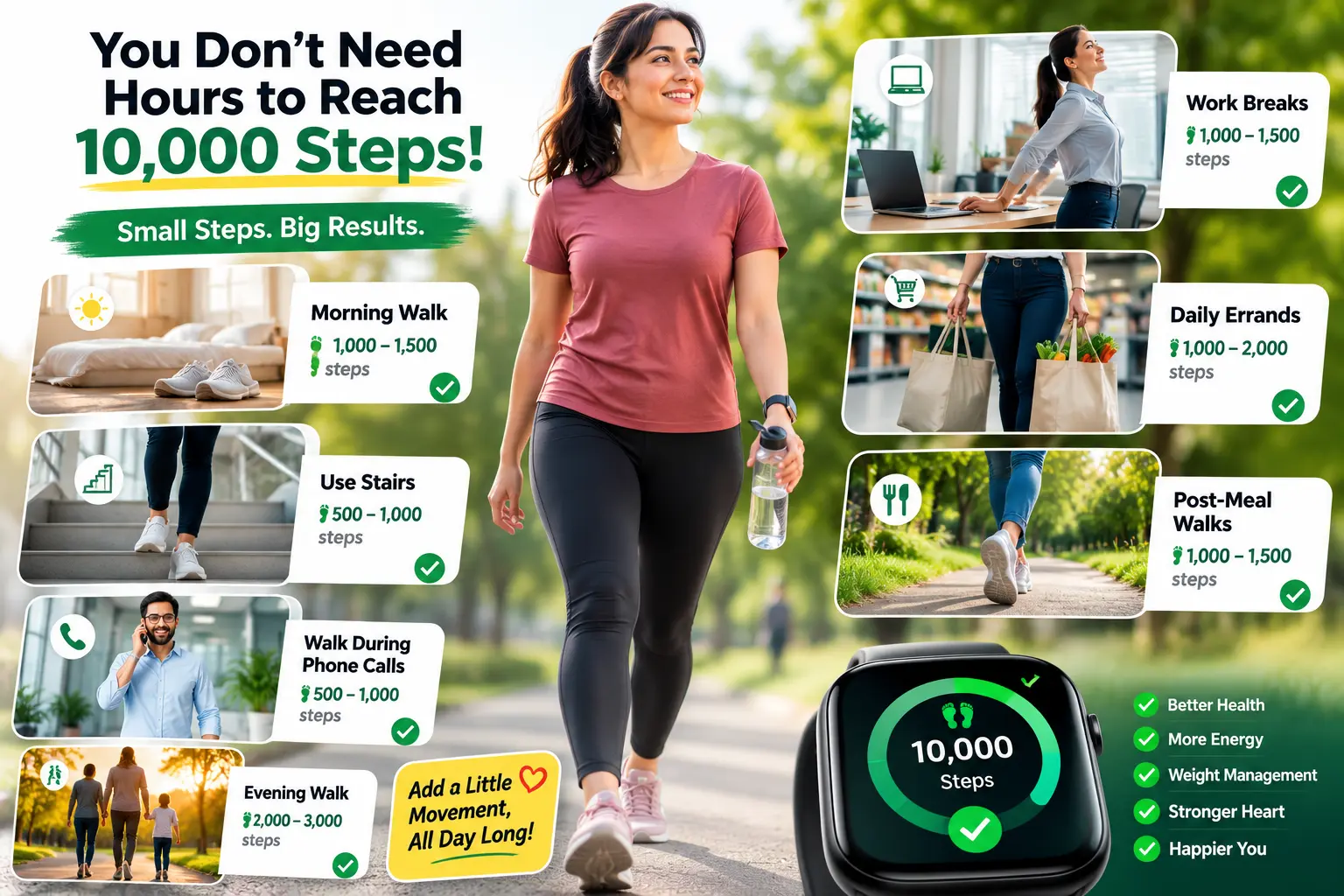
The following table can help to assess the required time split:
| Time / Routine Block | Activity Example | Approx. Steps | Approx. Time |
| Morning Routine | Morning neighborhood walk or walking the dog | 2,500 – 3,000 | 20–25 mins |
| Workday Morning | Walking while taking phone calls or taking the stairs | 1,000 – 1,500 | Throughout morning |
| Lunch Break | Post-lunch outdoor walk or errand run | 2,000 – 2,500 | 20 mins |
| Workday Afternoon | Hourly movement breaks (walking to grab water, pacing) | 1,000 – 1,500 | Throughout afternoon |
| Evening Routine | Evening walk with family, post-dinner stroll, or house chores | 2,000 – 2,500 | 20 mins |
| Total Daily Accumulation | Distributed movement across the full day | 10,000+ | ~1.5–2 hrs total |
How Many Calories Does 10000 Steps Burn?
The average adult burns roughly 30 to 50 calories per 1,000 steps, which places 10,000 steps squarely in the 300–500 calorie range for most people.
Does Body Weight Change Calories Burned From 10000 Steps?
Yes. Body weight is one of the important factors affecting the energy required to move your body. Energy expenditure is directly tied to mass. A 130 lb (59 kg) person may burn around 300–350 calories, whereas a 200 lb (91 kg) person can burn upwards of 500 calories doing the same distance
| Body Weight | Casual Pace (2.0 mph) | Average Pace (3.0 mph) | Brisk Pace (4.0 mph) |
| 130 lbs (59 kg) | ~280 – 320 kcal | ~330 – 370 kcal | ~400 – 440 kcal |
| 160 lbs (73 kg) | ~340 – 380 kcal | ~400 – 450 kcal | ~490 – 540 kcal |
| 190 lbs (86 kg) | ~400 – 450 kcal | ~480 – 530 kcal | ~580 – 640 kcal |
| 220 lbs (100 kg) | ~470 – 520 kcal | ~550 – 610 kcal | ~670 – 740 kcal |
Note: Calorie burn estimates reflect gross energy expenditure for 10,000 steps. Actual individual expenditure varies depending on incline, terrain, and individual metabolic efficiency.
Does Burning More Calories Mean Losing More Body Fat?
Not automatically. Walking increases energy expenditure, but fat loss depends on your overall energy balance over time, not on the calorie expenditure of one walking session.
A 10,000-step a day can therefore support weight loss without guaranteeing it. If increased activity is consistently offset by increased food intake, the expected calorie deficit may disappear.
That is why 10,000 steps should be viewed as one component of a weight-management strategy, not a guaranteed calorie-burning prescription.
Is 10000 Steps Really Better Than 7,000 or 8,000?
No. You do not need exactly 10,000 steps to gain meaningful health benefits from walking. The important distinction is that 7,000 is not a new magic number either. Step count should be viewed as a continuous measure of activity, not a pass-or-fail threshold.
Do You Need Exactly 10000 Steps Every Day?
No. Your most useful target depends on your current activity level and what you can sustain consistently. Someone averaging 3,000 steps has already made meaningful progress by reaching 5,000 or 7,000 regularly. Someone already averaging 8,500 may reasonably use 10,000 as the next milestone.
Is More Than 10000 Steps Always Better?
Not necessarily. More movement can be valuable, but endlessly increasing step volume is not the only way to improve fitness. Once your walking habit is established, you may gain more from adding brisk walking, hills, resistance training, or other appropriate activity than from chasing an ever-higher step count.
Key Takeaways
- 10,000 steps is useful, but not mandatory.
- Meaningful benefits can occur below 10,000 steps.
- Your current baseline matters.
- Consistency matters more than occasionally reaching a large number.
- Once walking is established, activity quality matters alongside step volume.
How Should Beginners Build Up to 10000 Steps?
Beginners should build toward 10,000 steps from their current activity level rather than forcing the full target immediately. Starting with a manageable increase makes the habit easier to sustain and gives your feet, ankles, knees, and cardiovascular system time to adapt.
What If You Currently Walk Fewer Than 5,000 Steps?
Start by finding your normal daily average, then choose a realistic next milestone. If your baseline is 3,000 steps, there is no reason to make 10,000 your immediate requirement. Consistently increasing your movement is more useful than reaching 10,000 once and struggling to repeat it.
A simple progression is:
- Establish your baseline.
- Add a manageable amount of walking.
- Maintain that level until it feels sustainable.
- Increase again when your body and routine are ready.
Key Takeaways
- Start from your current baseline, not someone else’s target.
- Increase gradually rather than making a dramatic jump.
- Let your body adapt before adding substantially more walking.
- Persistent pain, dizziness, or unusual symptoms are reasons to stop and seek appropriate medical advice.
- A sustainable 6,000 or 7,000 steps can be more useful than an unsustainable 10,000.
How Can You Make 10000 Steps More Effective?
Once 10,000 steps becomes comfortable, you can increase the training effect by changing how you walk rather than simply adding more steps. Brisk walking, hills, stairs, and short pace intervals can make the same daily step target more demanding.
Is 10000 Steps Enough for Overall Fitness?
10,000 steps can provide substantial daily movement, but they do not replace every component of a complete fitness program. Walking can contribute to aerobic activity, while resistance training provides a different stimulus for muscular strength and development.
Do You Still Need Strength Training?
Yes, if your goal is complete fitness, 10,000 steps should complement rather than replace resistance training. Walking repeatedly loads the lower body, but it does not provide the progressive resistance stimulus used to develop muscular strength.
What Does a Balanced Routine Look Like?
A practical combination can include:
- Daily walking: builds movement volume.
- Brisk walking or other aerobic activity: adds cardiovascular challenge.
- Resistance training: develops muscular strength and function.
- Recovery: allows your body to adapt to increased activity.
The objective is not to turn every day into a demanding workout. Use your step target to support an active lifestyle, then add the forms of exercise that walking alone cannot provide.
What Are the Biggest Mistakes People Make With 10000 Steps?
The biggest mistake is treating 10,000 steps as a magic number instead of a practical movement target. A step count can help you monitor activity, but it does not tell you everything about exercise intensity, calorie expenditure, nutrition, recovery, or overall fitness.
Are You Relying Too Much on the Number 10000?
Don’t let your tracker turn 9,500 steps into a failed day. Meaningful health benefits can occur below 10,000 steps, so the more useful measure is your overall activity pattern and progress from your personal baseline.
Are You Overestimating Calories Burned?
Avoid treating your watch or phone’s calorie estimate as an exact measurement. The energy cost of 10,000 steps varies with body weight, pace, terrain, stride, and other individual factors.
A step count tells you how much movement occurred, not exactly how many calories your body used.
Are You Expecting Walking Alone to Guarantee Weight Loss?
Walking can support weight loss, but it does not override overall energy balance. If increased activity is consistently offset by increased calorie intake, the expected deficit may disappear.
Are You Increasing Your Steps Too Quickly?
A sudden jump in walking volume can create unnecessary soreness and make the habit harder to maintain. Build progressively from your normal activity level instead of forcing a large step increase overnight. IU Health recommends gradual progression for people building toward higher daily step counts.
Key Takeaways
Don’t chase the biggest number on your tracker. Build the most sustainable movement habit for your body, goals, and lifestyle.
Walking 10000 Steps vs. Running: Which Is Better?
Neither is universally better. Walking is generally easier to repeat and accumulate, while running provides greater exercise intensity in less time. The better choice depends on your current fitness level, goals, preferences, and what you can sustain consistently.
| Factor | Walking | Running |
|---|---|---|
| Impact | Lower | Higher |
| Exercise intensity | Lower to moderate, depending on pace | Generally higher |
| Beginner accessibility | Generally higher | More variable |
| Time efficiency | Lower | Higher |
| Daily repeatability | Often easier | More demanding |
For someone whose immediate goal is to increase daily movement, walking can be an excellent foundation. If you are already active and want a stronger cardiovascular stimulus in less time, running can provide that—but it is not necessary simply to make your 10,000-step goal more valuable.
Frequently Asked Questions
How many miles is 10000 steps?
About 5 miles (8 km) is a useful average estimate for 10,000 steps, based on an approximately 0.8-meter stride. Your actual distance can vary with stride length.
How long does 10000 steps take?
For many adults, approximately 1.5–2 hours of walking is a reasonable planning estimate, although pace and stride length can change the actual time.
Can you lose weight by walking 10,000 steps a day?
Walking 10,000 steps typically burns 300 to 500 calories above baseline for an average adult, depending on weight, pace, and terrain.. Burning an extra 350 calories per day creates a weekly deficit of 2,450 calories, which theoretically equates to roughly 0.7 lbs (0.3 kg) of fat loss per week from walking alone.
Can you split 10,000 steps throughout the day?
Yes. Short walks, work breaks, errands and other daily movement can collectively contribute to your target.
What if I cannot reach 10,000 steps?
Start from your current baseline and increase gradually. A sustainable increase is more useful than forcing an arbitrary number that you cannot maintain.
Conclusion
10,000 steps can be a practical way to increase daily movement, support weight management, and build a consistent walking habit, but it is not a magic health threshold. You do not need to hit exactly 10,000 every day to benefit from being more active.
Your actual distance, walking time, and calorie expenditure depend on factors such as stride length, pace, body weight, terrain, and fitness level. For some people, 7,000 or 8,000 steps may be a more realistic and equally valuable starting point.
The bigger goal is simple: move more, progress gradually, and stay consistent. Use 10,000 steps as a useful benchmark, not a pass-or-fail test, and combine regular walking with appropriate nutrition, aerobic activity, and strength training for a more complete approach to fitness.