Wearable technology has officially entered its Longevity Era in 2026. We’re no longer just counting steps or calories—we’re managing sleep quality, circadian rhythm alignment, and long-term biological resilience.
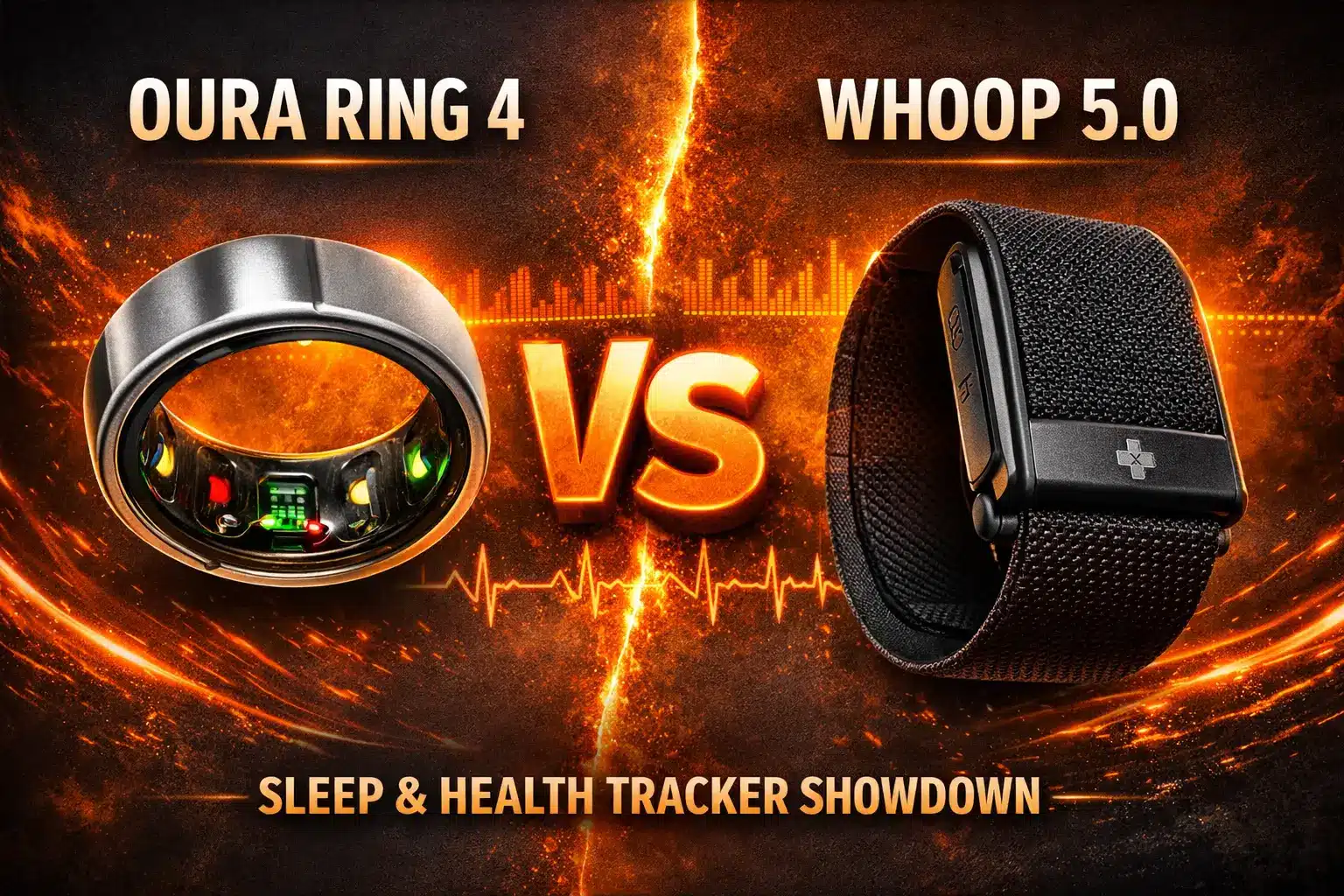
That’s why the comparison between Oura Ring 4 vs WHOOP 5.0 sleep recovery has intensified. Both devices promise advanced health insights in a screen-free form factor, but they are built for very different types of users.
If you’re searching for sleep optimization tips backed by real data, this guide breaks down the technology, science, hidden costs, and real-world usability so you can make the right choice.
Oura Ring 4 vs WHOOP 5.0 (30-Second Verdict)
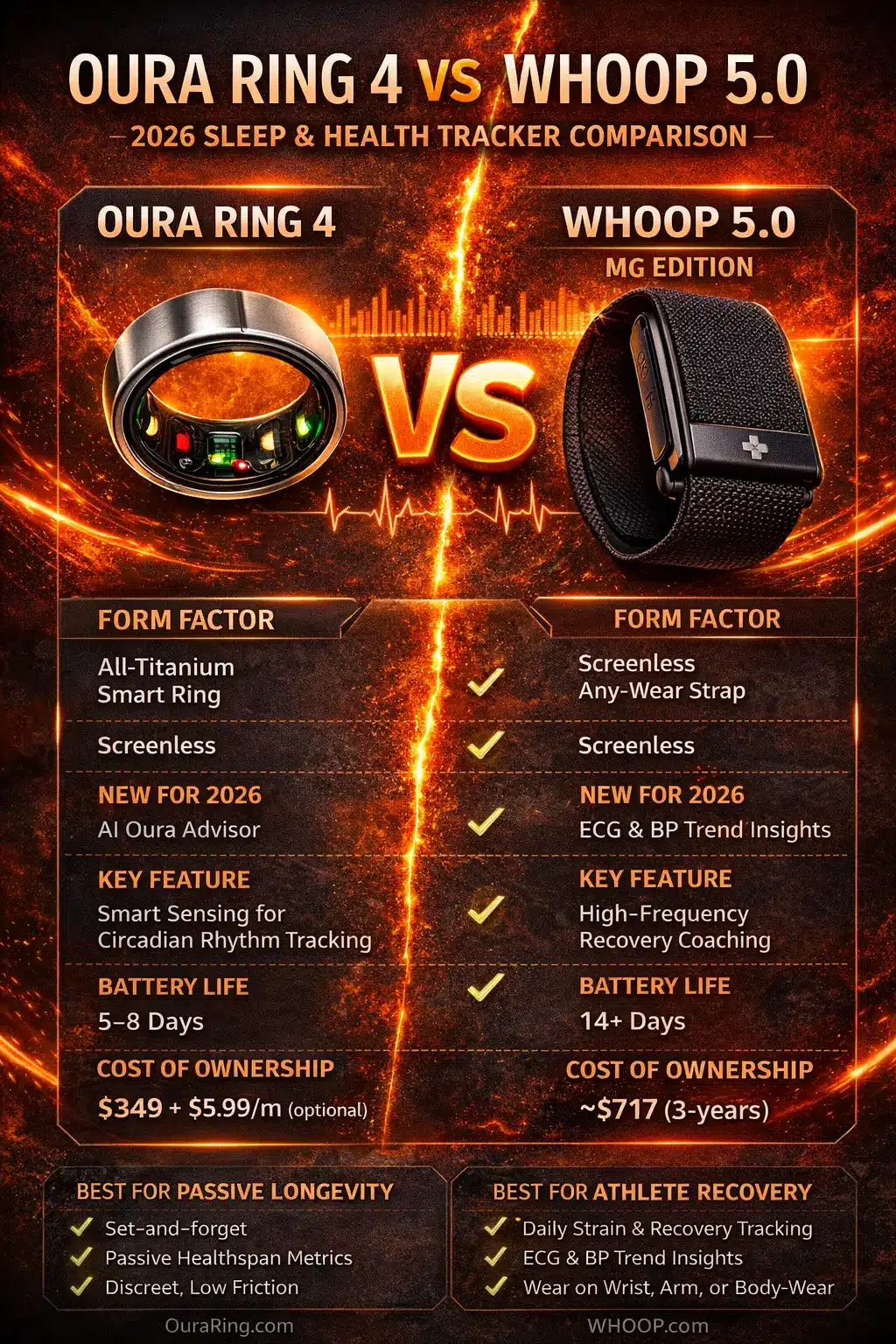
- Choose Oura Ring 4 if you want a “set-it-and-forget-it” wearable focused on passive longevity, circadian rhythm tracking, temperature trends, and minimal cognitive load.
- Choose WHOOP 5.0 (MG edition) if you’re an athlete or data-driven user who wants ECG-based heart screening, blood pressure trend insights, and aggressive recovery coaching.
Quick Comparison: 2026 Specs at a Glance
| Feature | Oura Ring 4 | WHOOP 5.0 (MG Edition) |
|---|---|---|
| Form Factor | All-Titanium Smart Ring | Screenless Any-Wear Strap |
| Core Technology | Smart Sensing (flush interior) | 26x/sec sensor sampling |
| Battery Life | 5–8 days | 14+ days |
| New for 2026 | AI Oura Advisor | ECG + BP trend insights |
| Pricing | $349 + $5.99/month | Membership only ($199–$359/year) |
Sleep Optimization Tips: How These Devices Actually Improve Sleep
To rank for sleep optimization tips in 2026, it’s no longer enough to talk about sleep duration or basic sleep scores. Modern sleep science focuses on how efficiently your body enters, maintains, and recovers from deep sleep, and both Oura Ring 4 and WHOOP 5.0 are built around this shift.
The new gold standards for high-quality sleep are adenosine clearance, circadian rhythm alignment, and thermal regulation. These wearables don’t just measure sleep; they actively help users understand why their sleep improves or deteriorates over time.
Protect and Align Your Circadian Rhythm
Your circadian rhythm is your body’s internal clock, governing melatonin release, cortisol timing, body temperature, and sleep pressure. When this rhythm is misaligned — even by 60–90 minutes — sleep quality can drop sharply.
Oura Ring 4 uses its upgraded Smart Sensing platform to map your ideal sleep window with much higher precision than earlier wearables. Instead of relying on fixed bedtime rules, it analyzes:
- Your heart rate decline timing
- Core body temperature trends
- Previous night’s sleep efficiency
This allows Oura to suggest personalized bedtime ranges, showing you when your body is biologically ready for sleep, not just when you think you should sleep.
Why this matters for optimization:
Sleeping outside your circadian window often leads to:
- Longer sleep onset latency
- Reduced REM sleep
- Increased nighttime awakenings
By nudging users toward circadian-aligned bedtimes, Oura indirectly improves sleep depth and consistency.
Support Adenosine Clearance for Deeper Sleep
Adenosine is the chemical “sleep pressure” that builds up while you’re awake and dissipates during deep sleep. Poor sleep quality often means incomplete adenosine clearance, leaving you groggy even after 7–8 hours in bed.
Both Oura Ring 4 and WHOOP 5.0 track indicators that correlate with adenosine clearance, including:
- Heart rate drop timing
- Sleep onset efficiency
- Duration of uninterrupted deep sleep
WHOOP 5.0 takes this further by linking adenosine clearance to daily strain and recovery. If your previous day’s physical or mental load was high, WHOOP automatically adjusts your sleep recommendations — often suggesting longer or earlier sleep to reset your nervous system fully.
Optimization insight:
Users who consistently match sleep duration to their strain level tend to report:
- Better morning alertness
- Improved HRV trends
- Reduced afternoon energy crashes
Detect and Reduce Micro-Overheating Events
A lesser-known sleep disruptor in 2026 is micro-overheating — small, brief increases in skin temperature that fragment REM and deep sleep without fully waking you.
Both devices now flag these temperature deviations, but they interpret them differently:
- Oura Ring 4 focuses on patterns, helping users identify whether overheating is linked to:
- Late meals
- Alcohol intake
- Room temperature or bedding
- WHOOP 5.0 links temperature spikes to suppression of recovery, showing that even minor thermal stress can lower next-day readiness.
Why this improves sleep:
Reducing micro-overheating can:
- Extend REM cycles
- Improve sleep continuity
- Reduce nighttime restlessness
Even small changes — like adjusting bedding or meal timing — can significantly improve sleep architecture once users are aware of these patterns.
Manage Sleep Debt Without Guesswork
Sleep debt is no longer treated as a simple “missed hours” calculation. In 2026, it’s understood as cumulative physiological strain that compounds over days and weeks.
WHOOP 5.0’s Sleep Coach excels here. It dynamically calculates sleep debt based on:
- Prior-day strain
- Recovery score
- HRV suppression
- Resting heart rate elevation
Instead of generic advice, WHOOP tells you exactly how much additional sleep you need to return to baseline recovery — sometimes recommending an extra 30–90 minutes for full physiological reset.
Oura Ring 4, meanwhile, takes a gentler approach. It highlights chronic sleep debt trends and focuses on consistency over perfection, which many users find more sustainable long-term.
Practical Takeaway: Which Device Improves Sleep More?
- Oura Ring 4 improves sleep by helping you live in sync with your biology — aligning circadian rhythm, reducing thermal stress, and reinforcing long-term sleep consistency.
- WHOOP 5.0 improves sleep by engineering recovery — adjusting sleep targets based on strain, stress, and performance demands.
Both approaches work — but they serve different personalities.
If your goal is calm, predictable, high-quality sleep, Oura’s passive optimization wins.
If your goal is maximal recovery under stress, WHOOP’s adaptive coaching has the edge.
Sleep Tracking & HRV Accuracy
When comparing Oura Ring 4 and WHOOP 5.0, accuracy is less about who collects more data and more about how consistently that data reflects real physiological trends over time.
In 2026, the gold standard for sleep tracking accuracy is no longer perfect sleep-stage labeling on a single night. Instead, it’s the ability to:
- Maintain stable sensor contact
- Reduce motion artifacts
- Track HRV trends, not isolated values
- Detect meaningful deviations from your personal baseline
Both Oura and WHOOP achieve this — but through very different design philosophies.
Oura Ring 4: Passive Longevity Accuracy
Oura Ring 4 has quietly optimized one of the most overlooked factors in wearable accuracy: sensor stability during sleep.
By removing internal sensor “bumps” and introducing a flush titanium interior, the ring sits more evenly against the finger throughout the night. This reduces micro-rotation, which is a common cause of inaccurate HRV and heart rate readings during sleep.
Why this matters:
Even slight sensor shifts can distort:
- HRV readings
- Resting heart rate
- Sleep stage transitions
Oura’s design prioritizes consistency over intensity, which makes its long-term data especially reliable for sleep trend analysis.
HRV Accuracy & Baseline Tracking
Rather than emphasizing daily HRV fluctuations, Oura focuses on multi-night HRV baselines. This approach is better suited for:
- Identifying chronic stress
- Monitoring recovery from illness
- Tracking nervous system resilience over time
Short-term HRV dips are contextualized instead of alarmist, which many users find more psychologically sustainable.
Sleep Stage Reliability
Oura Ring 4 performs particularly well at:
- Detecting sleep onset
- Measuring uninterrupted deep sleep
- Tracking REM vs deep sleep proportions over time
It may not always label every minute perfectly, but its trend accuracy is where it excels.
Best suited for:
- Side sleepers
- Light sleepers
- Users focused on sleep consistency and longevity
WHOOP 5.0: High-Frequency Recovery Precision
WHOOP 5.0 takes a fundamentally different approach. Instead of minimizing data noise through stability, it increases sampling frequency — collecting physiological data 26 times per second.
This high-resolution sampling allows WHOOP to detect:
- Rapid HRV changes
- Subtle heart rate fluctuations
- Short-term stress responses
The result is a system that’s highly sensitive to daily recovery state, especially after intense physical or mental strain.
HRV & Recovery Sensitivity
WHOOP places HRV at the center of its recovery algorithm. Rather than smoothing data over multiple days, it reacts quickly to:
- Training load
- Sleep disruption
- Alcohol or late-night stress
This makes WHOOP extremely useful for:
- Competitive athletes
- High-intensity training cycles
- Users who want immediate feedback on lifestyle choices
However, this sensitivity can also feel overly reactive for some users, particularly those not training intensely.
Any-Wear Sensor Placement & Accuracy
WHOOP’s accuracy improves significantly when worn on the bicep or body-wear, as these placements reduce wrist movement during sleep. Proper placement is critical — poorly positioned straps can introduce noise into HRV and sleep-stage data.
When worn correctly, WHOOP’s recovery metrics are among the most responsive on the consumer market.
Sleep Stages vs Sleep Quality: A Key Distinction
Both devices track REM, deep, and light sleep, but neither should be judged solely on stage labels.
In practice:
- Oura Ring 4 excels at identifying sleep quality trends
- WHOOP 5.0 excels at linking sleep outcomes to next-day performance
Neither device is designed to be clinically diagnostic. Their value lies in directional accuracy — showing whether your sleep and recovery are improving or declining relative to your own baseline.
Practical Accuracy Takeaway
- Choose Oura Ring 4 if you value stable, low-noise sleep and HRV trends that support long-term health and longevity tracking.
- Choose WHOOP 5.0 if you want highly responsive recovery metrics that adapt quickly to training load, stress, and lifestyle changes.
In simple terms:
- Oura prioritizes reliability over time
- WHOOP prioritizes responsiveness in the moment
Both are accurate, just optimized for different definitions of accuracy.
The Hidden Cost of Health: Subscription Fatigue
In 2026, buyers no longer evaluate wearables purely on features. Pricing psychology and long-term ownership value now play a decisive role — especially as subscription fatigue continues to rise across apps, fitness platforms, and digital health tools.
At first glance, Oura Ring 4 and WHOOP 5.0 may appear similarly priced over time. In reality, their cost structures create very different user experiences and commitment pressures.
3-Year Cost of Ownership (Realistic Breakdown)
- Oura Ring 4
- Hardware: ~$349 upfront
- Subscription: $5.99/month
- Approx. 3-year total: ~$565
- WHOOP 5.0 (Peak / MG Tier)
- No standalone hardware ownership
- Membership: ~$239/year
- Approx. 3-year total: ~$717
While the numerical difference may seem modest, the perceived value differs significantly.
Ownership vs Access: Why It Matters Psychologically
Oura Ring 4 feels like an asset you own. Even if you cancel the subscription:
- The ring still functions
- Core data remains accessible
- The device doesn’t lose its identity or usefulness
This ownership model encourages long-term, low-pressure use, especially for people tracking sleep, stress, and health trends rather than daily performance.
WHOOP 5.0, by contrast, is entirely membership-dependent.
- Cancel the subscription, and data access stops
- The device becomes effectively inactive
- Users often feel pressure to “justify” the ongoing cost
This model works well for highly motivated athletes, but can create friction for casual or lifestyle-focused users.
Subscription Fatigue: A Growing 2026 Trend
Subscription fatigue isn’t just about money — it’s about mental load.
Users increasingly report that:
- Missed workouts feel like “wasted money.”
- Rest days create guilt rather than recovery
- Continuous performance scoring can feel exhausting
For these users, Oura’s lighter subscription feels more sustainable. It emphasizes patterns over perfection, helping users stay engaged without constant self-optimization pressure.
WHOOP, on the other hand, thrives on engagement intensity. Its value increases the more closely you follow its recommendations — which is ideal for disciplined users, but overwhelming for others.
Value Alignment: Which Model Fits Your Lifestyle?
- Oura Ring 4 offers better long-term value for:
- Wellness-focused users
- Longevity and sleep optimization seekers
- People who want insights without daily obligation
- WHOOP 5.0 delivers stronger value for:
- Competitive athletes
- High-stress professionals in performance cycles
- Users who actively optimize training and recovery
Practical Takeaway on Cost
The real question isn’t which device is cheaper — it’s:
Do you want a wearable that quietly supports your health, or a service that actively pushes you to perform?
Oura’s cost model supports consistency and calm.
WHOOP’s cost model supports accountability and intensity.
Neither is wrong — but choosing the wrong model for your personality can lead to burnout, cancellation, or device abandonment.
Sleep Earbuds: Alternatives Worth Knowing
As sleep science evolves, 2026 has seen growing interest in sleep-focused alternatives for users who find rings or body straps intrusive. One of the fastest-growing categories is sleep earbuds, designed not for health tracking but for sleep initiation and environmental control.
Understanding where sleep earbuds fit — and where they fall short — helps position Oura Ring 4 and WHOOP 5.0 more clearly in the broader sleep optimization ecosystem.
The Core Benefits of Sleep Earbuds
Sleep earbuds are built around one primary goal: helping users fall asleep faster and stay asleep in challenging environments.
Modern sleep earbuds typically offer:
Active or Adaptive Noise Masking
Rather than full noise cancellation, most sleep earbuds use noise masking — blending external sounds with controlled audio to reduce sleep disruption. This is particularly useful for:
- Snoring partners
- Urban noise
- Irregular household environments
By minimizing sudden sound spikes, earbuds reduce sleep fragmentation during light and REM sleep.
Neural Entrainment and Pink Noise
Many 2026 sleep earbuds incorporate pink noise or binaural soundscapes, designed to support:
- Faster sleep onset
- Deeper slow-wave (deep) sleep
- Reduced nighttime awakenings
Pink noise has been shown to help synchronize brain waves during deep sleep phases, which may indirectly support adenosine clearance and next-day alertness.
Where Sleep Earbuds Fall Short
Despite their benefits, sleep earbuds are not a replacement for wearables like Oura or WHOOP.
Key limitations include:
- ❌ No HRV tracking
- ❌ No sleep stage analysis
- ❌ No recovery or readiness metrics
- ❌ No long-term trend analysis
They are sleep aids, not health monitoring tools.
In other words:
- Earbuds help you fall asleep
- Wearables help you understand and improve sleep over time
Best Use Case: Complement, Not Replace
For many users, the most effective setup is combining tools:
- Sleep earbuds to improve the sleep environment and onset
- Oura Ring 4 or WHOOP 5.0 to track sleep quality, recovery, and physiological trends
This layered approach is increasingly common among people dealing with:
- Chronic sleep disruption
- Shift work
- High stress or travel-related sleep issues
Oura vs WHOOP vs Sleep Earbuds: A Clear Distinction
| Tool | Primary Role | Best For |
|---|---|---|
| Oura Ring 4 | Long-term sleep & health trends | Longevity, circadian alignment |
| WHOOP 5.0 | Recovery & strain optimization | Athletes, high performance |
| Sleep Earbuds | Sleep initiation & environment | Noise, anxiety, insomnia support |
This comparison reinforces that sleep quality is multi-dimensional — environment, biology, and recovery all play different roles.
Practical Takeaway for Readers
If your main struggle is falling asleep, sleep earbuds may offer immediate relief.
If your goal is improving sleep quality, recovery, and long-term health, earbuds alone are insufficient.
That’s where Oura Ring 4 and WHOOP 5.0 remain dominant in 2026: they don’t just help you sleep — they help you understand why you sleep the way you do and how to improve it sustainably.
Final Verdict: Which One Should You Buy?
Buy Oura Ring 4 if:
You want the most discreet, low-stress wearable that helps you sleep better, track long-term health trends, and age more gracefully.
Buy WHOOP 5.0 MG if:
You train hard, manage heavy workloads, or want continuous cardiovascular trend insights alongside performance-focused recovery coaching.
The Simple Truth
- Oura optimizes how you live
- WHOOP optimizes how you perform
Choose based on the life you’re building—not just the data you want to see.
FAQs
What’s the main difference between Oura Ring 4 and WHOOP 5.0?
The Oura Ring 4 focuses on holistic sleep and longevity tracking, prioritizing circadian rhythm insights, temperature trends, and passive wellness metrics with a discreet titanium ring form factor. WHOOP 5.0 emphasizes performance and recovery, offering high-frequency sensor sampling, dynamic strain-based sleep recommendations, and advanced cardiovascular trend tracking (including ECG and blood pressure insights in 2026 models). The core difference is long-term health trends vs. adaptive performance coaching.
Do Oura Ring and WHOOP 5.0 track sleep the same way?
Both wearables monitor sleep stages, heart rate variability (HRV), and sleep efficiency, but they differ in focus. Oura tends to offer trend-based sleep pattern insights and simple readiness scores, while WHOOP links sleep results to recovery and daily strain, often including sleep debt calculations and recovery targets based on prior activities. Users often find Oura’s results easier to interpret for general sleep health, while WHOOP’s metrics are deeper for performance tuning.
Which is more accurate at tracking sleep and recovery?
Wearables like Oura Ring and WHOOP use photoplethysmography (PPG) and motion sensors to estimate sleep and HRV. Independent reviewers note that both devices have good overall precision for total sleep time and readiness/recovery trends, although neither matches clinical EEG measurements. Oura generally performs slightly better at sleep staging trends, while WHOOP’s high sampling rate gives sensitive insights into recovery changes — making them both reliable in different ways.
Can you use Oura Ring 4 or WHOOP 5.0 without a subscription?
Oura Ring 4 can be used at a basic level without an active subscription, but advanced features like readiness insights, trends, and longevity metrics require ongoing membership access. WHOOP 5.0 requires a membership for any data access, meaning the device relies entirely on the subscription model and loses full functionality if the membership lapses. This difference affects long-term cost and how users interpret the value of each wearable.