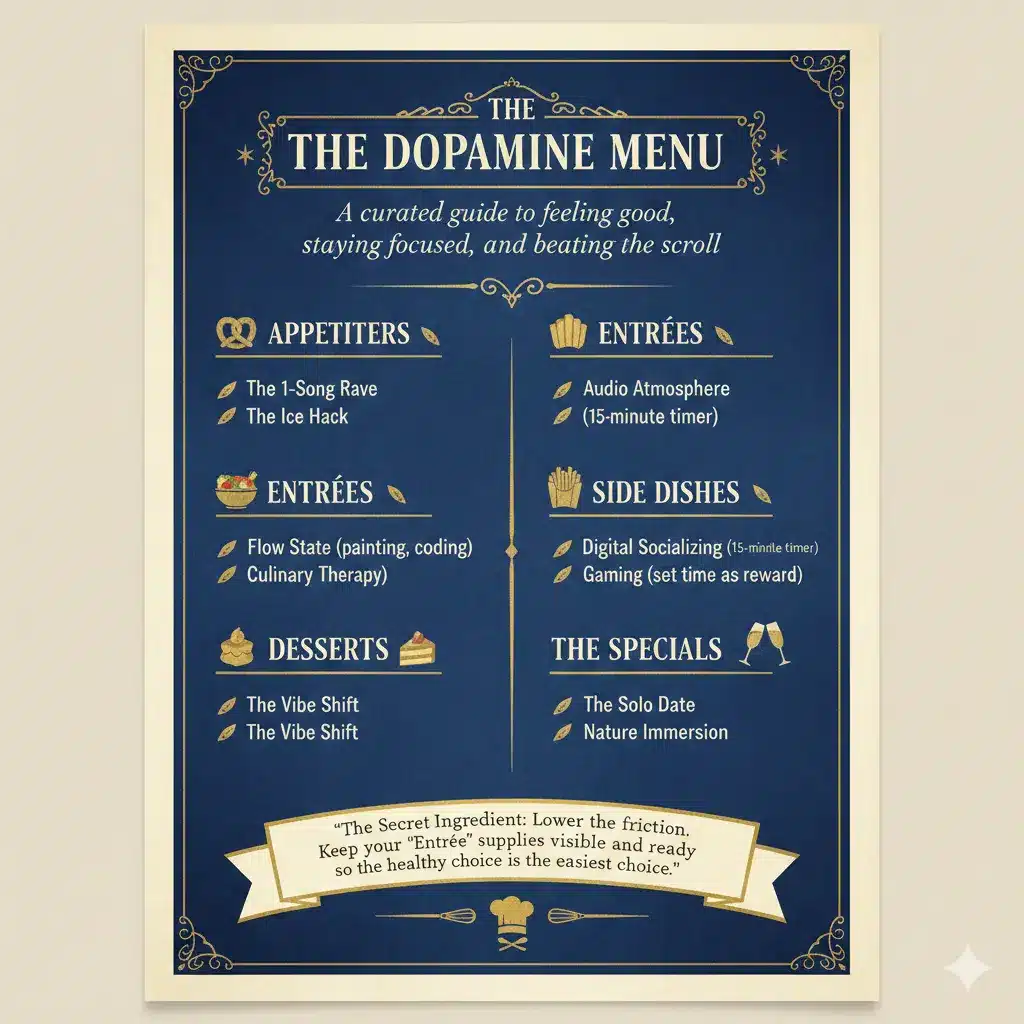
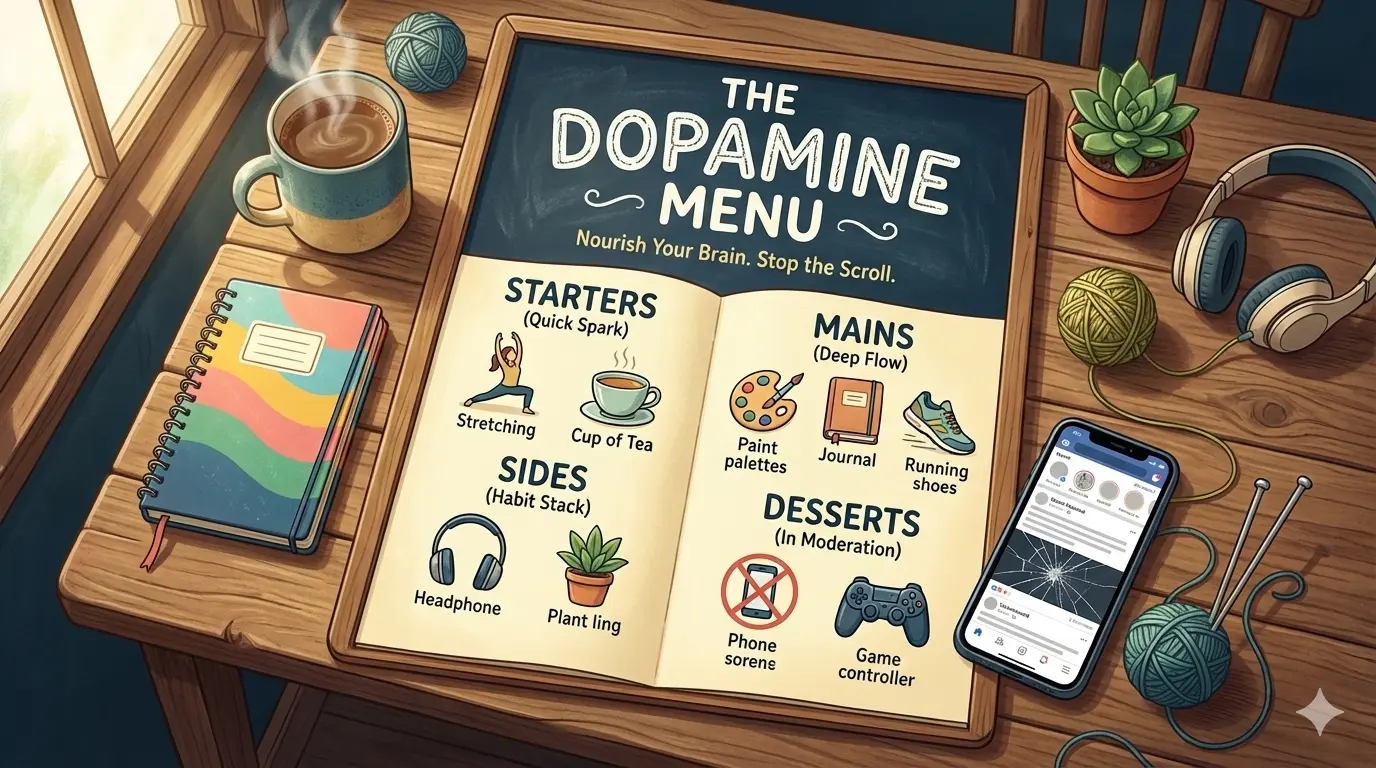


A dopamine menu is a simple, science-backed way to regain focus, break scroll paralysis, and replace mindless digital habits with intentional dopamine. Do you ever find yourself stuck on the couch, phone in hand, endlessly scrolling through social media—even though you’re bored, tired, and frustrated with yourself? You’re not lazy, unmotivated, or broken. You’re experiencing scroll paralysis, a modern form of mental freeze caused by how our brains chase dopamine.
Dopamine is often misunderstood as the “pleasure chemical,” but in reality, it’s the motivation and anticipation neurotransmitter. It’s what nudges you to take action. When your brain is under-stimulated, overwhelmed, or emotionally drained, it seeks the fastest possible dopamine hit. Today, that usually comes from cheap dopamine sources: social media, short-form videos, sugar, endless notifications, or impulsive online browsing.
The problem is that these quick dopamine hits demand almost zero activation energy. You don’t have to think, move, or commit—scroll. Over time, this rewires your brain to avoid effort-based rewards, leading to executive dysfunction, digital burnout, reduced focus, and an inability to start even simple tasks.
This is where the dopamine menu comes in.
A dopamine menu, sometimes called a dopamenu, is a personalized system that helps you consciously choose intentional dopamine over impulsive distraction. Instead of fighting your brain, you work with it. The result? Better focus, less scrolling, improved motivation, and a healthier relationship with stimulation in a digital world.
Cheap Dopamine vs. Earned Dopamine (Why Motivation Feels Broken)
Cheap dopamine (from social media, sugar, and instant entertainment) floods the brain quickly but fades rapidly. Earned dopamine (exercise, learning, creativity) requires effort but leads to longer-lasting satisfaction.
When cheap dopamine dominates daily life:
- Motivation for effort-based tasks drops
- Focus duration shortens
- Executive dysfunction becomes more pronounced
This is why many users search for “dopamine reset,” “dopamine detox,” and “how to fix motivation”—they’re feeling the imbalance, even if they don’t have the language for it yet.
What Is a Dopamine Menu? (The Essentials)
A dopamine menu is a structured list of activities designed to provide healthy, intentional stimulation, without relying on mindless scrolling. A dopamine menu is a categorized list of activities that give your brain dopamine in different ways, depending on your energy level, time availability, and mental state. Instead of asking, “What should I do right now?”—which increases decision fatigue- you simply pick from the menu.
This concept gained mainstream attention through Jessica McCabe, creator of How to ADHD, as a practical strategy to manage ADHD-related executive dysfunction. However, it has since been widely adopted by people experiencing burnout, low motivation, focus issues, and digital overload.
Why dopamine menus work
The effectiveness of a dopamine menu comes down to activation energy, the minimum effort required to start an action. When activation energy feels too high, your brain defaults to scrolling because it’s easy and familiar.
A dopamine menu:
- Lowers decision-making friction
- Provides structured choices
- Helps bypass executive dysfunction
- Encourages habit stacking
- Replaces impulsive dopamine hits with intentional ones
This makes it especially useful for neurodivergent individuals, but also highly effective for anyone struggling with focus in a hyper-digital environment.
Dopamine Menu vs. To-Do Lists (Why Lists Often Fail)
A common frustration is: “I already have a to-do list—why doesn’t it work?”
To-do lists focus on obligations, not neurochemistry. They assume motivation comes first. A dopamine menu flips this model by addressing how the brain actually initiates action.
Key difference:
- To-do list → What should I do?
- Dopamine menu → What can help my brain start?
This makes dopamine menus especially effective for people experiencing:
- Task paralysis
- Decision fatigue
- ADHD-related procrastination
Is a Dopamine Menu Scientifically Backed?
While “dopamine menu” is not a clinical term, the principles behind it are supported by behavioral psychology and neuroscience:
- Behavioral activation therapy (used in depression treatment)
- Reward substitution models
- Habit stacking research by BJ Fogg and James Clear
- ADHD coaching frameworks focused on lowering activation energy
This gives the dopamine menu strong practical validity, even without being a formal diagnosis tool.
To see how your personalized menu affects your recovery and stress levels in real-time, many wellness enthusiasts use wearable tech. Our detailed comparison of the Oura Ring 4 vs WHOOP 5.0 breaks down which device best tracks your body’s physiological response to new habits.
How to Structure Your Dopamenu (The Restaurant Analogy)
Starters: What to Do When Even “Easy” Feels Hard
Many people search: “What if I have zero energy?”
Starters exist for this exact state.
When activation energy feels impossible:
- The goal is movement, not productivity
- Even 60 seconds counts
- Physical actions work better than mental ones
Example insight: Studies show that light physical movement increases dopamine and norepinephrine within minutes, improving alertness without caffeine.
Main Courses: Why Flow Beats Discipline

Flow states are one of the healthiest dopamine sources. According to psychologist Mihaly Csikszentmihalyi, flow occurs when challenge slightly exceeds skill—creating deep engagement.
Pain point addressed:
- “I start motivated but quit halfway.”
Solution:
- Choose main courses that are challenging but familiar
- Avoid tasks that are too easy (boring) or too hard (overwhelming)
This helps sustain focus for 30–90 minutes, which aligns with natural ultradian rhythms.
Side Dishes: Solving Boring but Necessary Tasks
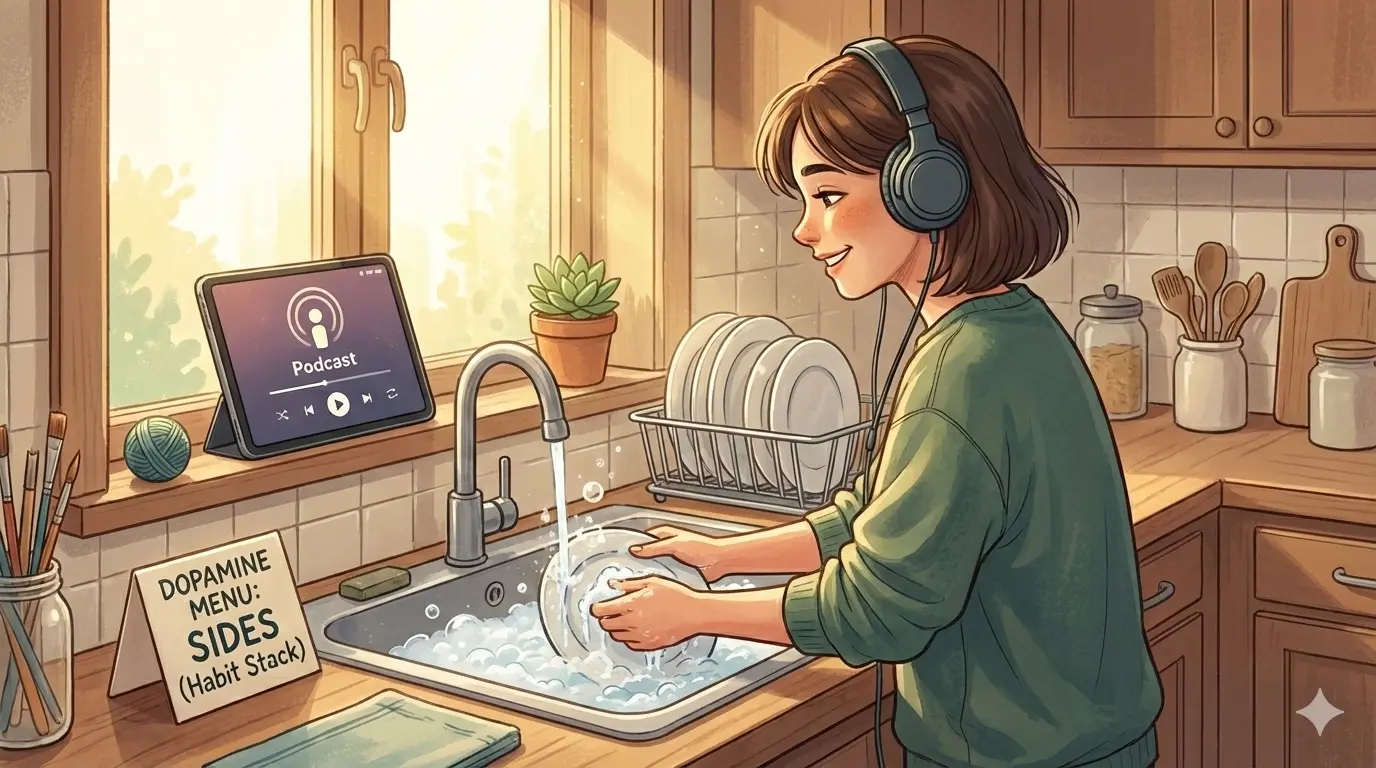
Why side dishes work:
- They reduce perceived effort
- They add novelty to repetitive tasks
- They prevent avoidance behaviors
Example: People who listen to podcasts while cleaning report higher task completion and lower mental resistance, according to behavioral habit studies.
Desserts: Setting Boundaries Without Shame
One of the biggest misconceptions is that dopamine menus ban social media. They don’t.
The real problem isn’t usage—it’s unplanned overuse.
Helpful rule:
- Decide before you scroll
- Use timers, app limits, or “after X task” rules
- Treat desserts as intentional rewards, not default behaviors
This reframes scrolling from guilt-inducing to controlled and conscious.
Specials: Preventing Long-Term Burnout
Many people focus only on daily dopamine, ignoring anticipatory dopamine—the excitement of something coming up.
Neuroscience insight:
Anticipation activates dopamine more sustainably than consumption itself.
That’s why planning:
- Trips
- Events
- Experiences
Can significantly improve mood and motivation, even weeks in advance.
20+ Realistic Dopamine Menu Examples
| Category | Idea | Time Required | Effort Level |
|---|---|---|---|
| Starter | 10 Jumping Jacks | 1 Min | Low |
| Starter | Deep Breathing | 3–5 Mins | Low |
| Starter | Make Tea | 5 Mins | Low |
| Main | Journaling / Free Writing | 20+ Mins | Medium |
| Main | Home Workout | 30 Mins | High |
| Main | Creative Hobby | 45+ Mins | High |
| Side | Lo-Fi Music for Focus | Unlimited | Very Low |
| Side | Podcast While Cleaning | Unlimited | Very Low |
| Side | Audiobook While Walking | 20+ Mins | Low |
| Dessert | Instagram Scroll | 15 Min Limit | Zero |
| Dessert | YouTube Videos | 20 Min Limit | Zero |
| Dessert | Video Games | 30 Min Limit | Low |
| Special | New Restaurant | 2 Hours | High |
| Special | Weekend Trip | 1–2 Days | High |
| Special | Concert or Event | Half Day | High |
How to Personalize Dopamine Menu Examples
A common query is: “Which dopamine menu ideas work best?”
Answer: The best dopamine menu is highly personal. Factors include:
- Introvert vs. extrovert tendencies
- Physical vs. mental fatigue
- Sensory preferences (music, movement, silence)
What works for one neurodivergent person may overwhelm another—experimentation is key.
How to Build Your Own ADHD Dopamine Menu
Common Mistakes When Creating a Dopamine Menu
Many first-time users fail because they:
- Add only “productive” activities
- Ignore rest-based dopamine
- Overload the menu with too many options
Best practice:
- 5–7 starters
- 5–7 mains
- 3–5 desserts
- 2–3 specials
This keeps choice paralysis low.
Dopamine Menu for Workdays vs. Weekends
Another overlooked point: context matters.
Workday menus should emphasize:
- Starters
- Side dishes
- Focus-friendly mains
Weekend menus can include:
- More specials
- Creative mains
- Social dopamine sources
This aligns your dopamine strategy with real-life energy cycles
FAQ: Frequently Asked Questions
Is a dopamine menu just for people with ADHD?
No. While popular as an ADHD dopamine menu, it works for anyone with a modern brain exposed to constant digital stimulation.
What is a dopamine detox—and do I need one?
A dopamine detox focuses on restriction. A dopamine menu focuses on replacement. Sustainable change comes from intentional rewards, not deprivation.
How often should I change my dopamine menu?
A seasonal refresh every 2–3 months works best. Your nervous system changes—your menu should too.
Can a Dopamine Menu Help With Anxiety or Depression?
While not a treatment, dopamine menus can support emotional regulation by:
Encouraging gentle activation
Reducing avoidance loops
Providing structure during low-mood days
Many therapists already use similar activation-based tools in practice.
Does This Replace Therapy or Medication?
No. A dopamine menu is a support tool, not a medical replacement. It works best alongside professional care when needed.
Conclusion & Next Steps
The goal of a dopamine menu isn’t discipline or perfection. It’s intentional energy management. Instead of letting algorithms decide how your attention is spent, you reclaim control—one choice at a time. When you feel stuck, overwhelmed, or tempted to scroll, don’t ask, “What’s wrong with me?” Ask, “What’s on my menu?”
Want a head start?
Download our free dopamine menu template, and tag us when you build yours.
Your focus doesn’t need fixing—your dopamine just needs direction.
Progress Over Perfection
The biggest mindset shift is this:
You don’t need more discipline—you need better dopamine options.
Even using your dopamine menu once a day is progress. Over time, those small intentional choices compound into better focus, less scrolling, and more control over your attention.