

Meal replacement shakes can make weight loss easier by simplifying calorie control, protein intake, and meal planning. But the best meal replacement shake is not simply the one with the fewest calories or the most protein. Its overall nutrition, portion size, ingredients, fiber, dietary fit, taste, and convenience all matter.
A good choice should function as a practical meal replacement while fitting into an otherwise balanced diet. Research and current health guidance support meal replacements as one possible tool for weight management, not as a magic solution or replacement for nutritious whole foods.
Quick Takeaways
- Meal replacement shakes can support weight loss when they help you maintain an appropriate calorie deficit.
- Protein and fiber matter because they can contribute to fullness and make a reduced-calorie eating plan easier to follow.
- The lowest-calorie shake is not automatically the best. A product that replaces a meal should provide meaningful nutrition rather than simply cutting calories.
- Read the nutrition label before buying. Check calories, protein, fiber, added sugar, vitamins and minerals, ingredients, and allergens.
- A meal replacement is different from ordinary protein powder. Protein powder primarily adds protein, while a meal replacement is formulated for broader nutritional use.
- Commercial shakes are not the only option. A homemade shake can work when it combines protein, fiber-rich foods, produce, and an appropriate calorie level.
- Whole foods still matter. Meal replacement shakes are best viewed as a convenient tool within a varied eating pattern.
- Best starting point: Choose a shake based on its complete nutrition profile and how well it fits your diet, hunger levels, budget, and daily routine.
Quick Reference: What Makes a Good Meal Replacement Shake?
| What to Check | Why It Matters | What to Look For |
|---|---|---|
| Calories | Helps determine whether it actually replaces a meal | Appropriate for your individual needs |
| Protein | Supports fullness and helps increase protein intake | A meaningful amount per serving |
| Fiber | Adds nutritional value and may support fullness | A useful amount from the product or meal |
| Added sugar | Excess can add calories without much nutritional value | Lower amounts are generally preferable |
| Vitamins & minerals | Important when the shake replaces a meal | Broad micronutrient coverage |
| Ingredients | Helps you assess dietary fit and preferences | Ingredients you tolerate and want |
| Allergens | Important for allergies and intolerances | Clear allergen labeling |
A useful product should be assessed as a whole package, not judged by one number. Some meal replacement shakes are very low in calories, yet that can become a disadvantage if the serving is substantially smaller than the meal it replaces
What Are Meal Replacement Shakes?
Meal replacement shakes are products designed to replace a meal such as breakfast, lunch, or dinner. They are commonly available as ready-to-drink bottles or powders mixed with water, milk, or another liquid. Many are formulated with protein and added vitamins and minerals, while some also provide fiber.
Unlike a conventional beverage, a meal replacement is intended to provide more than protein alone. Its purpose is to offer a convenient combination of calories and nutrients when you do not have, or do not want to prepare, a traditional meal.
What Makes a Shake a Meal Replacement?
The defining feature is intended use. A meal replacement is formulated to stand in for a meal, so its nutrition should be considered in that context.
Look beyond the protein number and examine:
- Calories
- Protein
- Fiber
- Carbohydrates
- Fat
- Vitamins and minerals
- Added sugar
- Ingredients and allergens
This distinction matters because products marketed around protein can vary considerably in their nutritional purpose. A shake containing protein is not automatically a nutritionally complete meal replacement.
Why Are Meal Replacement Shakes Popular for Weight Loss?
Convenience is one of their biggest advantages. A prepared shake can provide a predictable portion when preparing or estimating a meal would otherwise be difficult.
That can be useful during a busy workday, while traveling, or when your alternative is a less balanced convenience meal. Current health information also emphasizes that meal replacement shakes can be useful as one tool while whole foods remain an important part of the overall diet.
The weight-loss advantage therefore comes less from the fact that a product is a “shake” and more from how it changes your overall calorie intake and eating pattern.
Do Meal Replacement Shakes Actually Work for Weight Loss?
Meal replacement shakes can support weight loss, but they do not cause weight loss simply because they come in a bottle or powder. Their main advantage is that they can make calorie control, portion consistency, and protein intake easier. Whether they work depends on the overall eating pattern, the product chosen, and how consistently it is used.
How Do Meal Replacement Shakes Create a Calorie Deficit?
Weight loss generally requires maintaining an energy deficit over time. A meal replacement can make that easier by providing a defined amount of food and calories instead of leaving portion size to guesswork.
For example, replacing a calorie-dense takeaway lunch with a nutritionally balanced shake may substantially reduce the calories consumed at that meal. The important factor is the difference in total daily energy intake, not the shake itself.
However, choosing the lowest-calorie product possible is not necessarily the best strategy. If a shake is too small to function as a satisfying meal, you may become hungry soon afterward and compensate with snacks or a larger meal later.
Does More Protein Make a Meal Replacement More Filling?
Protein is an important consideration when choosing a meal replacement shake. Higher-protein diets can increase feelings of fullness, making calorie restriction easier for some people.
Many meal replacement products therefore emphasize protein content. But protein should not be considered in isolation. A useful shake should provide an appropriate combination of protein, calories, fiber, and other nutrients.
The goal is not simply to find the shake with the highest protein number. It is to find one that provides enough nutrition to work as part of a sustainable eating pattern.
Does Fiber Matter in a Meal Replacement Shake?
Yes. Fiber can contribute to fullness and is an important part of a balanced diet. Some meal replacement products add fiber specifically to improve their nutritional profile.
Fiber content can also help distinguish products that provide more than protein and calories. However, a high-fiber label alone does not make a shake a good meal replacement. The entire nutrition panel still needs to be considered. Current health information notes that meal replacement shakes often contain added fiber and that product quality varies considerably.
What Does the Research Say About Meal Replacement Weight Loss?
Research suggests that meal-replacement approaches can produce greater weight loss than some food-based reduced-calorie approaches, particularly when they simplify calorie control and improve adherence. A systematic review and meta-analysis of randomized controlled trials found a small but significant advantage for meal-replacement-based diets compared with food-based calorie restriction. The benefit was not universal and varied according to the type of calorie restriction and intervention used.
Research Insight
- The strongest case for meal replacements is their ability to simplify a calorie-controlled eating pattern. Their effectiveness still depends on the broader diet and long-term adherence.
- Clinical Evidence: A systematic review published in the European Journal of Clinical Nutrition demonstrated that partial meal replacement diets resulted in an average 7–8% body weight reduction over 12 weeks, significantly outperforming traditional food-based calorie-restricted diets
How Do You Choose the Best Meal Replacement Shake for Weight Loss?
The best meal replacement shake for weight loss should provide appropriate calories, meaningful protein and fiber, useful micronutrients, and a formulation that fits your dietary needs. There is no single nutrition profile that is ideal for everyone, so compare the complete label rather than relying on one marketing claim.
How Many Calories Should a Meal Replacement Shake Have?
There is no universal calorie target for every person or every meal. Your energy needs depend on factors such as body size, activity, age, and the rest of your diet.
The key question is whether the serving provides enough nutrition and satisfaction to reasonably function as a meal.
Very low-calorie shakes can appear attractive for weight loss, but cutting calories too aggressively can make an eating plan difficult to sustain. Some products contain only 150–200 calories, which may be substantially less than the meal they replace.
Think “appropriate meal,” not “fewest calories.”
How Much Protein Should a Meal Replacement Shake Have?
Protein should be one of the first numbers you compare. It contributes to dietary protein intake and can help support fullness during calorie restriction.
Rather than treating a specific number as a universal requirement, compare products within the context of your total daily protein intake.
A shake with 30 grams of protein is not automatically better than one with 20 grams if the rest of its nutritional profile is poor or it does not suit your calorie needs.
How Much Fiber Should a Meal Replacement Shake Have?
Fiber is another useful comparison point. It can contribute to fullness and supports overall dietary quality.
Look at both the amount and source of fiber on the nutrition label. Current consumer guidance specifically recommends checking fiber because some products marketed as meal replacements provide relatively little.
There is no need to turn one fiber number into a rigid pass-or-fail rule. Instead, use it alongside protein, calories, micronutrients, and the rest of the ingredient list.
Should You Choose a Shake With Less Added Sugar?
Generally, a lower amount of added sugar can be preferable, particularly when comparing otherwise similar products.
But “low sugar” does not automatically mean “best for weight loss.” A product may be low in sugar yet still provide inadequate nutrition, excessive calories, or poor satiety.
Check added sugar together with total calories, protein, fiber, carbohydrates, and fat rather than judging the product from one line on the label.
What Vitamins and Minerals Should You Check?
If you are replacing a meal, micronutrients deserve attention. Many commercial meal replacement products are fortified with vitamins and minerals, which is one feature that distinguishes them from simple protein supplements.
Check the nutrition panel for meaningful coverage of vitamins and minerals rather than assuming that every product labeled “meal replacement” is nutritionally equivalent.
Fortification can be useful, but it does not eliminate the value of eating varied whole foods throughout the rest of the day.
What Ingredients Should You Watch For?
Read the ingredient list as carefully as the nutrition panel.
Pay particular attention to:
- Protein source: whey, milk, soy, pea, or other proteins
- Fiber sources: the types and amounts included
- Added sugars and sweeteners
- Allergens: especially dairy, soy, nuts, or other ingredients relevant to you
- Ingredients you personally tolerate or prefer to avoid
Some products contain added sugars or numerous processed ingredients, while others use different formulations. Product quality is therefore uneven, making label comparison important.
Avoid Red Flag Ingredients
| Avoid / Limit These Ingredients | Why It Harms Weight Loss | Better Alternative to Look For |
|---|---|---|
| Added Sugars (>5g) | Triggers insulin spikes & rapid hunger crashes | Stevia, Monk Fruit, or <2g Sugars |
| Maltodextrin / High-GI Carbs | High glycemic response causing fat storage | Whole Oat Flour, Chia, or Flaxseed |
| Artificial Oils (Hydrogenated) | Increases inflammatory markers | MCT Oil, Sunflower Lecithin, Avocado Oil |
| Low Fiber (<3g per serving) | Fails to trigger satiety hormones (GLP-1/PYY) | Soluble Fiber / Inulin (5g+ per serving) |
Is a Ready-to-Drink Shake Better Than Powder?
Neither format is automatically better. The better option is the one whose nutrition, price, taste, and convenience fit your routine.
| Factor | Ready-to-Drink | Powder |
|---|---|---|
| Convenience | Very high | High |
| Preparation | None | Requires mixing |
| Portability | Excellent | Excellent |
| Customization | Limited | Greater |
| Storage | Convenient but bulky | Usually more compact |
| Cost per serving | Often higher | Often lower |
Ready-to-drink shakes work well when convenience is the priority. Powders can offer greater flexibility because you control the liquid and can sometimes add other ingredients.
Key Takeaway
Don’t choose a meal replacement because its front label says “weight loss.” Compare the nutrition facts, ingredients, serving size, dietary fit, and cost before deciding.
Which Meal Replacement Shakes Are Worth Considering for Weight Loss?
There is no single best meal replacement shake for everyone. The better choice depends on calories, protein, fiber, dietary preferences, convenience, and how the shake fits into your overall calorie intake. The products below were selected because they have clearly defined nutrition profiles and are currently marketed for meal replacement or complete/meal-style nutrition.
Nutrition data below were checked against current manufacturer information in September 2026. Formulas can vary by flavor and may change, so always confirm the label before purchasing.
How We Selected These Products
We compared meal replacement shakes using the same criteria discussed in this guide: calories, protein, fiber, vitamins and minerals, added sugar, ingredients, dietary suitability, serving size, and convenience. Nutrition information was checked against manufacturer-published data. Products are presented by their nutritional characteristics and practical use cases, not by claims of guaranteed weight-loss results.
| Product | Best Fit | Calories | Protein | Fiber | Format | Key Consideration |
|---|---|---|---|---|---|---|
| Huel Ready-to-Drink Meal | Overall nutrition | 400 | 20g | 6–8g* | Ready-to-drink | Broad nutritional profile with protein, fiber, fats, carbohydrates, and vitamins/minerals |
| Soylent Original Ready-to-Drink Meal | Convenient complete meal | 400 | 20g | 3g | Ready-to-drink | Plant-based, shelf-stable, 39 essential nutrients |
| OWYN High Protein Complete Nutrition Shake | Higher protein, lower calories | 180 | 26g | 3g | Ready-to-drink | Plant-based and zero added sugar, but substantially lower in calories than a typical meal |
| Orgain Organic Nutrition Shake | Organic option | 250 | 16g | 1g | Ready-to-drink | USDA Organic with vitamins/minerals; contains milk and whey |
| Ka’Chava Superblend | Plant-based powder | 240 | 25g | 6g | Powder | Requires preparation; provides protein, fiber, fats, and a broad micronutrient profile |
*Huel’s current product comparison lists fiber from 6g depending on formula, while its detailed chocolate nutrition panel lists 8g. Nutrition values are based on manufacturer-published information and may change with product formulation or flavor.
Health Disclaimer: Meal replacement shakes can be useful for some people, but they are not essential for weight loss. Individual calorie and nutritional needs vary. People who are pregnant, under 18, managing a medical condition, or taking medication should consult a doctor or registered dietitian before using meal replacements regularly.
A lower-calorie shake is not automatically better for weight loss. If it replaces a full meal, consider whether it provides enough protein, fiber, and overall nutrition to keep you satisfied.
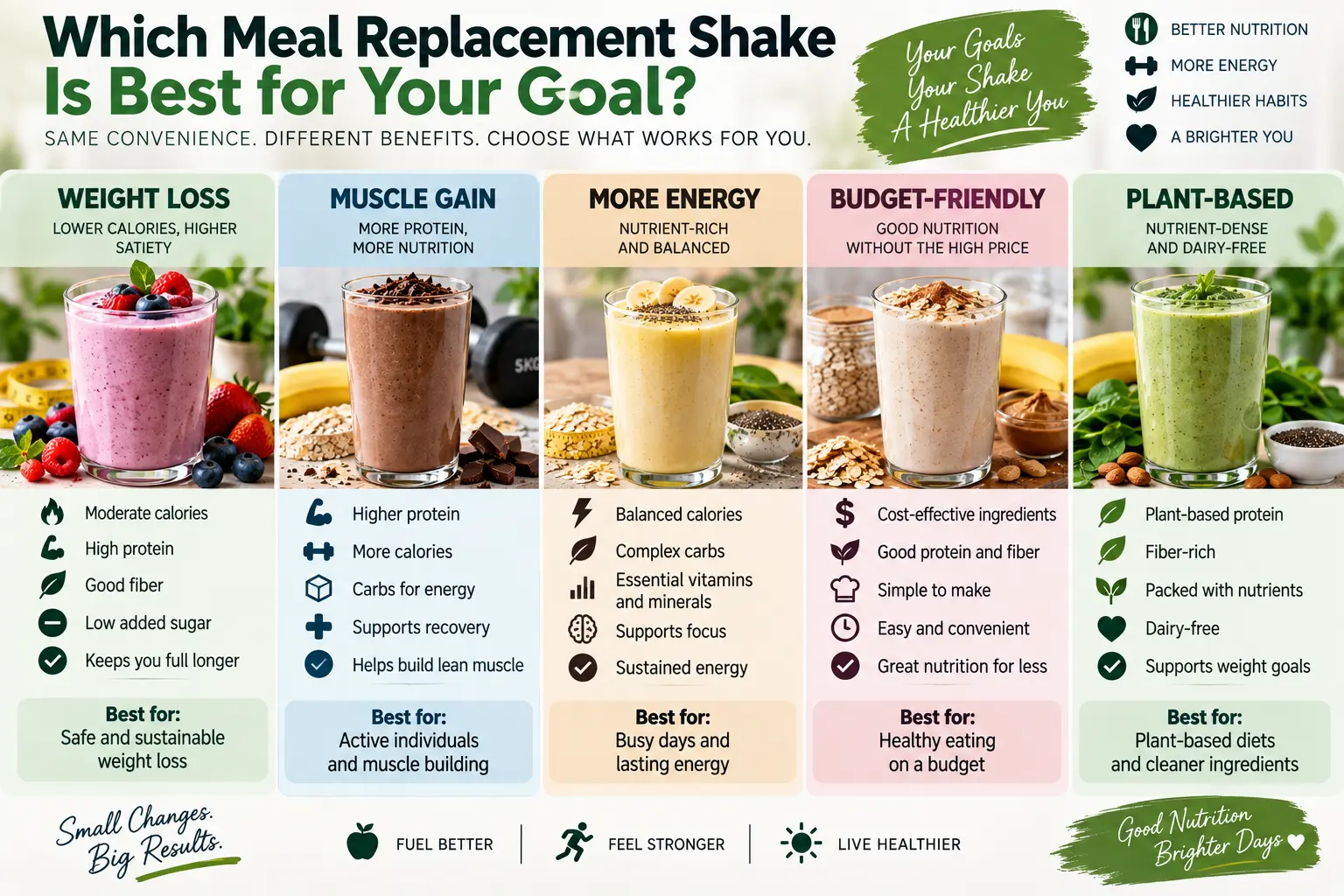
Which Meal Replacement Shake Is Best for Your Goal?
There is no single best meal replacement shake for weight loss for everyone. The right choice depends on your nutritional needs, dietary preferences, budget, taste, and how you plan to use it. A goal-based comparison is more useful than declaring one product universally superior.
What Is the Best Meal Replacement Shake for Overall Nutrition?
For overall nutrition, prioritize a product that provides a balanced combination of protein, fiber, calories, carbohydrates, fats, and vitamins and minerals.
A strong option should make sense as a meal rather than functioning mainly as a protein supplement. Check the serving size and nutrition panel together, because impressive numbers per serving are less useful if the serving itself is too small to satisfy you.
What Is the Best Meal Replacement Shake for Convenience?
For busy mornings, office lunches, commuting, or travel, convenience may be the deciding factor.
Ready-to-drink products require no preparation and are easy to portion. Powdered products can also be convenient when you have access to water or milk and want a lighter package.
The best choice is therefore the one you can actually use consistently without turning your weight-loss plan into another daily obstacle.
What Is the Best Meal Replacement Shake for Plant-Based Diets?
For a plant-based diet, start with the protein source and then examine the rest of the formulation.
Look for a product that fits your dietary requirements while providing meaningful protein, fiber, calories, and micronutrients. Check the ingredients and allergen information carefully, because “plant-based” does not automatically mean nutritionally complete or suitable for every person.
What Is the Best Meal Replacement Shake for a Lower-Carbohydrate Diet?
A lower-carbohydrate shake may suit someone who deliberately follows a lower-carb eating pattern, but fewer carbohydrates do not automatically make a product better for weight loss.
Compare the total calorie content, protein, fiber, fat, ingredients, and serving size. If you follow a ketogenic diet, also verify that the product actually fits your carbohydrate targets rather than relying solely on “keto-friendly” marketing.
What Is the Best Budget Meal Replacement Shake?
For value, compare cost per serving, not simply the price of the container.
Powders often make it easier to calculate the cost of each serving and may offer better value when purchased in larger quantities. Ready-to-drink products can cost more because preparation and packaging are built into the product.
However, the cheapest shake is not necessarily the best value. A slightly more expensive product may be worthwhile if you enjoy its taste, tolerate its ingredients, and can use it consistently.
Key Takeaway
The “best” meal replacement shake depends on the goal. Compare nutrition first, then consider convenience, dietary requirements, taste, and price.
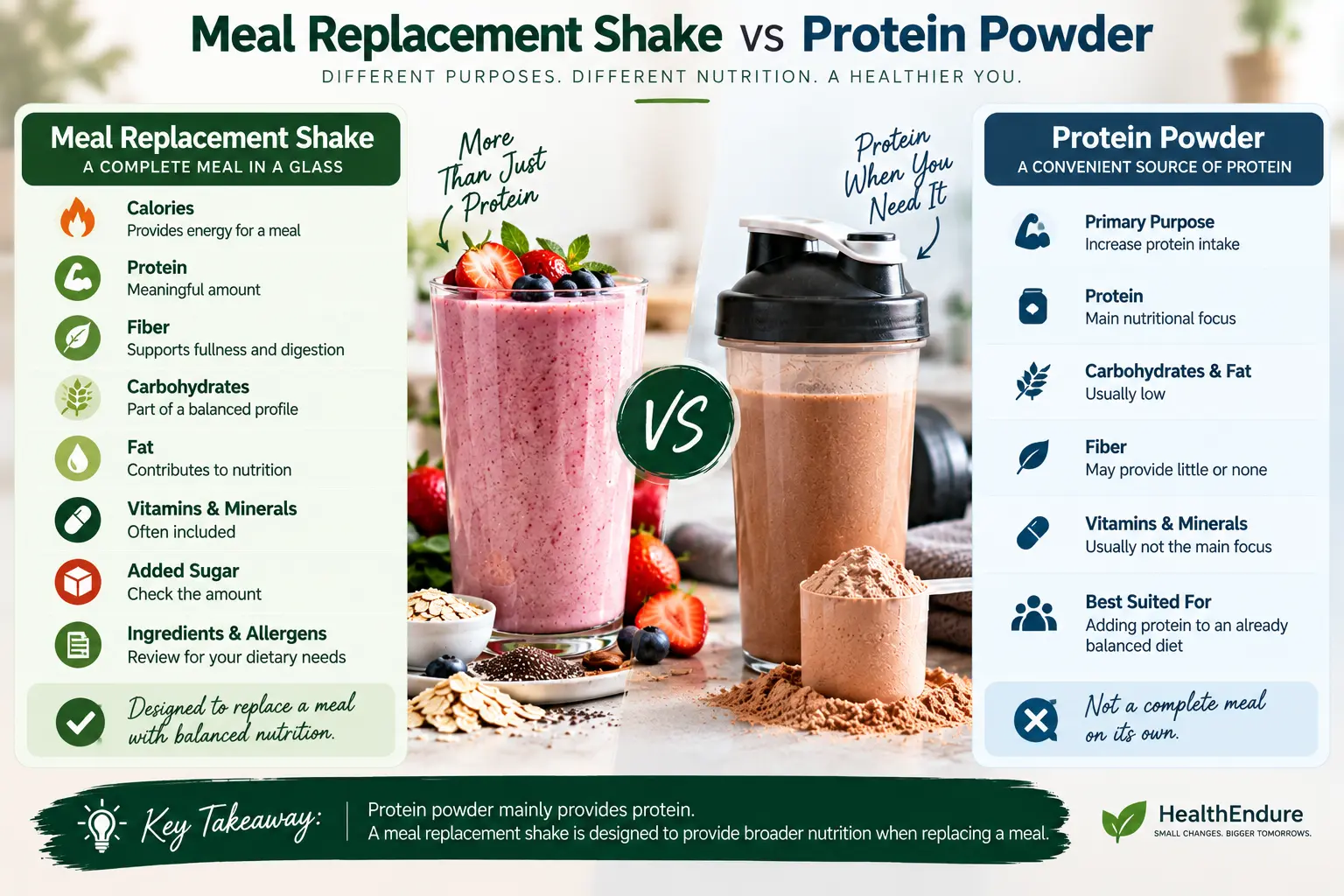
What Is the Difference Between a Meal Replacement Shake and Protein Powder?
A meal replacement shake is designed to provide broader nutrition when it replaces a meal, while protein powder is primarily intended to increase protein intake. The two products can overlap, but they should not automatically be treated as interchangeable.
Can You Turn Protein Powder Into a Meal Replacement?
You can make a more substantial homemade shake by combining protein powder with other nutritious ingredients, but adding protein powder alone does not transform it into a meal replacement.
For example, a homemade shake could combine:
Protein + fruit or vegetables + fiber-rich ingredients + healthy fat + an appropriate liquid
This approach gives you greater control over calories, ingredients, flavor, and portion size.
However, homemade does not automatically mean nutritionally complete. If the shake regularly replaces a meal, consider the nutrients you are getting from the rest of your diet as well.
Which Is Better for Weight Loss?
Neither is universally better.
Choose a meal replacement when you want a convenient, portion-controlled option that provides broader nutrition.
Choose protein powder when you already have a balanced meal or diet and simply need additional protein.
The important distinction is what role the product plays in your diet. Using protein powder as a supplement is different from relying on it as your entire meal.
How Should You Use Meal Replacement Shakes for Weight Loss?
Meal replacement shakes work best when they simplify a meal without making your overall diet overly restrictive. Use them where convenience and predictable nutrition genuinely help, while keeping the rest of your eating pattern varied and balanced.
Should You Replace Breakfast With a Meal Replacement Shake?
Breakfast can be a practical time to use a shake if mornings are rushed or you regularly skip meals.
A shake can provide a predictable option instead of grabbing a high-calorie convenience food later. However, there is nothing inherently more effective about replacing breakfast than another meal. The useful question is whether the shake helps you manage your overall intake and stay satisfied.
If you are hungry again shortly after drinking it, reconsider the product, portion, or whether a whole-food breakfast would work better.
Can You Replace Lunch With a Meal Replacement Shake?
Lunch may be another convenient opportunity, particularly for people working away from home or with limited time to prepare food.
A meal replacement can reduce the need to make an unplanned food choice when healthier options are unavailable. Ready-to-drink products are especially practical for this situation.
Still, convenience should not become dependence. Your other meals should provide a variety of whole foods, including vegetables, fruits, whole grains, and protein-rich foods.
Should You Replace One Meal or Two?
There is no universal number that everyone should follow.
Replacing one meal may be easier to incorporate into a normal eating pattern, while replacing more meals creates a greater dependence on formulated products. The appropriate approach depends on your calorie needs, hunger, dietary preferences, health circumstances, and ability to maintain the routine.
Is It Better to Drink a Shake Every Day or Only When Convenient?
Either approach can work.
Daily use may simplify a predictable meal, while occasional use can provide flexibility when your schedule becomes difficult. You do not need to drink a shake every day for it to be useful.
The better strategy is the one that fits naturally into your lifestyle without displacing too much food variety.
What Should You Eat With or Around a Meal Replacement Shake?
Think about the whole day, rather than trying to make every nutritional decision inside the shake.
Your other meals can provide foods that may be limited in a formulated drink, including fresh vegetables, fruit, whole grains, legumes, dairy or alternatives, and minimally processed protein sources.
This matters because meal replacement shakes are generally designed for convenience and nutrient delivery, but they do not need to become the foundation of your entire diet. Health guidance continues to emphasize nutritious whole foods as part of a balanced eating pattern.
Practical rule
Use a meal replacement where it solves a real problem, such as time, portion control, or meal planning rather than using it simply because the label says “weight loss.”
When Should You Not Use a Meal Replacement Shake?
A meal replacement shake may not be the right choice when it leaves you hungry, provides inadequate nutrition, or begins replacing too much dietary variety. It is a tool for convenience and structured eating—not something you need to use simply because you want to lose weight.
What If the Shake Leaves You Hungry?
Persistent hunger is a sign that the product or portion may not be working well for you.
Check its calorie, protein, and fiber content first. You should also consider what you normally eat at that meal and whether a more substantial whole-food option would provide better satisfaction.
A shake that repeatedly leads to snacking soon afterward may defeat the practical advantage of using one in the first place.
What If the Shake Is Extremely Low in Calories?
Extremely low calories can be a disadvantage when the product is being used as a meal replacement.
Some shakes provide only 150–200 calories, which may be considerably less than a typical meal.
Lower calories can help create a deficit, but less is not always better. The rest of your diet still needs to provide enough energy and nutrients for your individual needs.
Should Children or Teenagers Use Meal Replacement Shakes for Weight Loss?
Children and teenagers have different nutritional needs because they are still growing and developing. Weight-loss strategies for younger people should therefore not simply copy adult approaches.
A meal replacement shake should not be introduced as a routine weight-loss strategy for a child or teenager without appropriate professional guidance.
Who Should Talk to a Doctor or Registered Dietitian First?
Professional advice is particularly sensible when you have a medical condition, significant dietary restrictions, food allergies, or a history of disordered eating.
It is also worth getting individualized advice if you plan to replace multiple meals regularly or substantially restrict your food intake.
Safety Note
- Meal replacement shakes are not appropriate for everyone. If you are pregnant or breastfeeding, under 18, managing a medical condition, taking medication, or have food allergies or significant dietary restrictions, discuss regular meal-replacement use with a doctor or registered dietitian first.
- Meal replacement products differ considerably in calories, ingredients, protein, fiber, and micronutrient content. “Meal replacement” on the package does not mean every product is appropriate for every person.
What Are the Downsides of Meal Replacement Shakes?
Not every product offers the same nutritional quality.
Potential drawbacks include:
- Too few calories to provide adequate meal satisfaction
- Added sugars
- Limited food variety
- Ingredients that do not suit your preferences or dietary needs
- Higher cost than some homemade meals
- Over-reliance on processed products
Some products may also contain ingredients or allergens that require careful label checking.
The bigger concern is often how the shake is used, rather than whether shakes themselves are inherently healthy or unhealthy.
Can You Live on Meal Replacement Shakes Alone?
A shake-only diet should not be treated as a standard approach to weight loss.
Meal replacement products can simplify part of your diet, but whole foods provide variety in texture, ingredients, nutrients, and eating experiences. Even products designed to provide substantial nutrition should be considered within the context of the entire diet.
For most people, the more practical approach is to use a shake when it genuinely improves convenience or calorie management while keeping nutritious whole foods central to other meals.
Quick Takeaways
Meal replacement shakes may be useful when you need a convenient, portion-controlled option that still provides meaningful nutrition.
They may suit you if you:
- Have limited time to prepare a balanced meal.
- Prefer a predictable calorie intake.
- Struggle with portion control during busy days.
- Need a convenient option while traveling or working.
- Want an alternative to skipping a meal.
Are Homemade Meal Replacement Shakes Good for Weight Loss?
Yes. Homemade meal replacement shakes can support weight loss when they provide enough protein, fiber, and overall nutrition while fitting your calorie needs. Their main advantage is control: you choose the ingredients, portion size, sweetness, and protein source instead of relying entirely on a commercial formula.
What Should You Put in a Homemade Meal Replacement Shake?
Build the shake around five elements:
- Protein: Greek yogurt, milk, tofu, or protein powder.
- Fruit or vegetables: berries, banana, spinach, or other produce.
- Fiber-rich ingredients: oats, chia seeds, flaxseed, or other whole-food sources.
- Healthy fat: nuts, nut butter, seeds, or avocado.
- Liquid: milk, unsweetened plant milk, or water.
The goal is to create something substantial enough to function as a meal, rather than simply blending protein powder with water.
What Is a Simple High-Protein Breakfast Shake?
A practical combination is Greek yogurt or protein powder with berries, oats, chia seeds, and milk or an unsweetened alternative.
Adjust the quantities according to your calorie and protein needs. Frozen fruit can improve texture without requiring added sugar.
What Is a Budget-Friendly Meal Replacement Shake?
Use inexpensive staples such as oats, bananas, milk, yogurt, peanut butter, and seasonal or frozen fruit.
Homemade shakes can also reduce dependence on individually packaged products, although their nutritional content depends entirely on the ingredients and portions you choose.
What Is a Plant-Based Meal Replacement Shake?
Use a suitable plant-based protein source with fruit, vegetables, oats or another fiber-rich ingredient, and a plant-based milk.
Check the nutritional profile rather than assuming that every plant-based combination provides all the nutrients you need.
Practical Tip
Homemade does not automatically mean healthier or lower-calorie. Measure calorie-dense ingredients such as nut butter, seeds, oats, and dates when weight loss is your goal.
How Do You Compare Meal Replacement Shakes Side by Side?
Compare meal replacement shakes by looking at the entire nutrition label rather than the marketing on the front of the package. A useful comparison considers calories, protein, fiber, added sugar, micronutrients, ingredients, allergens, serving size, and cost.
Which Nutrition Facts Should You Compare First?
Use this order when comparing products:
- Calories — Does the serving make sense as a meal?
- Protein — Does it make a meaningful contribution to your daily intake?
- Fiber — Does it provide a useful amount?
- Added sugar — Is unnecessary sugar adding calories?
- Carbohydrates and fats — How does the overall energy profile fit your diet?
- Vitamins and minerals — Does the product provide meaningful micronutrient coverage?
- Ingredients and allergens — Does it suit your dietary needs?
- Serving size — Are you comparing equivalent portions?
This prevents one impressive number from making the decision for you.
How Should You Compare Cost?
Compare cost per serving, not the price printed on the package.
For example, a larger tub may appear expensive but provide substantially more servings than a smaller container. Likewise, a ready-to-drink product may cost more because you are paying for preparation and packaging.
Cost should be considered alongside nutritional value and how consistently you will actually use the product.
Should You Trust “Weight Loss” Marketing on the Label?
Treat weight-loss marketing as a reason to inspect the product, not as proof that it is superior for weight loss.
Words such as “high protein,” “low carb,” “keto,” or “weight management” describe particular features or marketing positions. They do not replace the nutrition facts panel.
A better question is:
Does this product provide appropriate nutrition at a calorie level that fits my overall diet?
That simple test is more useful than choosing a product because its packaging promises faster results.
Quick Takeaways
Compare meal replacement shakes using measurable nutrition, serving size, dietary fit, and cost—not the biggest claim on the front label.
Frequently Asked Questions
What Is the Best Meal Replacement Shake for Weight Loss?
The best meal replacement shake for weight loss is one that provides enough protein and fiber, fits your calorie needs, and supplies useful vitamins and minerals without excessive added sugar. There is no single best shake for everyone. Compare the nutrition label, ingredients, dietary needs, serving size, and cost before choosing.
Do Meal Replacement Shakes Help You Lose Weight?
They can. Meal replacement shakes may make calorie control easier by providing a predictable portion and convenient nutrition. Weight loss still depends on maintaining an appropriate calorie deficit over time.
Is a Protein Shake the Same as a Meal Replacement?
No. Protein powder primarily increases protein intake, while a meal replacement is intended to provide broader nutrition when replacing a meal. A protein shake only becomes a more substantial meal when other nutritious ingredients are added.
Are Meal Replacement Shakes Healthy?
They can be part of a healthy diet when the product is nutritionally appropriate and used sensibly. Product quality varies, so check the nutrition facts and ingredients rather than relying on the term “meal replacement.”
Can I Replace Two Meals a Day With Shakes?
Some meal-replacement plans use more than one shake per day, but there is no universal requirement to replace two meals. Consider hunger, nutritional adequacy, individual calorie needs, and whether the approach is sustainable for you.
How Many Calories Should a Meal Replacement Shake Have?
There is no single calorie number that suits everyone. The shake should provide an appropriate amount of energy for the meal it replaces and fit within your overall daily calorie needs.
How Much Protein Should a Meal Replacement Shake Have?
Choose a product that makes a meaningful contribution to your daily protein intake. There is no universal protein number that makes a shake suitable for every person.
Can I Make My Own Meal Replacement Shake?
Yes. A homemade version can combine a protein source, fruit or vegetables, a fiber-rich ingredient, healthy fat, and an appropriate liquid. Portion sizes still matter when weight loss is the goal.
Can I Drink Meal Replacement Shakes Every Day?
You can incorporate them regularly if they fit your nutritional needs and overall eating pattern. However, daily use should not mean eliminating variety from the rest of your diet.
Are Meal Replacement Shakes Safe for People on GLP-1 Medications?
Yes. Individuals using GLP-1 weight-loss medications often struggle to consume adequate daily protein due to appetite suppression. High-protein meal replacement shakes help preserve lean muscle mass and prevent micronutrient deficiencies when solid food intake drops.
Final Takeaway: Choose the Shake That Fits Your Diet, Not the Marketing
Meal replacement shakes can be a practical weight-loss tool, especially when they make calorie control, portion management, and meal planning easier. But the shake itself is not what causes weight loss.
Choose products by looking at the complete nutrition profile: calories, protein, fiber, added sugar, vitamins and minerals, ingredients, serving size, and dietary fit. Do not assume that the lowest-calorie or highest-protein option is automatically the best.
Most importantly, use meal replacement shakes to simplify your diet—not to eliminate nutritious whole foods. A sustainable approach is one you can follow consistently while still enjoying a varied, balanced eating pattern.
The best meal replacement shake is ultimately the one that meets your nutritional needs, fits your lifestyle, and helps you maintain an eating pattern you can sustain.